Cosmic Pioneers 06
Ingenuity
First powered flight on another planet
Deployed 3 April 2021, Jezero Crater, Mars
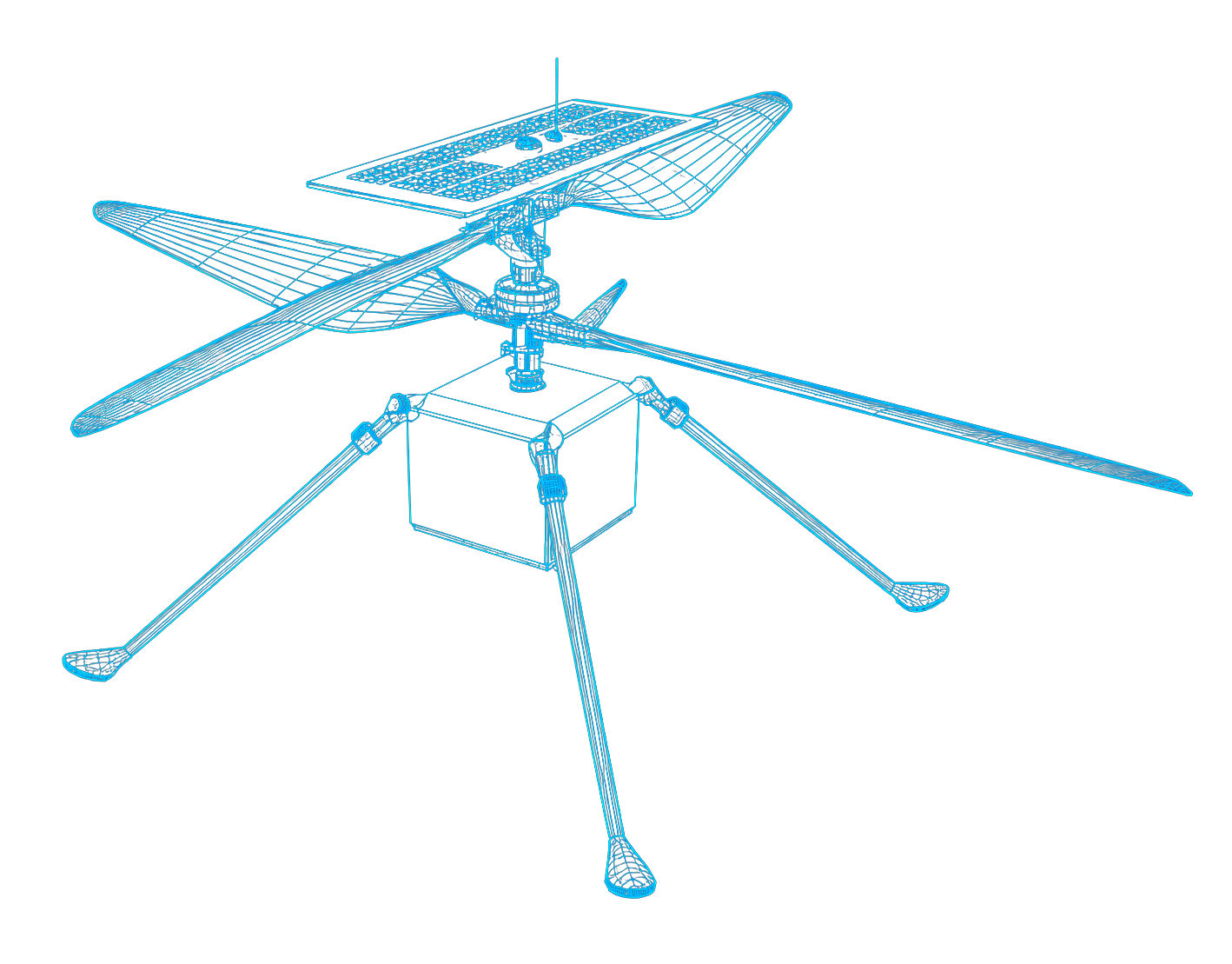
Perseverance carried it to Mars strapped under its belly, lowered it onto the floor of Jezero Crater on 3 April 2021, and drove away.
A helicopter weighing 1.8 kilograms, built as a proof of concept to test if anything could fly in the Martian atmosphere. Before it could take off, its first job was simply to survive a night where the temperature falls past minus ninety, entirely on its own.
It made it through the night. Now it had to fly.
- Deployed
- 3 April 2021
- Mass
- 1.8 kg
Air that thin
Mars has an atmosphere and it is barely there: under one per cent of the density at Earth's surface. NASA's own comparison is that flying at Jezero is flying at a hundred thousand feet here, roughly three times the altitude of an airliner and far above the ceiling of any helicopter ever built.
Gravity gives some of it back, at 38 per cent of ours. The rest has to come from the rotors, 1.2 metres across, turning at up to 2,900 revolutions a minute. About ten times an Earth machine.
Blades that fast in air that thin sit at the edge of what rotors can do.
- Atmospheric density
- Under 1% of Earth's
- Equivalent altitude
- 100,000 ft on Earth
- Rotor speed
- 2,400 to 2,900 rpm
The same aeroplane
Taped to a cable under the solar panel is a piece of muslin the size of a postage stamp, cut from the lower left wing of the aircraft the Wright brothers flew at Kitty Hawk in 1903.
It is the second time pieces of that aeroplane have gone somewhere new. In 1969 Neil Armstrong carried wood from its left propeller and fabric from its upper left wing in his personal kit, and took them out onto the surface of the Moon in a pocket of his suit.
Upper wing to the Moon, lower wing to Mars. Sixty six years, then fifty two more.
Forty seconds
It climbed to three metres, held there, turned to face its camera, and came down. About forty seconds in total.
The strip was called Wright Brothers Field. The plan was five flights in thirty sols, after which the helicopter would be finished and the rover would get on with its own mission.
- First flight
- 19 April 2021, 07:34 UTC
- Planned mission
- 5 flights, 30 sols
Eighty four hertz
On flight 4 a microphone on Perseverance was left running, eighty metres away.
Nobody expected it to pick anything up. Sound carries badly through air that thin, and the rover's own machinery sat closer to the microphone than the helicopter did. What came back was a low hum at eighty four hertz, a bottom E, buried in the wind.
It is the first recording ever made of one spacecraft by another.
- Range
- 80 m
- Blade tone
- 84 Hz
The shortcut
On 5 July 2021 it flew out over Séítah, a field of sand ripples the rover had no way to cross, and came back with pictures of the far side.
That was flight 9, and it changed what the helicopter was for. It stopped being a demonstration and became a scout, going ahead to find ground the rover could actually use.
Five flights became seventy two, over nearly three years.
- Flights
- 72
- Distance flown
- 17.0 km
How it knew
A camera in the fuselage pointed straight down and took thirty pictures a second, each one 640 by 480, black and white.
The software picked features out of one frame, found the same features in the next, and measured how far they had shifted. That shift, thirty times a second, is how it knew how fast it was going and in which direction.
It never knew where it was. It knew only how the ground was moving underneath it, and for seventy one flights that was enough.
- Navigation camera
- 640 x 480, 30 Hz
- Method
- Visual odometry
Featureless
Flight 72 was meant to be trivial. Straight up to twelve metres, a systems check, straight back down, after the flight before it had landed earlier than planned.
Underneath was sand. Ripples in rows, evenly spaced, each one indistinguishable from the next.
About twenty seconds after takeoff the software ran out of things to hold on to.
- Flight 72
- 18 January 2024
One metre
With no fix on its own motion it came down moving sideways, hit a ripple hard, and pitched and rolled.
The radio went out one metre above the ground.
Perseverance was told to stop what it was doing and listen, in long sessions, on the chance that the helicopter was still there. It took three days.
- Contact lost
- 1 m above the surface
A third from the tip
Contact came back on January 21. The first evidence was a shadow: a rotor blade lying on the sand with its tip missing.
In February the rover drove close enough to look properly. All four blades had broken about a third of the way from the tips, bent by the landing. One piece lay fifteen metres from the body.
The mission was declared over on 25 January 2024. In December, NASA published what it called the first aircraft accident investigation carried out on another world.
- Blade fragment
- 15 m from the body
Valinor Hills
It had come down in a place the team named Valinor Hills, after the land in Tolkien where nothing dies.
They sent it new software. Wake each morning, run the flight computers, test the solar panel and the batteries, record the temperatures, photograph the ground, store it, sleep.
On 16 April 2024 the last transmission came home. It carried a message the team had sent up first: the names of everyone who had worked on it, relayed to the helicopter and read back.
Then Perseverance drove on, out of range, and stayed out of it. Ingenuity is still working. Every morning it photographs the sand it could not read and files the picture away, with room for about twenty years of them and nobody around to ask.
- Final transmission
- 16 April 2024
- Onboard storage
- About 20 years