Cosmic Pioneers 01
Sputnik 1
First artificial Earth satellite
Launched 4 October 1957, Baikonur Cosmodrome, Kazakhstan
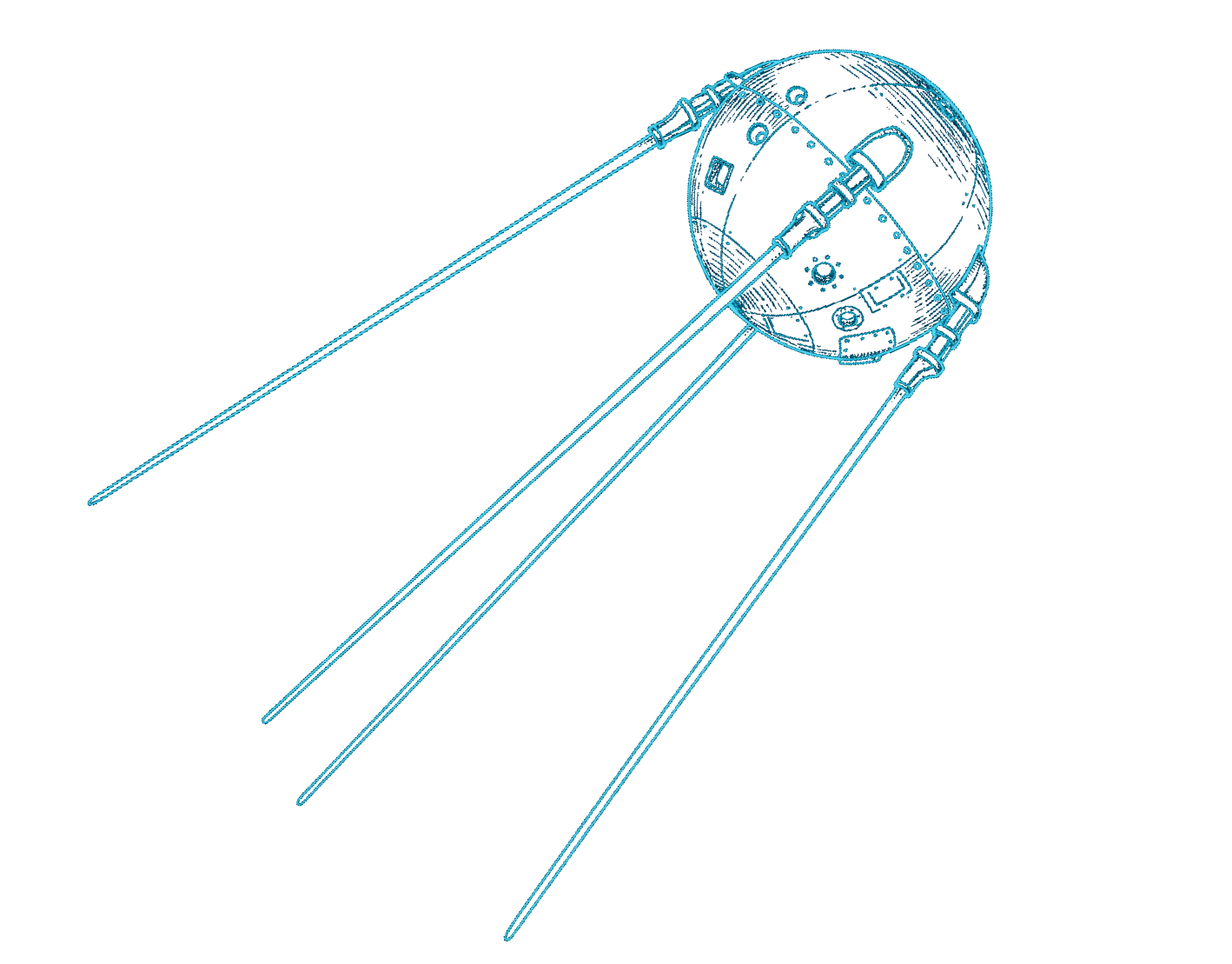
On 4 October 1957 a new sound arrived that anyone could hear.
It came in on 20.005 megahertz, a frequency ordinary people already owned receivers for. That was no accident.
The object
This is all of it. A sealed aluminium sphere about the width of a beach ball, four trailing whips, three batteries and a radio transmitter.
There was nothing else on board. No camera, no instruments, nothing to measure what it was flying through.
- Diameter
- 580 mm
- Mass
- 83.6 kg
- Power
- 1 W
What it wasn't
The satellite the Soviet Union initially meant to launch weighed well over a tonne and carried up to 300 kilograms of instruments. It was an orbital laboratory called Object D, and by the end of 1956 it was late.
So they threw it out. Object PS, the elementary satellite, was approved in February 1957 and built in under a month.
One of the most consequential spacecraft ever flown was built when the original plan collapsed.
The antennas
Four whips in two matched pairs, 2.4 and 2.9 metres. Two lengths because two frequencies.
The 20 megahertz signal sat inside the shortwave band that ham radio operators already tuned across every night, anywhere in the world. The 40 megahertz signal was for the military, and for measuring how the ionosphere bent a radio wave on its way down.
One of those choices was engineering. The other meant that anybody with a receiver could listen for themselves, which made the proof impossible to ignore.
- Frequency A
- 20.005 MHz
- Frequency B
- 40.002 MHz
- Antennas
- 2.4 m and 2.9 m pairs
- Pulse
- 0.3 s at about 3 Hz
The power
Three silver zinc batteries, 51 kilograms of a total 83.6.
Sixty percent of its mass was the power to keep broadcasting.
The beep carried vitals
Two hemispheres two millimetres thick, closed with 36 bolts and a rubber seal, filled with dry nitrogen at 1.3 atmospheres.
The length of each pulse encoded the temperature inside the sphere. A barometric switch would have altered the signal if the shell was ever punctured.
It was not just a beep, it was transmitting its own vital signs, and most on the ground had no idea.
- Shell
- AMG6T, 2 mm, 36 bolts
- Fill
- dry nitrogen, 1.3 atm
What was actually seen
Sputnik was sixth magnitude, right at the limit of what an unaided eye can pick out.
The bright object people stood in gardens to watch was the spent core stage of the rocket that put it there, 26 metres of it, first magnitude and unmistakable.
Millions of people looked up at the wrong object. Sputnik was never really a sight. It was a sound.
The ninety minute wait
A junior engineer lieutenant named Borisov caught the first signal about two minutes after separation.
Korolev, who was in overall command of the launch campaign, did not celebrate. He drove out to the mobile radio station and waited one full cycle, 96 minutes, to hear it come round again.
Anything can go up once, but completing an orbit is another matter. Only then did he telephone Khrushchev.
The miss
The intended apogee was 1,450 kilometres. Premature fuel depletion cut the engine about a second early and left it 500 kilometres short.
The most famous orbit in history was a miss.
- Orbit
- 223 x 950 km
- Inclination
- 65.10 deg
- Period
- 96.20 min
- Intended apogee
- 1,450 km
Silence
On 26 October the batteries went flat, after 22 days and 326 orbits.
It stayed up there, silent, for another 1,114 circuits and some 70 million kilometres, and burned up on 4 January 1958.
The satellite didn't last the winter, but the political impact was permanent. In Washington, the reaction to the beep led directly to a new agency: NASA opened on 1 October 1958.
The inversion
Two physicists at the Applied Physics Laboratory, William Guier and George Weiffenbach, recorded the passes and noticed the pitch sliding as the satellite crossed the sky.
From that Doppler shift they could work out precisely where it was. Their deputy director, Frank McClure, turned the problem around: if you already know where the satellite is, the same shift tells the listener where they are.
That became TRANSIT, and TRANSIT became GPS.
The signal that said where it was is now the signal that says where you are.