Cosmic Pioneers 02
Vostok 1
First human spaceflight
Launched 12 April 1961, Baikonur Cosmodrome, Kazakhstan
Sergei Korolev had put twenty four rockets up and watched exactly half of them fail. On the morning of 12 April 1961 he was going to put a man on one.
He had chest pains the night before, took a sedative and did not sleep. At the pad he talked to the cosmonaut over the radio, who asked for some music.
Half an hour before launch, Yuri Gagarin's pulse was 64.
- Korolev's launches
- 12 of 24 failed
- Gagarin's pulse
- 64 bpm at T minus 30
At 06:07 UTC the engines lit and Korolev's voice went up with them. Preliminary stage. Intermediate. Main. Lift off. We wish you a good flight, everything is all right.
Gagarin answered with one word. Поехали. Poyekhali! Let's go!
He was flying as Kedr, cedar. Soviet callsigns worked as code words and were not made public before a launch, so anyone listening in learned nothing.
The ball
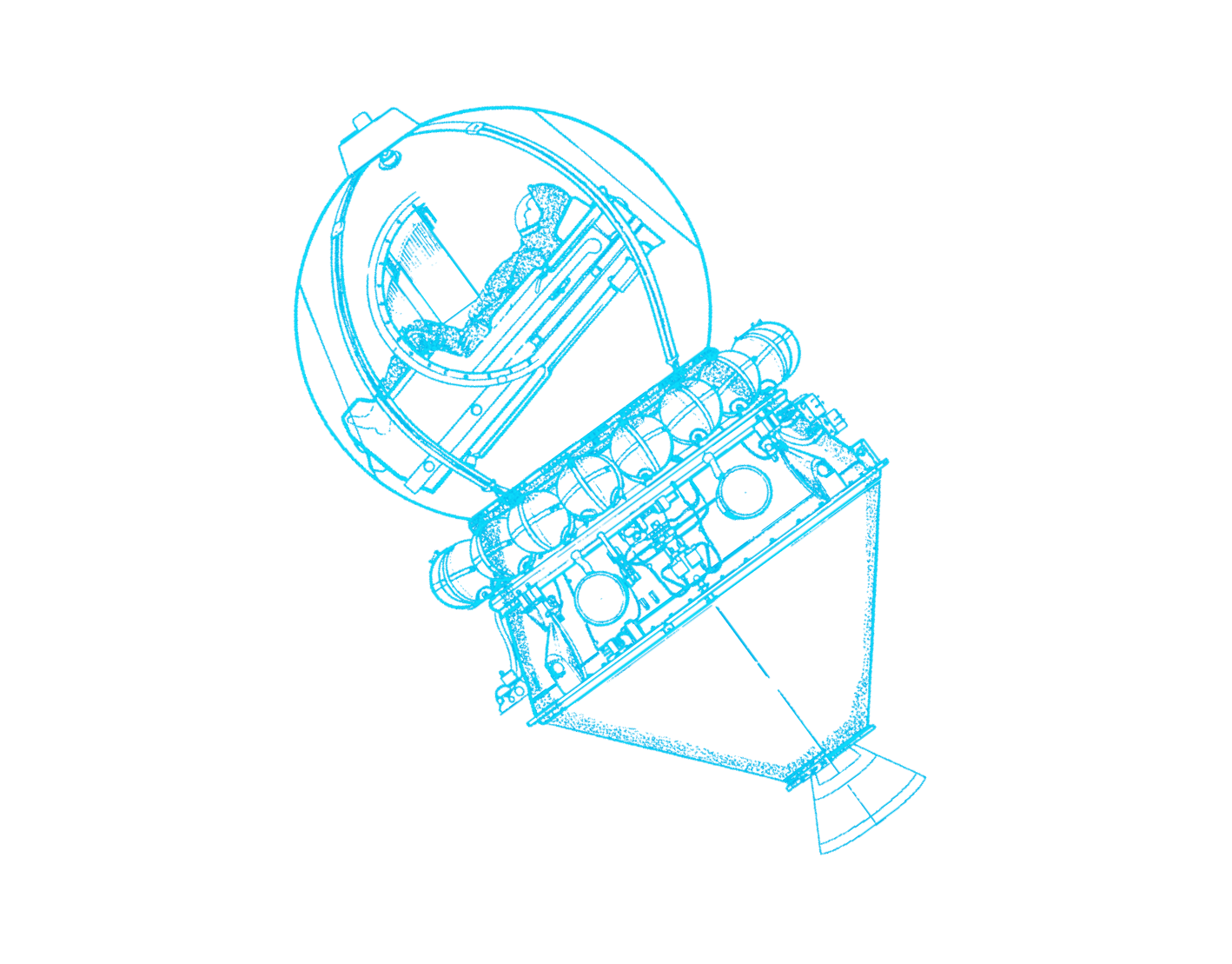
This is the part that came back: a sealed sphere of aluminium magnesium alloy, 2.3 metres across, with a man inside it.
No wings, no steering, nothing to trim its attitude on the way down. Its mass was hung off centre so one side was heavier, and the air did the rest. A sphere has no nose, so they gave it one by loading it.
The ablative coating went over all of it anyway. Nobody was willing to guarantee the physics.
- Diameter
- 2.3 m
- Launch mass
- 4,725 kg
- Landing mass
- 2,400 kg
Inside
One seat, one man, and the SK-1, the first spacesuit anyone had worn, built to work with the ejection seat as much as the cabin.
On the floor at his feet sat the Vzor: a central sight with eight ports ringed around it. Square the craft up against the horizon and all eight lit at once.
It only worked in daylight. At night there was nothing to line up against, so the burn had to come from the ground.
- Crew
- 1
- Suit
- SK-1
- Provisions
- 13 days
The locked panel
Nobody knew what weightlessness did to a person's eyesight, judgement or hands. The controls were locked before the hatch closed, and the pilot went up as cargo.
The code was 1-2-5, sealed in an envelope in the cabin, for an emergency.
Nikolai Kamanin told him the code before the flight anyway.
СССР
An engineer called Gherman Lebedev painted the four letters onto Gagarin's helmet by hand while he was driven to the pad.
Eleven months earlier, Francis Gary Powers had come down over Sverdlovsk in a U-2 and been paraded as a spy. A man landing by parachute in an orange suit with nothing on him to say who he was would have been a problem, and somebody thought of it late.
One hundred and eight minutes
One lap, and in 108 minutes one person saw the whole planet from outside it for the first time.
Fewer than a thousand have followed him.
- Perigee
- 181 km
- Apogee
- 327 km
- Inclination
- 64.95 deg
- Period
- 89.1 min
- Duration
- 108 min
Everything is OK
At 07:25 UTC the retrorocket fired over the west coast of Africa. Ten seconds later the command went out to release the equipment module, but it stayed connected.
A bundle of wires still held the two halves together, and somewhere above Egypt Vostok 1 began to gyrate hard.
Gagarin radioed that everything was OK.
He had worked out that it did not matter. The weight in the ball's base would turn it the right way round in the end, and saying so would only make noise.
The wires burned through. The sphere settled and took around 8 g coming in, which he later put at over 10.
The spacecraft was broken for ten minutes, but nobody apart from Gagarin knew.
He sang
By his own account, coming down, he sang.
The Motherland Hears, The Motherland Knows. That comes from his memories rather than from the mission record.
A man at eight times his own weight, in a sphere that had spent the previous ten minutes tumbling, singing about the country listening for him.
Seven thousand metres
The ball had no way of returning a man to terra firma softly: no retrorockets, no crushable base. It met the ground the way a thrown brick meets the ground.
That was never the plan for Gagarin. At 7,000 metres the hatch opened and the cosmonaut departed in the ejection seat, coming down under his own canopy near Smelovka, 26 kilometres south west of Engels. The empty sphere came down separately.
All of it was the plan, tested and signed off.
By the letter of the rulebook it was not a spaceflight at all.
- Retrofire
- 07:25 UTC
- Ejection
- 7,000 m
- Landing
- 08:05 UTC
The record
In 1961 the Fédération Aéronautique Internationale recognised a flight only if the pilot landed with the aircraft.
Gagarin had not, so the Soviet Union declined to mention this, and made him play along too. The FAI certified the first human spaceflight on a false account in the one detail its own rules required.
They admitted the ejection in 1971. The FAI changed the rule and confirmed the record, which had never really been in doubt: he went to space and he came back.
Sputnik transmitted the truth in a language almost nobody could read. Vostok spoke clearly, and held back the one fact that mattered.