Cosmic Pioneers 03
Apollo 11
First crewed Moon landing
Launched 16 July 1969, Kennedy Space Center, Florida
Kennedy committed the United States to the Moon on 25 May 1961, six weeks after Gagarin's orbit, on a national total of fifteen minutes of human spaceflight.
Eight years later the Saturn V blasted off Launch Complex 39A at 13:32 UTC. The world was watching.
- Vehicle
- Saturn V (AS-506)
- Commitment
- 25 May 1961
- Experience then
- 15 min 28 s
Eagle
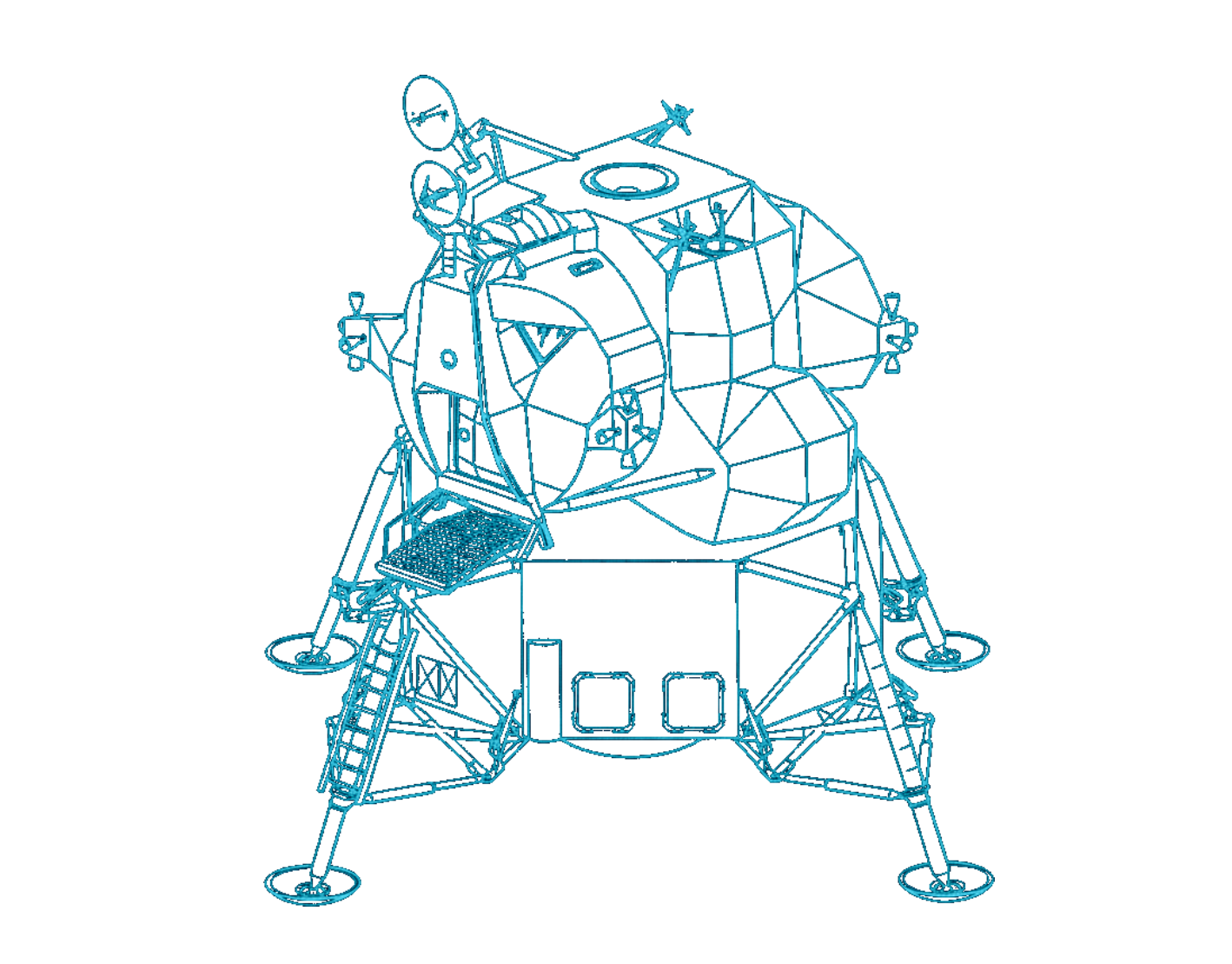
The craft on the page is the part that went down, built for an atmosphere of none.
Because it never meets air it has no need to be streamlined, and only its top half leaves the Moon.
Neither half was going home, they would not have survived the attempt.
- Crew
- 2
- Stages
- Descent and ascent
- Mass, fuelled
- 15,103 kg
1202
Seven minutes out, the computer flashed an error code.
1202 meant the onboard computer was overwhelmed with incoming radar data. Margaret Hamilton's software had been designed for this: rather than crashing or freezing, it automatically dropped low-priority tasks to keep the core landing guidance running.
In Houston, 26-year-old guidance officer Steve Bales had seconds to decide if it was safe to continue. He said go.
The alarm was the system working. Without it, the computer would have stopped, and the failure would have been silent.
- Alarm
- 1202, executive overflow
- Altitude
- about 33,500 ft
Long
They were flying past their intended target. The descent had taken a few seconds longer than calculated, and the computer was blindly steering them kilometres downrange towards West Crater.
Looking down they saw the surface choked with boulders the size of cars. Landing there meant almost certain destruction.
A few hundred feet up, Armstrong took semi-automatic control. He pitched the craft forward, flying over the crater to hunt for a flat patch of ground.
Every extra second he spent searching burned fuel they were rapidly running out of.
- Overshoot
- about 6.4 km
Tranquility Base
Houston, Tranquility Base here. The Eagle has landed.
There was no Tranquility Base. Armstrong invented it as the contact light came on; the name was in no simulation, flight plan or checklist.
Charlie Duke fumbled it once, then took it exactly as it came: Roger, Tranquility, we copy you on the ground. You got a bunch of guys about to turn blue. We're breathing again.
- Touchdown
- 20:17:40 UTC, 20 July 1969
The far side
While Eagle sat on the surface, Columbia kept going round.
Once an orbit the Moon came between Michael Collins and everyone: Houston, Armstrong and Aldrin, and every other human being alive. Forty seven minutes, completely out of touch.
The press called him the loneliest man in history. He spent his life correcting them.
In Carrying the Fire: I feel this powerfully: not as fear or loneliness, but as awareness, anticipation, satisfaction, confidence, almost exultation. I like the feeling.
- Out of contact
- 47 min per orbit
Two clocks
Go back a minute, to a light coming on in the cabin.
That light triggered a countdown. Sixty seconds remaining. Thirty seconds remaining. They weren't counting down to empty tanks; they were counting down to "bingo", the mandatory safety threshold where they had to abort the landing and fly back.
Touchdown came just nine seconds after the final warning call.
Afterwards they reconstructed the tanks and found roughly forty five seconds of engine time. Houston had believed twenty five.
The sensors hadn't broken. In the low gravity, the remaining fuel was sloshing around, repeatedly uncovering the gauge and tricking the computer into thinking they were nearly dry.
Every word of that descent reached the ground intact. But the clock they were racing against was a mirage.
- Quantity light
- 5.6% remaining
- The calls
- "60 seconds", "30 seconds"
- Believed remaining
- about 25 s of flight
- Actually remaining
- about 45 s, 20 s of it reserve
One small step
Six hours and thirty nine minutes later, Armstrong went down the ladder and put his left boot in the dust.
About six hundred million watched, roughly one person in six then alive.
He said one small step for man, one giant leap for mankind. He maintained ever after that he had said a man, the version that makes sense. The a is not audible, and has never been settled.
Aldrin came down after him, looked out and commented on the magnificent desolation.
- First step
- 02:56:15 UTC, 21 July 1969
- EVA
- 2 h 31 min 40 s
- Audience
- about 600 million
What they left
Bolted behind the ladder, a plaque: Here men from the planet Earth first set foot upon the Moon. July 1969, A.D. We came in peace for all mankind.
They left an Apollo 1 patch for Grissom, White and Chaffee.
And two Soviet medals, handed to Frank Borman in Moscow by Gagarin's widow and Komarov's. Two men who died on the way to this, honoured by the country that got there first.
Not sent, not kept
William Safire wrote a speech for Nixon in case the ascent engine failed to light: Fate has ordained that the men who went to the Moon to explore in peace will stay on the Moon to rest in peace. Declassified decades later, never read aloud.
The other thing that's missing is the tape.
What six hundred million people saw was a makeshift broadcast patched together from a specialised signal meant for engineers. The true master recordings were vastly superior, but they were scrubbed and reused because magnetic tape was a finite resource in a government agency. An official search later turned up nothing.
The ultimate technical monument to human engineering was wiped by an archivist who needed a blank cassette.
Still answering
One of the things they set down is not a monument.
The laser ranging retroreflector is a panel of corner cubes, a shape that returns light along the path it came in on. Point a laser at the Sea of Tranquility and a handful of the photons come back, about two and a half seconds later. Observatories have done it since 1969.
It transmits nothing. It has no power and nothing to say. It waits, and it answers.
Sputnik transmitted the truth in a code almost nobody understood. Vostok spoke clearly and held back the fact that mattered. Apollo was heard by six hundred million, the best recording of it was taped-over, and the thing they left behind is still replying.
- Round trip
- about 2.5 s, varying