Cosmic Pioneers 04
STS-1 Columbia
First reusable orbital spacecraft
Launched 12 April 1981, Kennedy Space Center, Florida
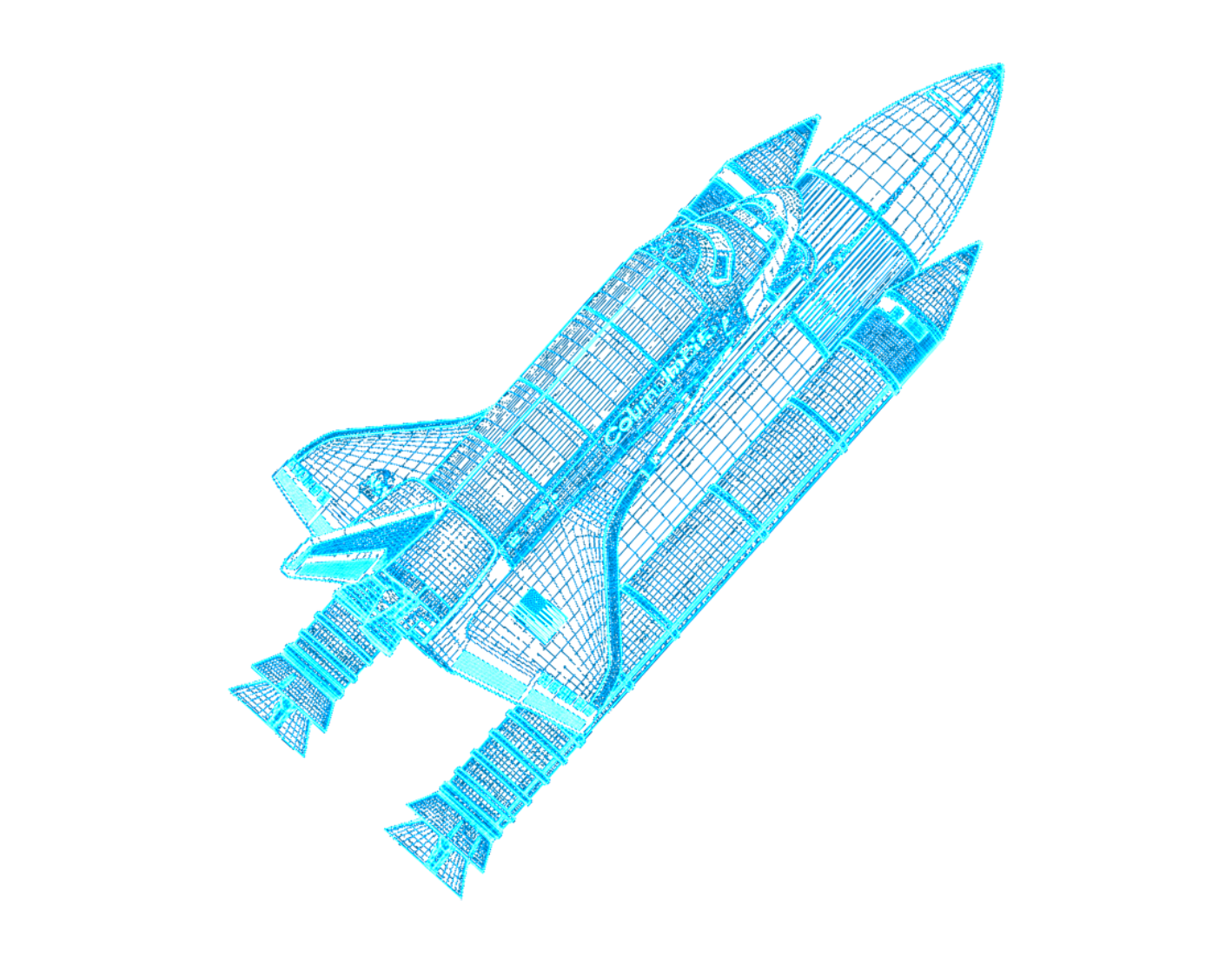
Originally scheduled for launch on 10 April 1981, it was instead delayed by a technical problem. Columbia left Launch Complex 39A two days later at 12:00:04 UTC.
Twenty years to the day since Gagarin's orbital flight. A happy coincidence caused by a scrubbed launch.
John Young had the commander's seat on his fifth flight. Bob Crippen, beside him on his first, was flying a spacecraft that had never flown.
- Vehicle
- OV-102, Rockwell International
- Crew
- John Young, Robert Crippen
- Launch
- 12 April 1981, 12:00:04 UTC
Built to come back
Everything that had gone up before this was thrown away. Gagarin's sphere, Apollo's command module: used once, and that was the end of them.
Four things left the pad that morning: the orbiter, a propellant tank taller than the orbiter itself, and two solid boosters along its flanks. Columbia was the first vehicle built to be flown, refurbished and flown again.
The name had been used twice already: a Boston sloop, Columbia Rediviva, the first American ship to sail round the world, and then Michael Collins's lunar command module. This was the third.
- The name, third use
- 1787, 1969, 1981
The skin
Going up is mostly a matter of holding on. Coming back means meeting the atmosphere at twenty five times the speed of sound and turning all of it into heat.
Columbia's answer was a skin of silica tiles, each machined for one position on one vehicle, none interchangeable, every one inspected between flights. It carried more of them than any orbiter built afterwards.
Sixteen came off on the way up, on the very first flight.
After seven flights most of the white tiles on the upper surfaces were replaced with quilted blankets, one blanket standing in for as many as twenty five tiles. The process worked, but was labour intensive and expensive.
- Lost on the first ascent
- 16 tiles
- Replaced after flight 7
- about 6,000
Sixteen minutes
On 14 April Columbia turned itself round, fired its engines against its own direction of travel and fell back into the air.
The air could not get out of the way fast enough. It compressed, and glowed, and wrapped the vehicle in ionised gas that no radio signal could cross. For about sixteen minutes Houston had nothing: no voice, no telemetry, no radar.
The signal hadn't gone away. There was simply no way for it to reach anybody. Radar found it again at 165,000 feet.
- Blackout
- about 16 min
- Contact regained
- 165,000 ft
Wheels down
Young took manual control and put it down on Runway 23, on the dry lakebed at Edwards, two and a quarter days and thirty six orbits after Florida.
He came out an hour and eight minutes later and walked the whole way round the outside of it, looking at the tiles.
This is the world's greatest flying machine, I'll tell you that. It worked super.
- Duration
- 2 d 6 h 20 min 53 s
- Landing
- 14 April 1981, Edwards Runway 23
Again
A spacecraft coming home was not new. Gagarin came home; Apollo came home. What had never happened was the next part.
On 12 November 1981 the same vehicle stood on the same pad and went up again. Not a sister ship, not a fresh build to the same drawings. The same one.
The first flight proved Columbia could come back. The second proved it could go again.
Even then, not all of it came back. The boosters fell into the Atlantic two minutes up, where ships were waiting. The tanks were never collected.
- Flew again
- 12 November 1981, 7 months later
The workhorse
Columbia was the heaviest orbiter ever built, about three and a half tonnes more than the ones that followed: it was the prototype, and carried test instrumentation no other craft needed.
That weight cost it the space station. Too heavy for the climb into that orbit, it was never given a docking system, and the ship that could not go to the station became the fleet's laboratory instead. It flew eleven of the fifteen Spacelab missions.
- Flights
- 28
- Orbits
- 4,808
- Distance
- 201.5 million km
- Longest flight
- 17 d 15 h, STS-80
The pattern
Foam came off the tank. It had been coming off the tank for years.
This is the part that usually gets told wrong. Nobody ignored it. It was filmed, measured, argued about and written up, and the conclusion was always the same: foam had struck the orbiter before, and the orbiter had come home.
Which was true, and was the crux of the problem. Every strike that had no consequences became evidence that a strike destroys nothing. Twenty two years of coming back was read as proof it would keep coming back.
Eighty one seconds
16 January 2003. Eighty one point seven seconds after liftoff, a piece of foam the size of a briefcase came off the left bipod ramp, where the tank braced against the orbiter's nose.
Two tenths of a second later it struck the leading edge of the left wing at something over four hundred miles an hour.
It was spotted the next day on the launch film, and assessed. Columbia stayed up another two weeks doing science, and everyone believed the vehicle was fine.
- Foam release
- T+81.7 s, left bipod ramp
- Impact
- left wing leading edge
Roger, uh
By 2003 the entry blackout was gone. The orbiter could reach a relay satellite through the gap in the plasma behind it, and Houston stayed on the loop the whole way down.
So there was nothing to hide in. At 13:59:32 UTC, over Texas, Charlie Hobaugh called up about pressure readings on the left main gear. Rick Husband answered.
Roger, uh, buh. The words stopped in the middle of one, and the data stopped with them.
Rick Husband. William McCool. Michael Anderson. David Brown. Kalpana Chawla. Laurel Clark. Ilan Ramon.
- Last transmission
- 13:59:32 UTC, 1 February 2003
What came back
The vehicle was gone. The tape survived.
In the tail there was an old recorder, running since 1981, writing sensor readings onto magnetic tape from places the telemetry never reached. It flew all twenty eight missions. It was not built to survive anything.
It kept writing for another forty six seconds after Husband's last word.
Seven weeks later a search team found it in a field near Hemphill, Texas, one edge three inches into the soil. Slightly damaged. Entirely readable.
Columbia was built to come back, and for twenty two years it did just that.
- Recorder found
- 19 March 2003, Hemphill, Texas
- Tape runs to
- 14:00:18 UTC