Cosmic Pioneers 05
Voyager 1
First craft to enter interstellar space
Launched 5 September 1977, Cape Canaveral, Florida
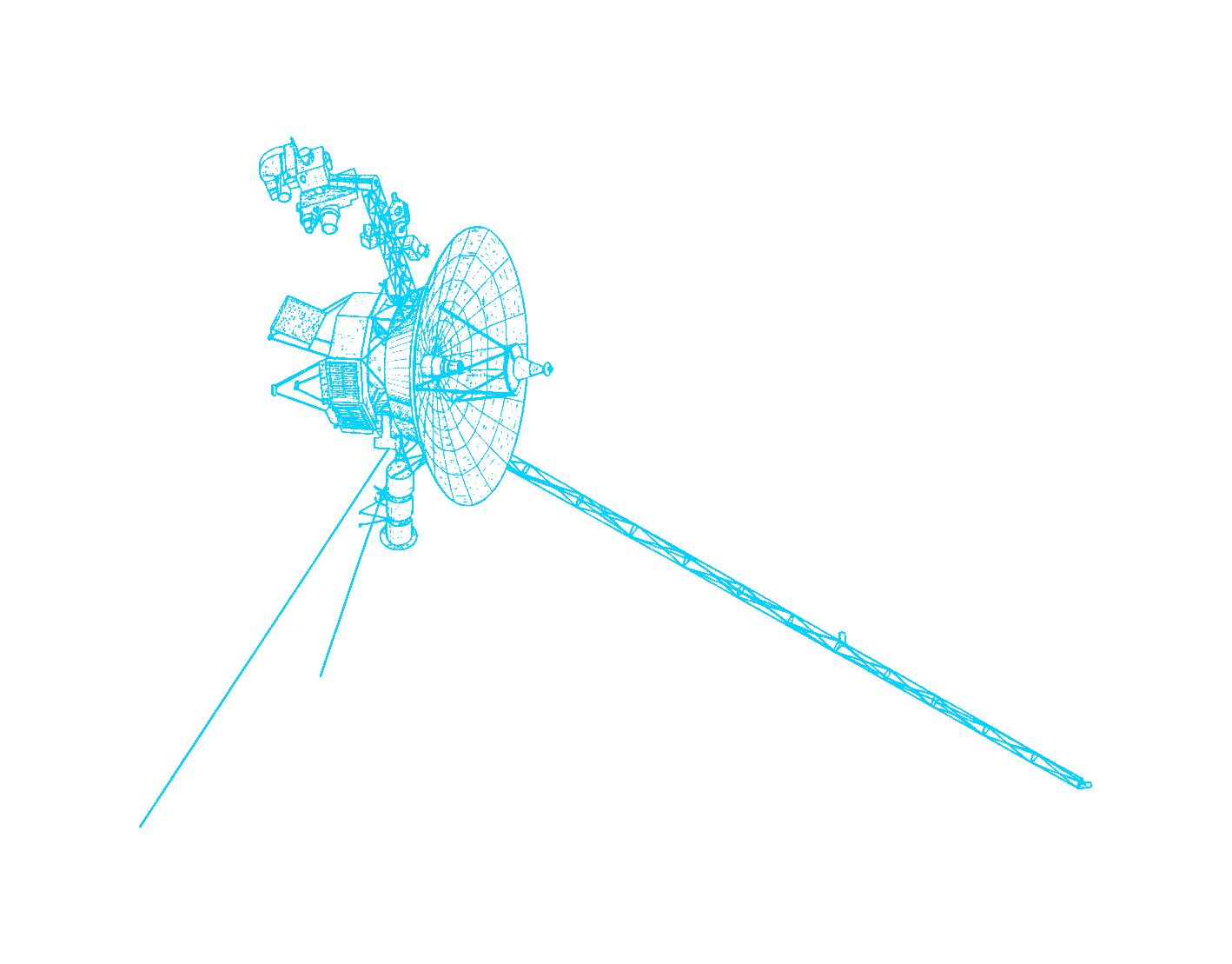
Voyager 2 left first, on 20 August 1977. Voyager 1 followed sixteen days later and launched faster, overtaking its twin in the dark.
Both were built to last five years.
They owed their existence to a rare geometry. Once every 175 years the outer planets align, allowing a single craft to borrow speed from each in turn, dropping the journey to Neptune from thirty years to twelve. Gary Flandro, a graduate student at JPL, worked it out in 1965.
- Launched
- 5 September 1977
- Design life
- 5 years
Dated by physics
Bolted to the side of each craft is a gold-plated copper disc, its playing instructions drawn on the cover in physics rather than any language.
Writing to nobody in particular has a problem: the reader cannot know when you wrote. So the cover carries two clocks, uranium-238 decaying at a known rate and a map of fourteen pulsars slowing predictably, either of which gives a date.
Etched on the gold is an act of hope: the quiet bet that someone exists to receive it, and that they will date it from the evidence.
- Cover clock
- Uranium-238, half-life 4.468 billion years
The turn north
On 12 November 1980 Voyager 1 passed within four thousand miles of Titan, trading the rest of the tour for a single moon with an atmosphere.
To make the pass it had to come at Saturn from below. Saturn's gravity flung it upward, thirty five degrees out of the planetary plane. Voyager 2 stayed in it and reached Uranus and Neptune. Voyager 1 was done with planets.
- Titan flyby
- 12 November 1980, 4,034 miles
The broken instrument
Soon after Saturn, its plasma instrument failed. That instrument measures the density of the gas the craft flies through, counting charged particles and reporting how thickly they are packed.
On a craft carrying ten instruments that sounds survivable. It was not. Density is the one measurement that says where you are: the gas inside the Sun's territory and the gas beyond differ in almost nothing else.
Voyager crossed the edge of the solar system carrying a broken version of the only instrument that could have told it so.
- Plasma instrument
- Failed 1980
Where the Sun stops
The Sun does not merely light the solar system; it blows through it. A wind of charged particles streams outward, clearing a bubble in the gas between the stars. That bubble is the heliosphere, and its edge is where the solar system ends.
It has two parts: the termination shock, where the wind meets interstellar gas and slows, and beyond it the heliopause, where the Sun's push and the galaxy's pressure balance, and the wind stops.
It is a balance of pressures rather than a wall, so it swells and sags as the Sun's output changes. Two craft crossed it six years apart and found it in different places.
- Voyager 1 crossings
- 94 AU, then 121.6 AU
- Voyager 2 crossings
- 84 AU, then 119 AU
Nothing
On 25 August 2012, at a hundred and twenty one times the Earth's distance from the Sun, Voyager 1 went through it.
There was no jolt and no line to see. The solar wind that had streamed past the craft for thirty five years simply dropped away, and cosmic rays from the rest of the galaxy climbed higher than they ever had. Both changes were measured and sent home.
At the Deep Space Network the signal arrived seventeen hours later, exactly as it always had, carrying the evidence, for now unrecognised.
- Crossed
- 25 August 2012
Ringing
In March 2012 the Sun threw off a series of eruptions, the kind that lights the aurora when it reaches Earth. These caught each other up and merged into one heavier wave.
Thirteen months on it reached Voyager and did what the broken instrument could not. It struck the surrounding gas and set it ringing, the way a bell rings at a pitch set by its size. A plasma's pitch is its density.
Voyager still had an antenna that could hear it. On 9 April 2013 it did just that, and the pitch was high: the gas out there was forty times thicker than the gas inside. It was already outside, and had been for months.
- Cloud travel time
- 13 months
- Interstellar plasma
- About 40 times denser
Assigned
The announcement came in September 2013. It did not say Voyager had crossed. It said Voyager had crossed thirteen months earlier, and gave a date.
That date was worked out backwards. Knowing the craft was outside, the team went back through the particle counts for the day the solar wind vanished and the cosmic rays peaked: 25 August 2012.
The most significant boundary any human object has crossed was not watched. It was reconstructed from evidence, and assigned.
- Announced
- September 2013
- Backdated to
- 25 August 2012
Unreadable
On 14 November 2023 Voyager 1 began broadcasting a repeating loop of gibberish.
The spacecraft wasn't dead. It received every command and carried it out, and the carrier never wavered. But the computer that packages data for the journey home had suffered a hardware failure: a single dead memory chip had wiped out a crucial block of code. After forty six years, the probe was still talking, but it had lost its language.
- Silence began
- 14 November 2023
- Memory lost
- About 3% of the flight data subsystem
There was no way to replace a physical chip fifteen billion miles away. Instead, engineers took the orphaned code, cut it into smaller fragments, and stored those pieces in separate, healthy corners of the remaining memory.
On 18 April 2024 they sent the patch, with no second attempt if it broke something. Two days later Voyager answered, speaking clearly for the first time in five months.
- Patch sent
- 18 April 2024
- Reply received
- 20 April 2024
Still on
The power is waning. The craft runs on decaying plutonium and sheds four watts a year, so instruments are switched off one by one. The charged particle detector, running almost without pause since 1977, shut down in April 2026 after forty nine years.
Only two remain: the magnetometer and the plasma wave antenna. That second one heard the ringing in 2013. The instrument that proved Voyager had entered interstellar space is one of the last two still on.
On 18 November 2026, at sixteen minutes past two in the morning, Pacific time, Voyager 1 will be one light-day from Earth.
Nobody will feel that one either.
- Charged particle detector
- Off, 17 April 2026
- One light-day
- 18 November 2026, 02:16:07 PST