The Hand
A silhouette pressed into stone, an X-ray cast into the dark — the same gesture, sixty-eight thousand years apart.
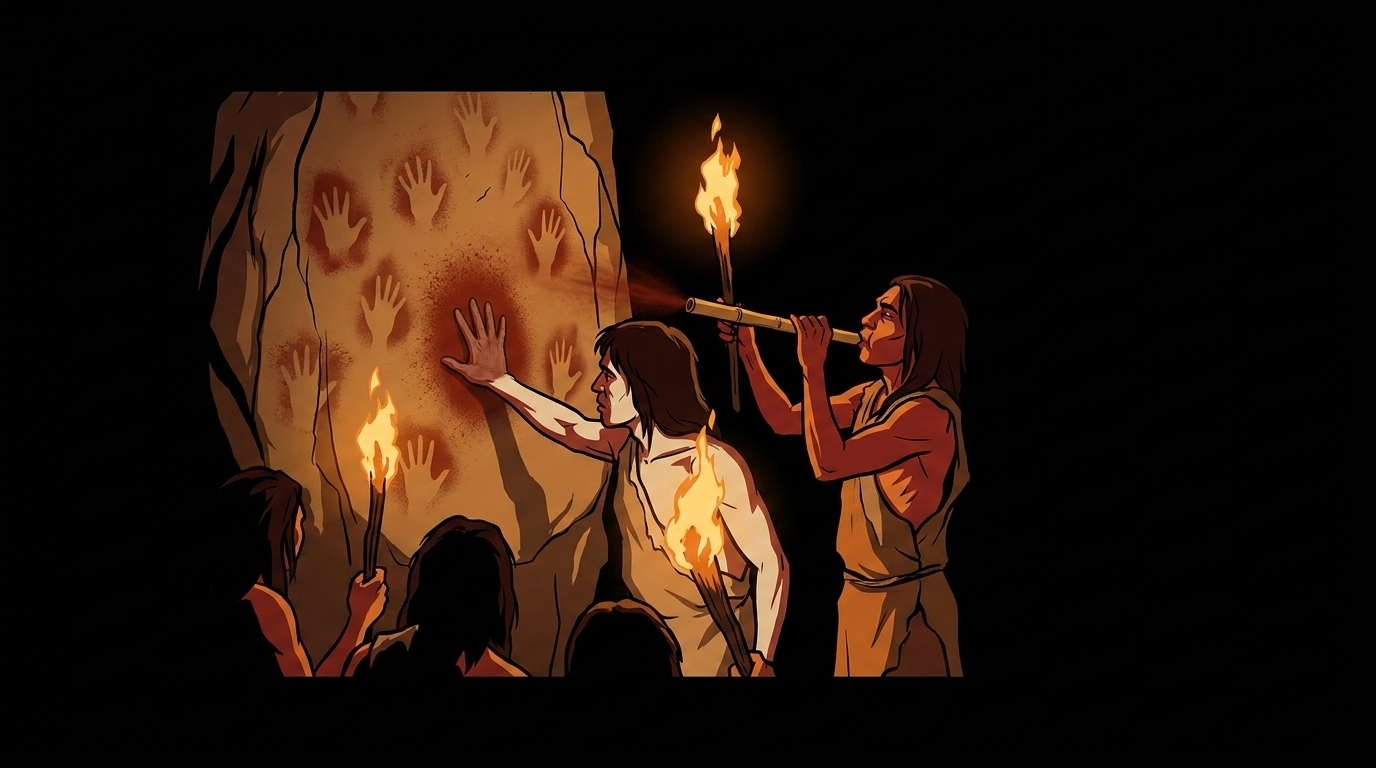

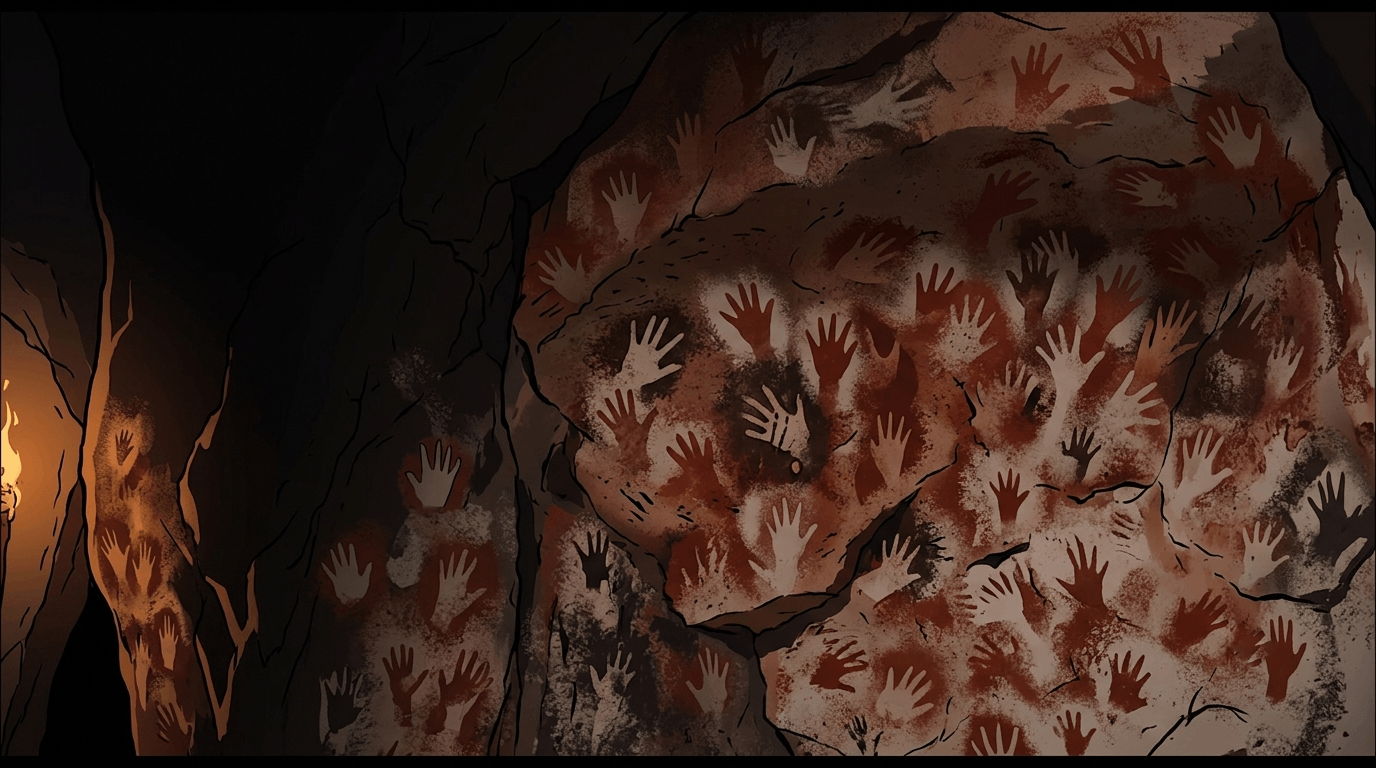
The darkness is broken by an approaching flickering yellow light getting steadily brighter. A flaming torch carried by a hand emerges from the gloom, followed by more torches. The dancing flames reveal the limestone walls of a cave. Other people show through the darkness carrying pots and bamboo sticks. They gather around and one of the figures places a hand on a chosen wall.
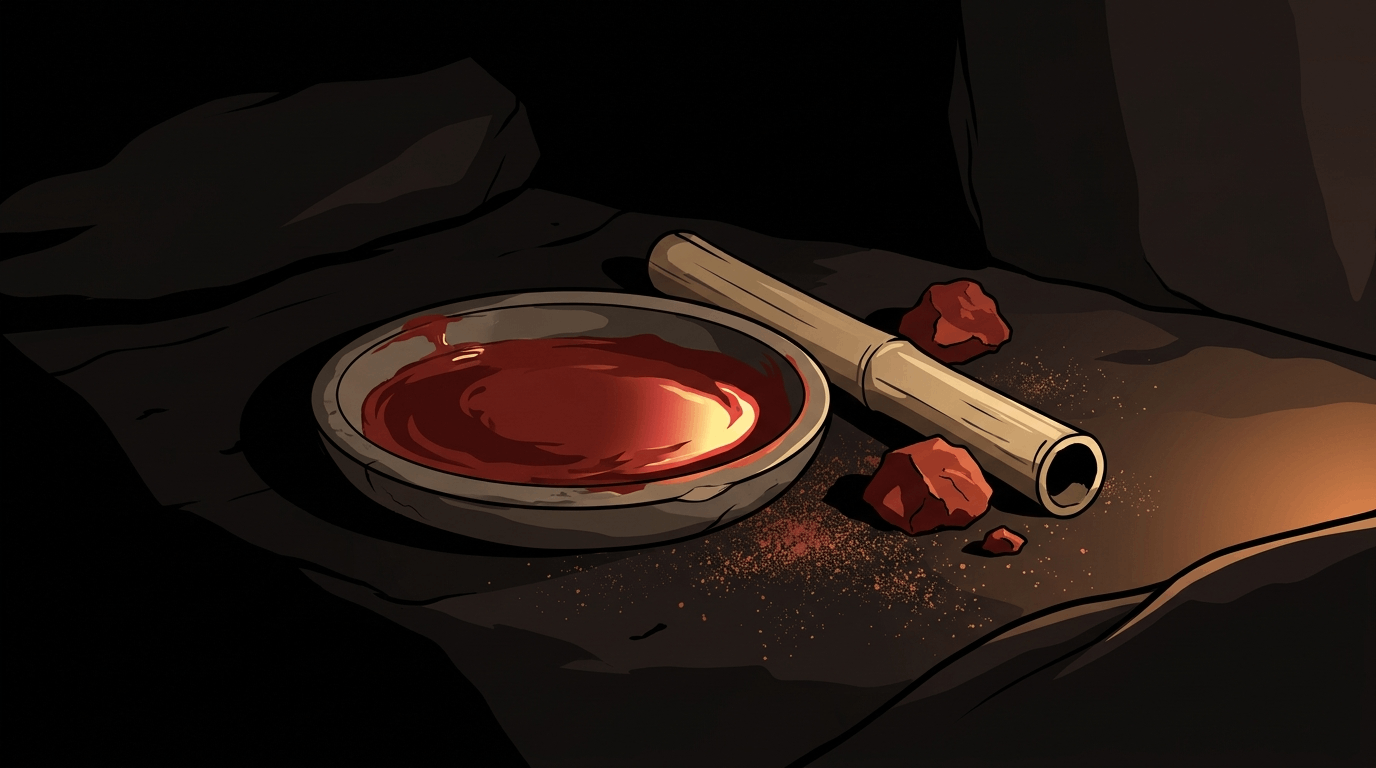
Another takes a piece of bamboo, dips it into one of the pots and carefully draws out a deep red liquid. Putting it to their lips they blow the pigment contained in the hollow bamboo onto the back of the hand placed on the wall, creating a silhouette once the hand is removed. This gathering of the community marking their presence had its roots back longer than anyone could remember. The hands that their ancestors had left had a new addition.
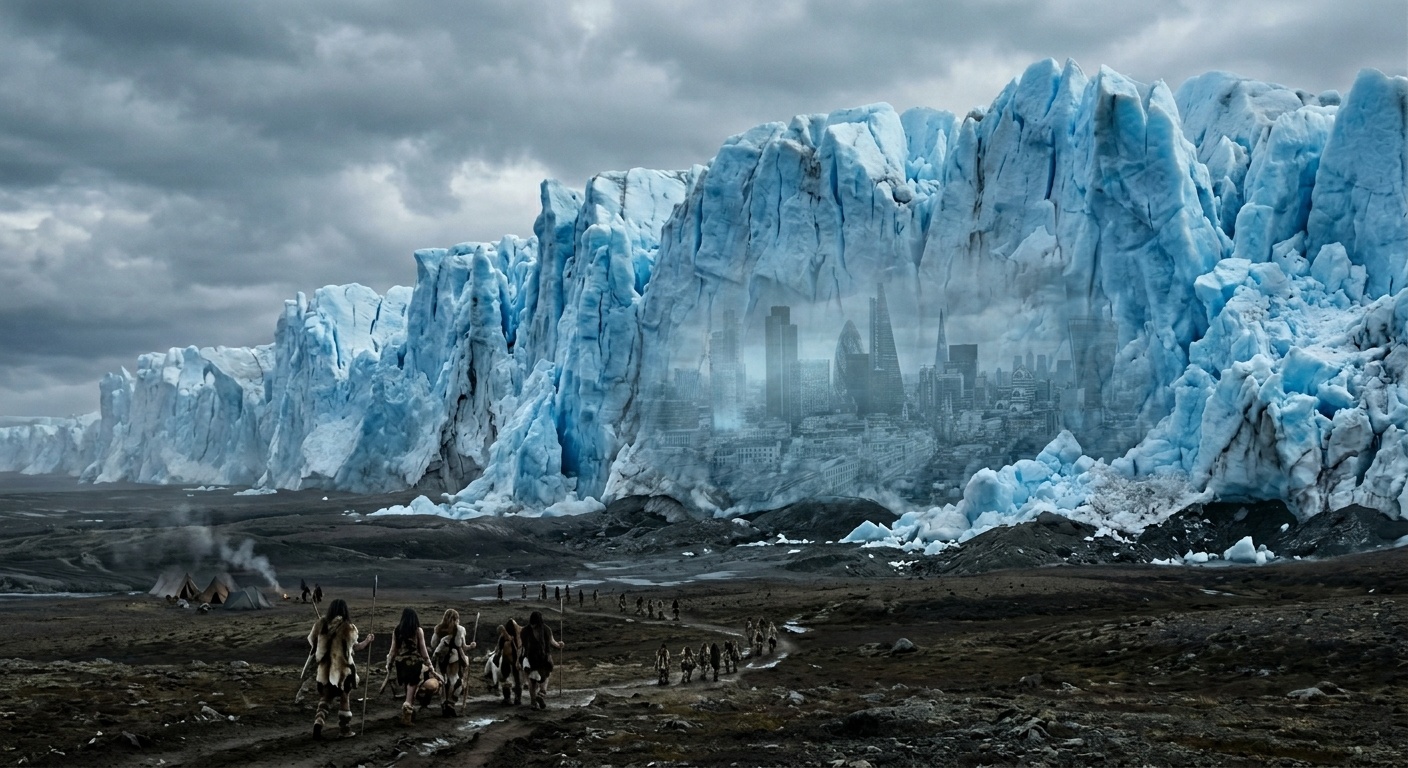
The summer sun grew too weak to melt the winter’s snow.
The northern frost steadily grows as the summer sun grew too weak to melt the previous winter’s snow. The ice sheets drank from the oceans, reducing sea levels and joining continents together. These monstrous sheets began to deform under the immense weight, behaving less like a solid and more like an ultra-viscous plastic, pushing so far south that they bury where New York, Chicago, Dublin, and Berlin will eventually be found — under solid ice up to three kilometres thick.
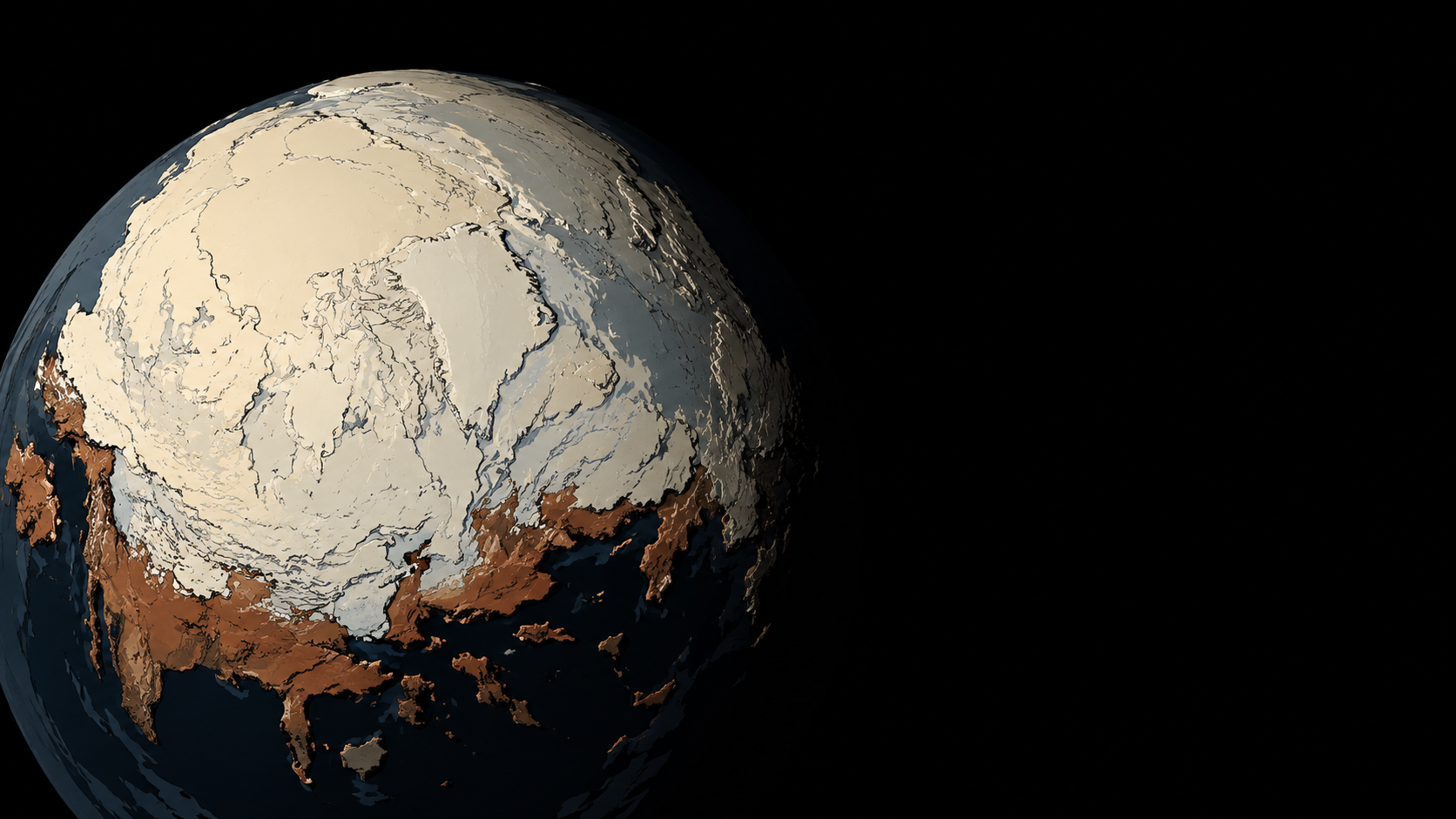
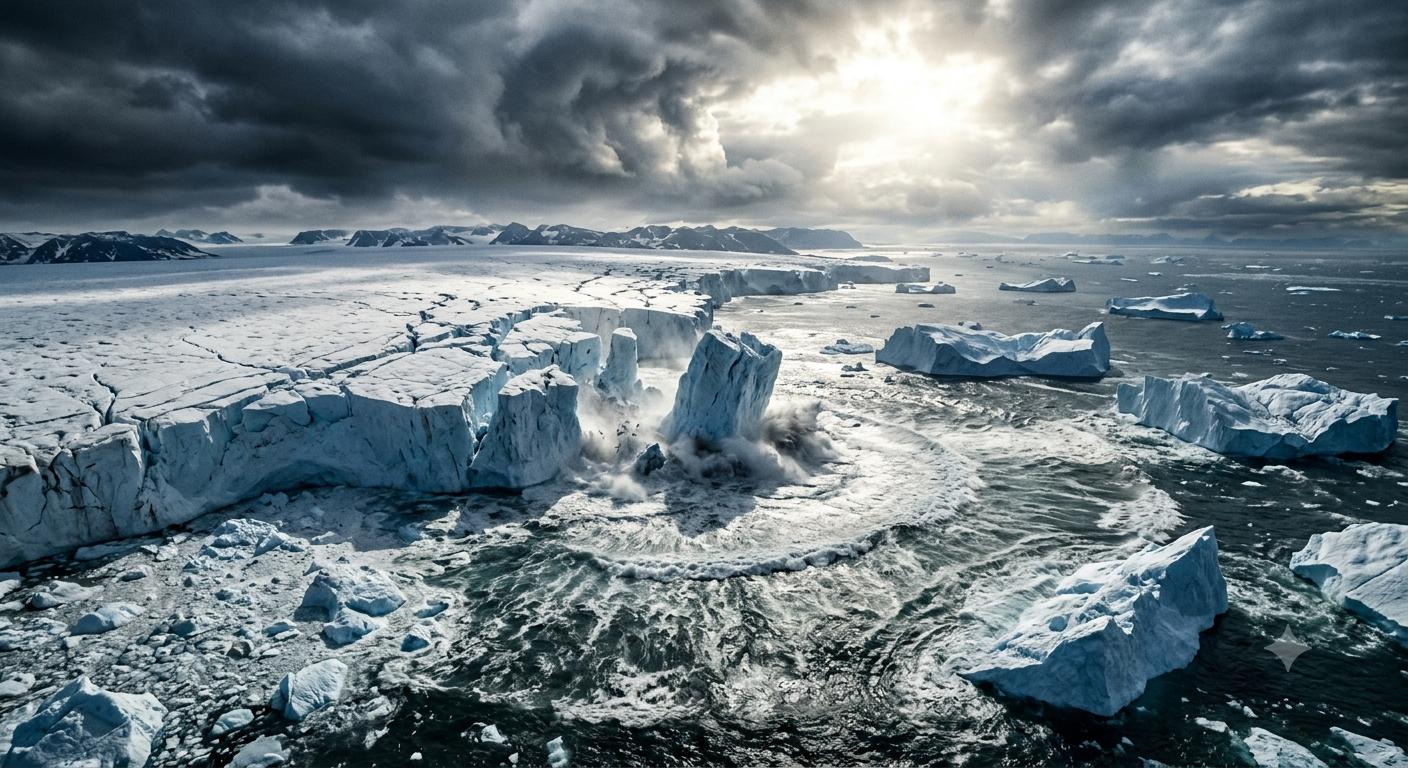
Then, subtle orbital shifts increase summer sunlight in the Northern Hemisphere. The ocean warms and fleets of icebergs calve into the Atlantic. The stronger summer sun melts the top layer, water finding its way through cracks, causing catastrophic failures and returning water to the seas, which surge by roughly 20 meters in just 400 to 500 years.
Just as the ice seems doomed, the cold melt water disrupts the ocean currents, plunging the north back into a mini ice-age.
But the sun still shines, warmer than ever, and as temperatures continue to rise, the great sheets of ice dissolve, freeing the land from their weight. The earth slowly warps upward, in a post-glacial rebound, leaving coastlines we recognise — and just Greenland and Antarctica as the two great survivors of the Pleistocene freeze.
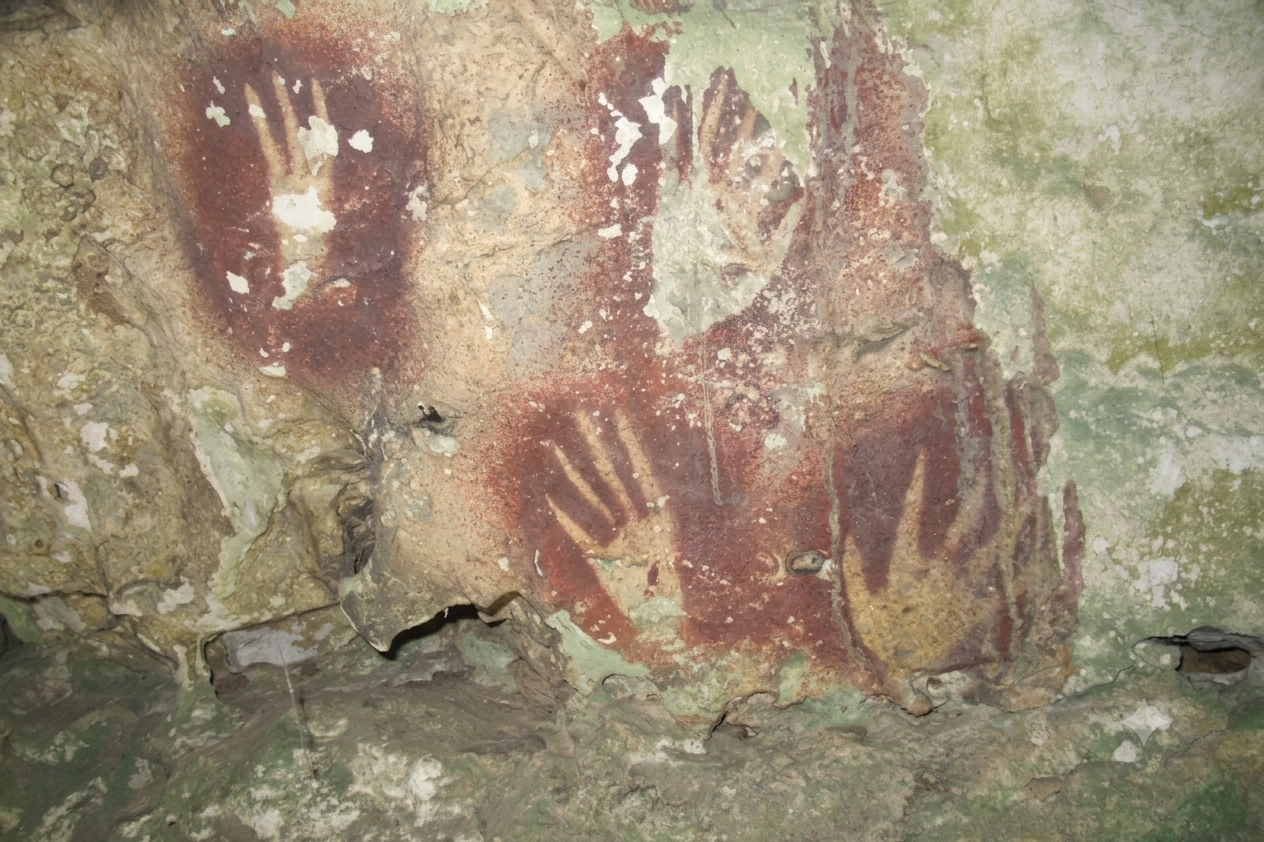
Through all of this change, destruction, and upheaval, the handprint endured. It waited in the deep silence of the Liang Metanduno cave, located on Muna Island in Southeast Sulawesi. More than 2,500 generations of humans lived and died while that red pigment remained in the dark. Then, in 2015, an Indonesian researcher named Adhi Agus Oktaviana stepped into the cave, tilted his head to a favourable angle and made out a shape on the wall. The stencil had already survived nearly 68,000 years, but its mystery would need another eleven years to be solved.
In 2026, a scientist named Maxime Aubert from Griffith University in Brisbane led the team that finally calculated its age. They proved the red shape was at least 67,800 years old, making it the oldest known example in the world. Right beside that first mark was another hand stencil, which testing showed was sprayed onto the stone around 60,900 years ago.
Two different human beings stood in the same spot and looked at the exact same wall, but they lived roughly 7,000 years apart. The gap between their lifetimes is wider than the entire history of human writing.
A standard hand stencil creates a shape using negative space: the form of a hand defined entirely by its absence on the wall. The creator of the older Sulawesi print chose to alter their silhouette. By narrowing one fingertip within the spray-shadow, whether by shifting their fingers slightly mid-spray or by refining the edges with wet pigment afterward, they transformed the human shape into a pointed claw.
Maxime Aubert notes that the artist was “drawing something that doesn’t really exist.” Archaeologist Adam Brumm describes this modification as evidence of a complicated thought: a mind describing a thing that was never actually there. This specific type of altered design is known only in Sulawesi.
While a red mark on a rock cannot definitively prove which human species held the bamboo tube, Aubert infers a modern human made it based on that creative intent alone.
The hand motif is stamped onto rock walls all over the world, appearing in France, Argentina, Australia, Mexico, and the Sahara. The populations moving through the Indonesian islands possessed a sophisticated culture and the seafaring abilities to cross open oceans, allowing the first settlers to reach Australia around 65,000 years ago.
Yet, for a long time, standard history books held the firm assumption that the earliest cave art was based strictly in Europe. This perspective was a consequence of carbon-14 dating, the traditional tool scientists used to calculate the age of ancient finds. Carbon dating requires remnants of material that were once alive, such as charcoal from a campfire or a carved animal bone. European cave artists frequently painted with charcoal, making their work easy to date.
In Southeast Asia, however, artists created their red pigment by crushing mineral rocks which held no remnants of living matter.
The historical record simply reflected what our tools could measure, instead of what had actually happened.
A technique called laser-ablation uranium-series dating helped to resolve the problem. Inside damp limestone caves, water slowly seeps through the rock, dissolving microscopic traces of uranium. As these water droplets evaporate, they lay down thin layers of a mineral called calcite on the cave walls. When a mineral layer forms directly over a painting, it seals the art beneath a natural timestamp.
Over thousands of years, that trapped uranium slowly decays into thorium at a completely consistent rate, allowing scientists to calculate the age of the deposit by measuring the ratio of the two elements. Older testing methods required scraping away large chunks of calcite, a process that blended different mineral layers together and blurred the results.
The laser system changes the process by targeting only the microscopic layer closest to the painting. It vaporises a tiny speck and sends the particles into a mass spectrometer.
This new tool allowed researchers to read a few more lines of that book. Armed with the uranium-series approach, scientists turned to the famous caves of Europe. The results flipped the picture entirely.
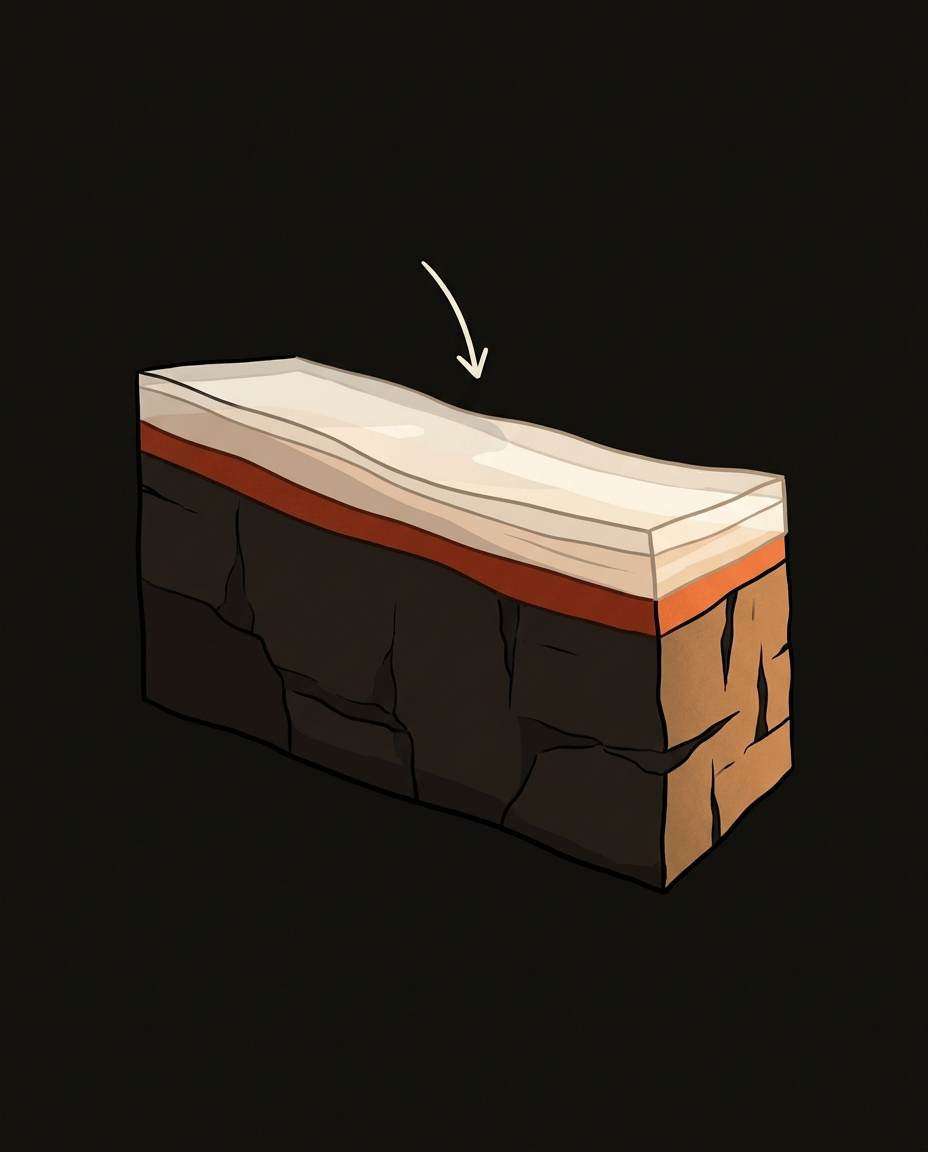
A few more lines of “a very big book of which we only have a few scattered pages.”
— DIEGO GARATE MAIDAGAN, PREHISTORIC ART PROFESSOR
In 2018, they began testing a cave wall in Maltravieso, located in Cáceres in western Spain. Hidden beneath a thin skin of calcite was another hand stencil, created with the exact same technique found in Indonesia. Someone had placed an open palm against the stone and sprayed a cloud of red ochre around the fingers. Looking at the wall, you recognise the shape instantly. It is a plain, familiar hand, reaching out from the deep past. Measuring the uranium and thorium in the calcite delivered a minimum age of 66,700 years.
At that point in history, modern humans had not yet reached Europe. Our ancestors were still to explore the continent, meaning that the hand pressed against the stone in Spain must have belonged to a Neanderthal. Traditionally, history books stereotyped Neanderthals as simple, brutish creatures who lacked the capacity for art or abstract thought. The wall at Maltravieso challenges that old narrative.
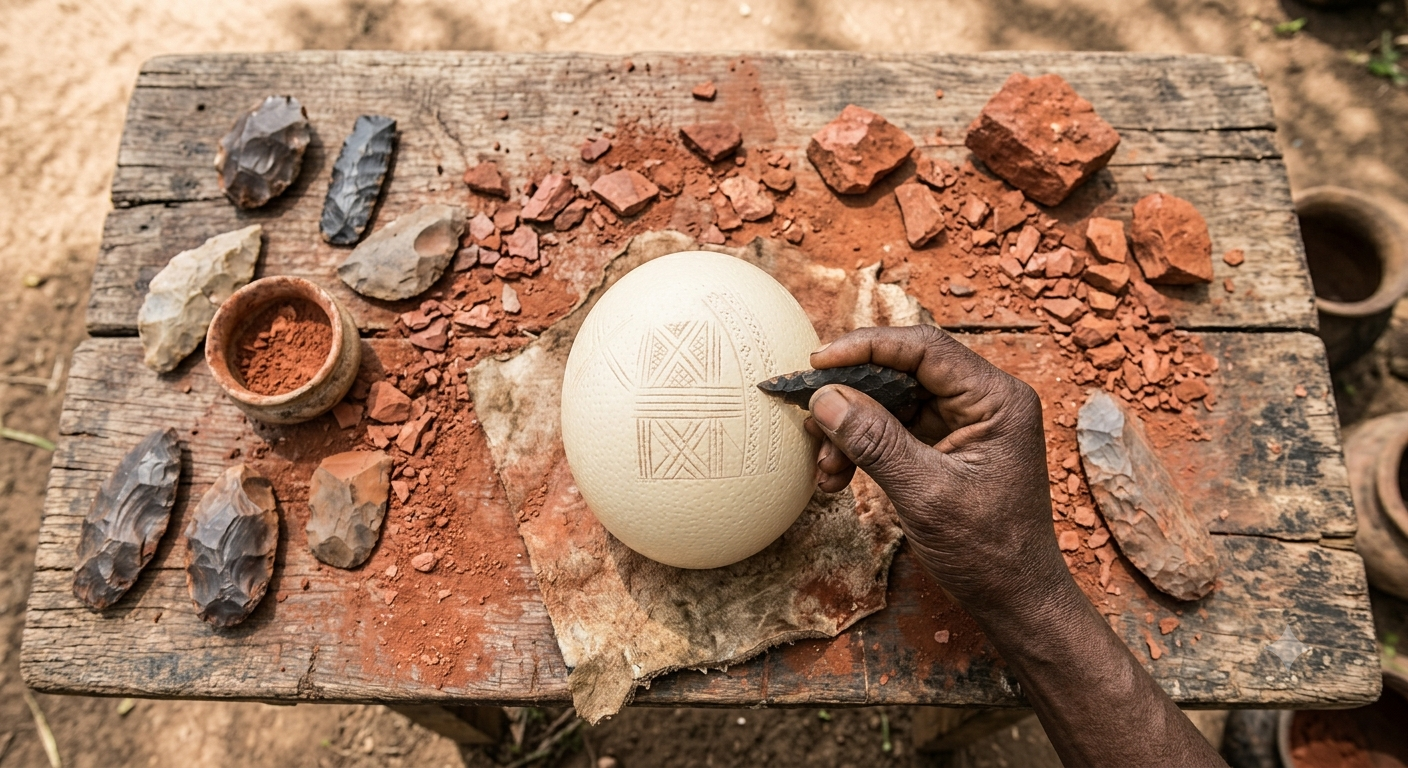
Scientist Alistair Pike noted that while this stencil was being made in Europe, homo sapiens back in Africa were merely scratching little bits of red ochre and ostrich eggshells — behaving no more creatively than the Neanderthals in Spain.
FIG. VIII · EARLY SYMBOLIC MARK-MAKING, AFRICA.
Neanderthals and modern humans diverged from a common ancestor long ago, somewhere between 400,000 and 700,000 years ago. Because both branches of the family tree left these exact marks on cave walls, many scientists argue that the simplest explanation is an inherited one. Instead of inventing the habit separately, both species may have carried the instinct with them from that shared ancestor. If that inference holds true, the urge to press a hand to a wall could be half a million years old.
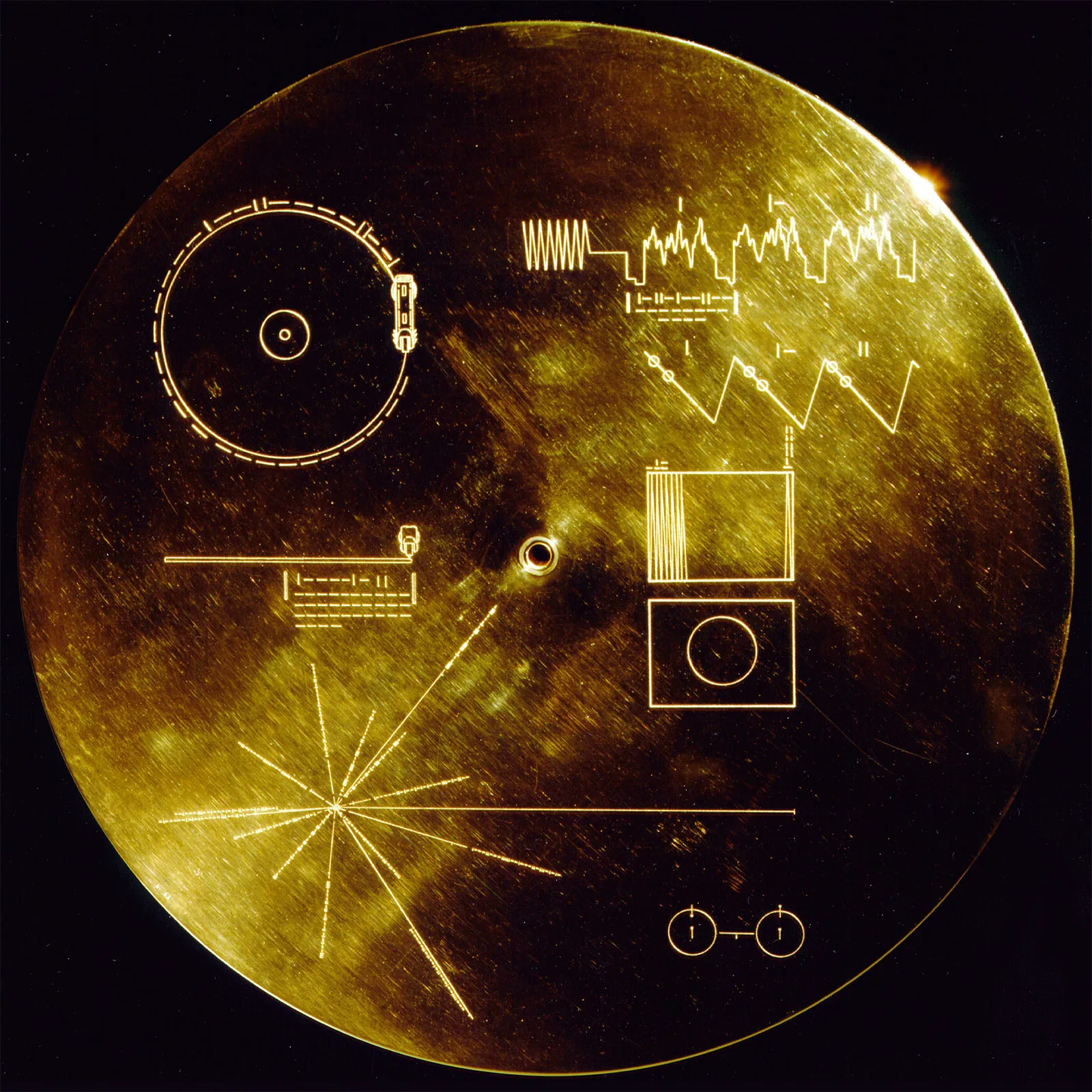
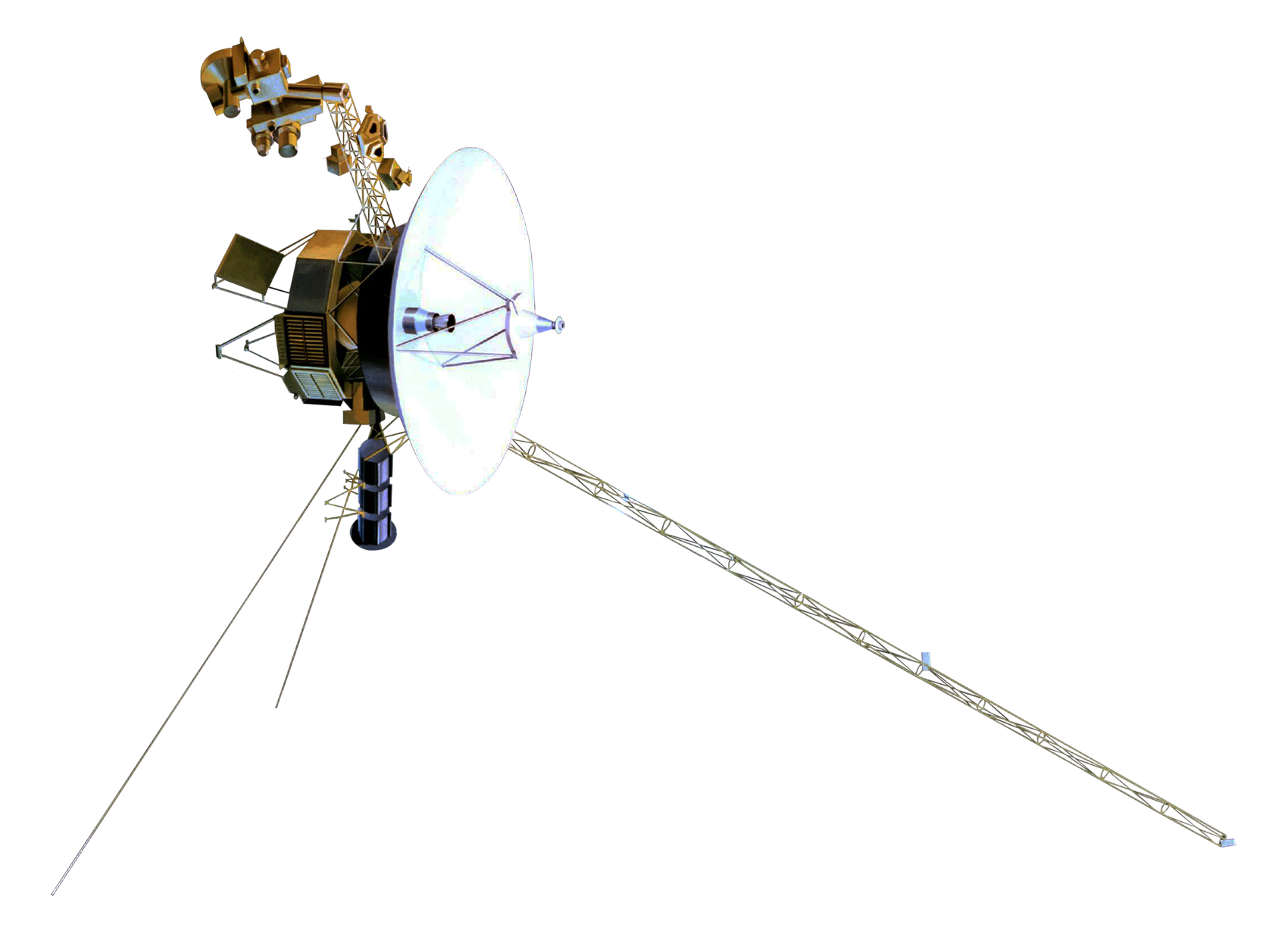
That half-million-year-old impulse seems to be remarkably difficult to suppress. Right now, Voyager I is hurtling through interstellar space at a brisk 17 kilometres per second with a gold-plated record bolted to its side. Etched onto that disc, among various attempts to explain our planet to total strangers, is an X-ray of a human hand.
The same gesture is found at both ends of our history, even if the format has been updated. In the cave, the artist sprayed pigment around the fingers, creating a persistent absence on the wall. For the interstellar version, we chose to show the interior, revealing the bones under the flesh. One is a silhouette on stone, the other an X-ray heading to the stars, with a gap of 68,000 years between the two.
The underlying intent remains identical. The cave artist trusted a limestone wall to hold their signal; NASA trusted a gold-plated disc to hold ours. The vacuum of space gives a far better chance of preservation than the cave wall, which is slowly attacked by air, water, and bacteria, erasing nearly every other prehistoric mark ever made. Each is a deliberate message left for an unknown finder who has not promised to look for them.
This is the first, essential rule of navigation: establishing a position called “here” so you can reach toward an unknown “there”. We have no idea if anything will ever pick up the record, just as those prehistoric painters could never have imagined us studying their caves, tens of thousands of years later, critiquing their creations.
One hand pressed into stone, one cast into space: a consistent trait, travelling in the dark.