
The Engine
From a damp coal pit to the edge of space, a two-century development of mechanical precision that turned fire into flight
The machine age stalled roughly 250 years ago, not because people lacked ideas, but because they could not shape metal precisely enough.
The Industrial Revolution ran on coal, and as the easy seams near the surface ran out, the mines had to go deeper. Deep mines flood. Groundwater seeps in through the rock and rises, and unless it is pumped out day and night the mine drowns and work stops. For fifty years, the engines that kept Britain's coal mines dry ran on a wasteful cycle.
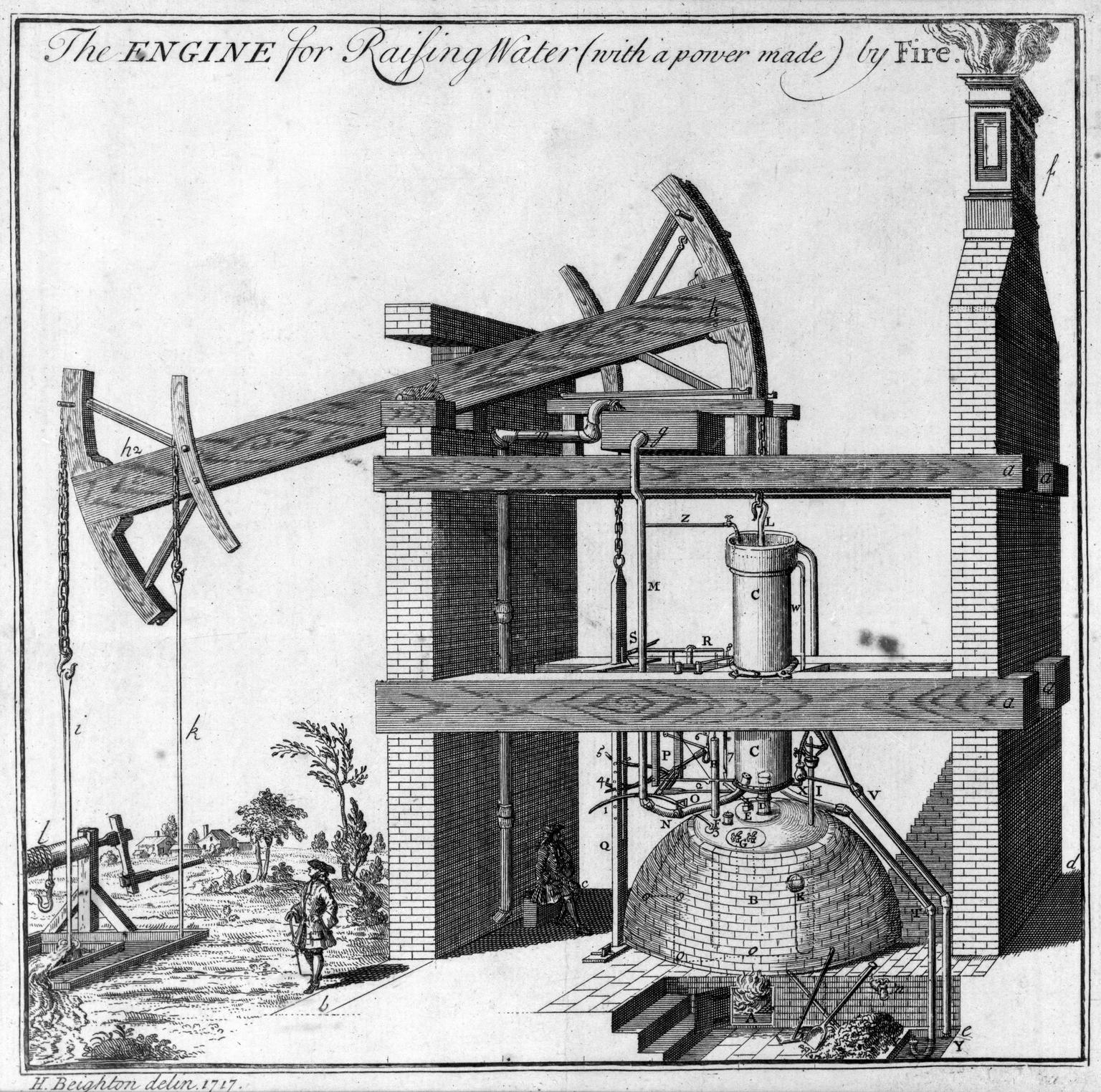
Thomas Newcomen, an ironmonger and lay preacher from Devon who built the first workable version in 1712, designed a system where steam from a boiler filled an iron cylinder as a counterweight pulled a heavy piston back up. Then cold water was sprayed straight into that cylinder, turning the steam back to water and leaving a vacuum behind. Ordinary air pressure, the weight of the whole atmosphere pressing down on everything around us, did the real work, driving the piston back down with enough force to work the pump. That is why these were called atmospheric engines: the steam did not do the heavy lifting; the vacuum did.
That constant swing between hot and cold meant the engine burned most of its coal just reheating the heavy iron walls, gone cold again on every stroke.
James Watt, who made instruments for the University of Glasgow, was repairing its model Newcomen engine when, as he told it years later, the fix came to him on a Sunday walk across Glasgow Green in 1765. Keep the working cylinder hot, and let the steam rush out through a pipe into a separate chamber that stayed cold, condensing away from the main cylinder. He patented it in 1769.
The idea worked on paper, but it could not yet be built. For years Watt's design for the separate condenser sat unmade, because no-one could bore a cylinder true. Cutting a large hole straight down the inside of the iron, perfectly round, the same width at every point, was beyond any workshop. Any error and the steam slipped past the piston, the way air escapes a worn bicycle pump, and the engine failed.
Watt's famous engine had to wait on the more obscure machine tool to be invented first.
John Wilkinson was an ironmaster so taken with the metal that people called him Iron-Mad Wilkinson. He patented a heavy boring machine in 1774 to bore out solid iron cannon barrels. If a cannon bore wandered even slightly off centre, the expanding gunpowder would split the barrel or throw the shot wide. Wilkinson solved that by anchoring a long cutting bar at both ends, so it could not sag under its own weight.
Although Wilkinson had not built the machine for Watt, a year later it was boring a steam engine cylinder anyway.
A cast-iron cylinder four feet across sits strapped to the boring rig. For hours the low groan of the iron turning against the tool is punctuated by the sound of shavings dropping to the floor. The slow pass of the cutter through the dark interior finishes, and the bore is cut.
When the work was done, Watt inspected it and wrote that the bore did not err, at any point, by more than the thickness of an old shilling: no more than about a millimetre and a half, across a cylinder of heavy iron wide enough to crouch inside.
It was enough.
Bolted into place with the separate condenser, the cylinder finally sealed. The steam went where it was sent, the vacuum held, and a design that had waited ten years for a tool equal to it worked.
Even with a true cylinder, the engine did only one thing: it pulled a heavy rod up and down. That could drain a mine, but it could not turn a mill or run a factory. For that, the straight up-and-down had to become rotation. A crank would have done it, the same bent arm that turns the push of your legs into a spinning bicycle wheel. But the crank was patented: a rival held the legal right to it, and for the length of that patent nobody else could use even so plain an idea.
Blocked by law, Watt's workshop found a way round it in 1781: the sun-and-planet gear. A toothed wheel fixed to the engine's rod ran around a matching wheel on the main shaft, and their meshing turned the straight strokes into steady rotation, with nary a crank in sight. Now the engine was not just a mine pump. It was a power source, and it could drive anything that turned.
Wilkinson had solved a problem of size: one huge cylinder, bored true. Henry Maudslay, the son of a wheelwright who set up his own workshop in London, went after the opposite problem: making that kind of accuracy small, repeatable, and easy to check. A lathe turns a piece of metal against a fixed cutting edge; Maudslay's screw-cutting lathe held that edge in a rigid frame instead of the worker's hand, and tied its movement to the turning metal. Once the machine was set, the same thread could be cut again and again, each one matching the last. He also built a bench micrometer that read to one ten-thousandth of an inch, far thinner than a human hair. His workmen called it "the Lord Chancellor", because it settled any argument over a measurement for good.
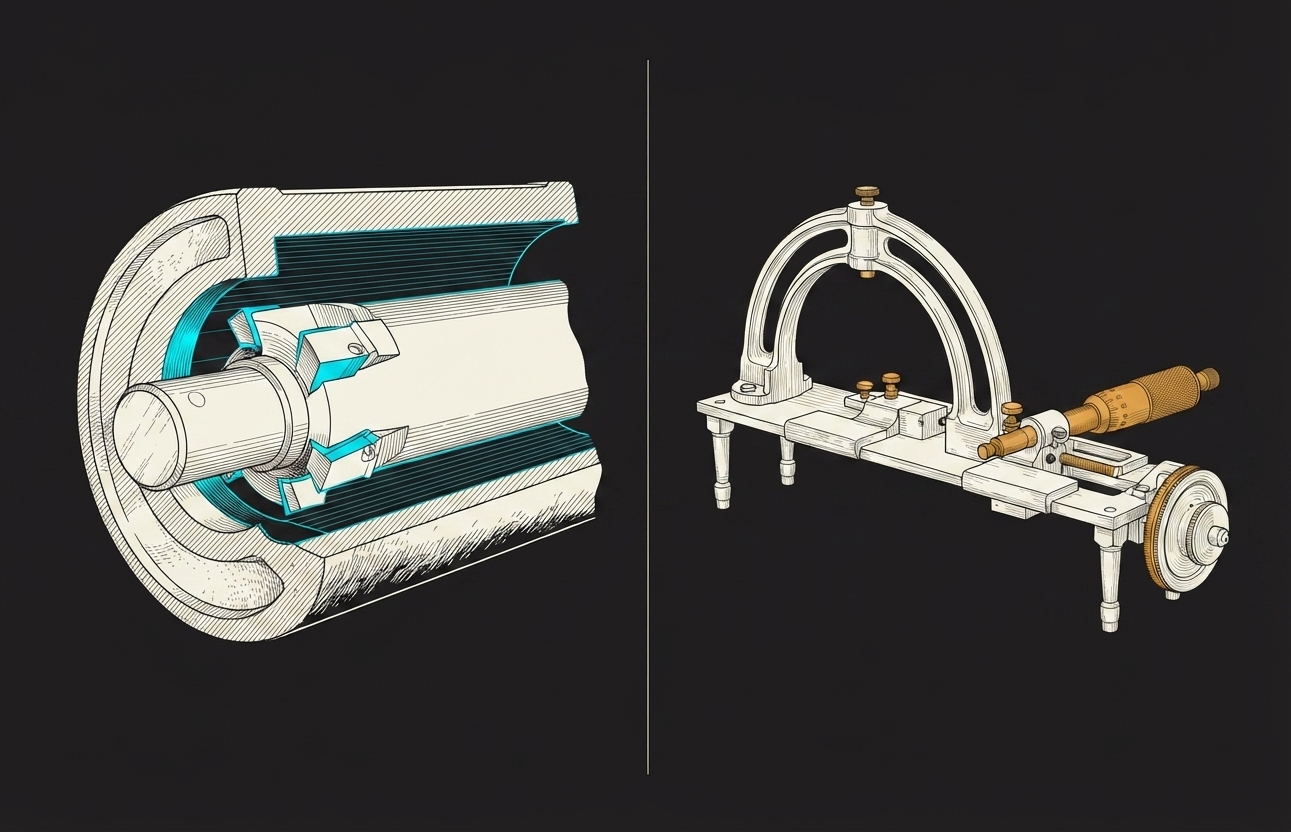
When parts can be made to a set size, and then checked against it, they stop being fitted to one particular machine. A bolt or a gear made to the standard fits any machine built to the same standard, and that is the ground mass production stands on. The cutting tools themselves were only possible because of an earlier invention, a harder, more even steel melted in sealed clay pots decades before.
Not long before, getting a single sea clock to anything near that standard had taken a craftsman two and a half years at the bench, fitting every part by hand.
Maudslay changed where precision lived. It stopped being a rare thing a gifted pair of hands did once, and became something a workshop could produce to a standard, again and again.
On 3 October 1942, from a testing range at Peenemünde on the Baltic coast, Nazi Germany launched a rocket that climbed to the top of the atmosphere: the first man-made object to come near the boundary of space. Fired at London two years later, it was called the V-2. The hardware that followed that first launch was built underground, in a tunnel factory worked by prisoners from the Mittelbau-Dora camp, after Allied bombing forced the programme off the coast.
Inside the rocket's tail sat a fuel pump, driven by a miniature steam engine. The design was begun in 1935 by Wernher von Braun, who would later lead the American team that built the rocket for the Moon landings. Power came from a Walter steam generator, a small unit that raised steam by breaking down hydrogen peroxide; the steam spun a turbine, a bladed wheel pushed round by jets of gas, at 4,000 rotations per minute. That turbine forced alcohol and liquid oxygen, oxygen chilled until it pours like water, into a combustion chamber burning at 2,820°C (5,100°F), about half as hot as the surface of the Sun.
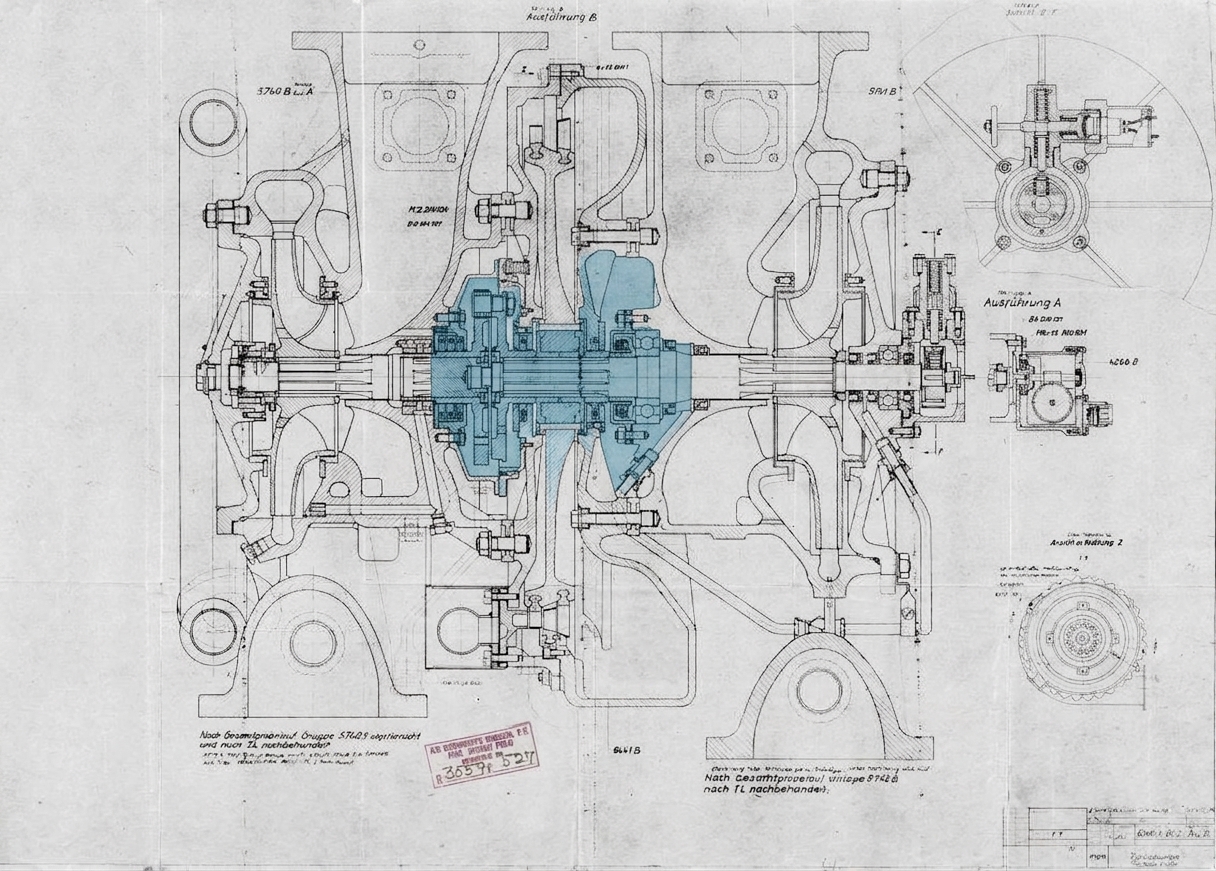
That machine, the turbopump, was a heat engine driving a pump: the same kind Newcomen and Watt had built. From Watt's 1769 patent to the Peenemünde launch lay 173 years of precision development, reaching from a mine pump to the edge of space.
A steam engine can only take you so far by itself. But everything that has carried people further, across the oceans and then off the earth, was made to a tolerance that was first worked out to build one.