
Invisible Forces
How a twitching compass needle and a spark in a darkened room became the instrument that still finds a machine we can no longer see, billions of kilometres out in the dark.
How do you know where something is when you can't see it?
Somewhere far beyond the outermost planets, an object moves through deep space. It's too distant for any optical telescope on Earth to spot, yet we know its distance to within a few hundred metres, how fast it's moving and how its path is changing. There is no photograph to measure against and no marker floating in space to point to. There is only a faint signal, taking a day to arrive through the darkness.
To trace that signal back to its origin, we must travel back to 1820 to a lecture hall in Copenhagen.
In April that year, Danish physicist Hans Christian Ørsted was demonstrating his suspicion that electricity and magnetism were connected. He had set a small magnetic compass directly under a current-carrying wire. When the electric circuit closed, the compass needle twitched away from magnetic north, aligning itself at an angle to the wire.
The deflection was slight, and the students in the room barely noticed it. Ørsted repeated the experiment privately, reversing the current and trying different arrangements, before publishing his findings three months later.
A compass needle was the oldest magnetic navigation tool in human history and here it was responding to an artificial influence nobody could see.

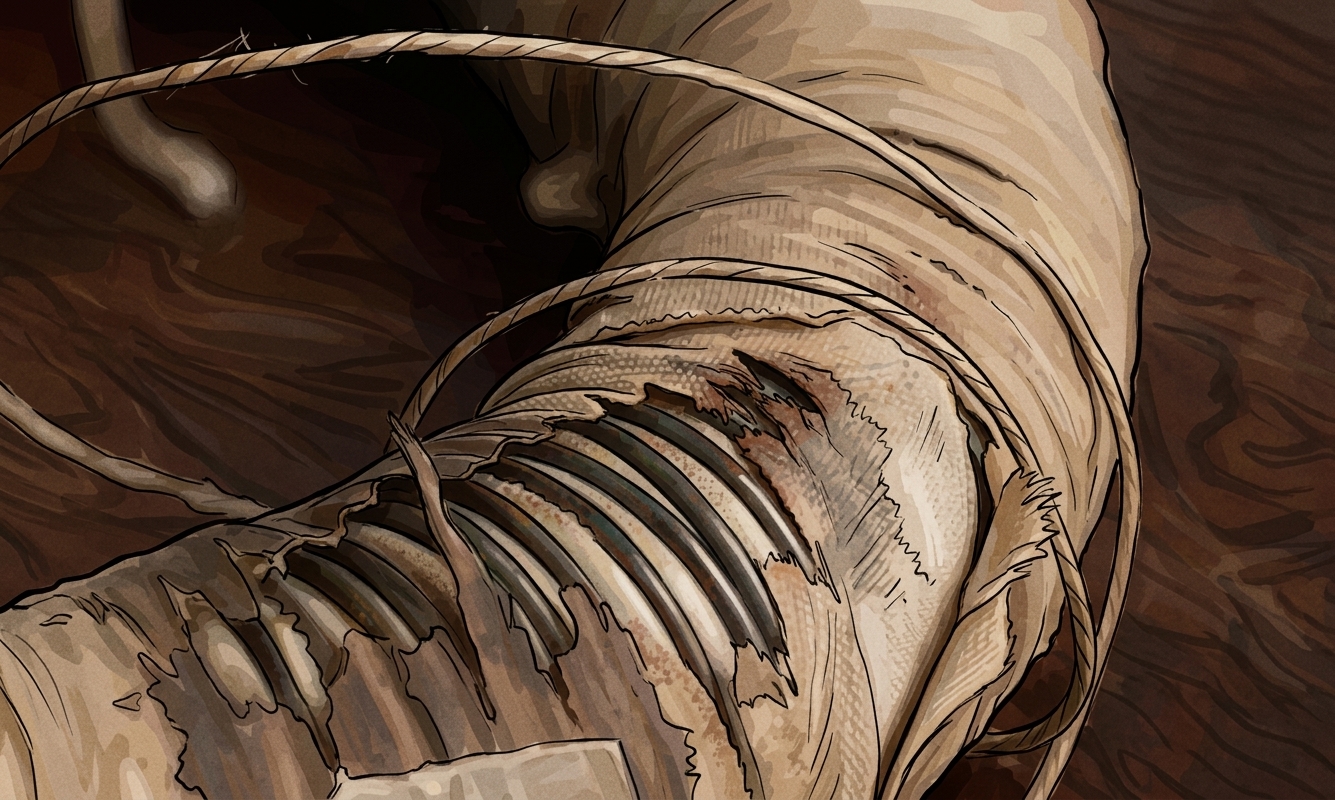
In London eleven years later, Michael Faraday found that magnetism could work the other way too. By plunging a bar magnet into a coil of copper wire, he induced electricity using motion alone.
Faraday's crucial move was how he visualised the effect. Most physicists of his era assumed that magnetic forces acted directly across empty space, pulling on distant objects without any physical connection. Faraday rejected that idea. He pictured the space surrounding a magnet filled with physical "lines of force", a field of continuous tension stretching through the room. Pushing a magnet through wire didn't send an instantaneous command across a void; it disturbed a field that filled the space between them.
The compass had given the first visible sign of an invisible connection. The empty gap between objects was no longer empty. It was a field that could be measured. Faraday had given electricity and magnetism a physical presence in the space around them.
In 1861, James Clerk Maxwell was working through two stacks of numerical data measured by other scientists in different countries. His goal was to understand the mathematical rules for Faraday's invisible fields, trying to describe how an electric or magnetic disturbance might travel through space.
The first set of numbers came from electricity researchers in Germany. In 1856, Wilhelm Weber and Rudolf Kohlrausch had set out to compare two ways of measuring electricity: static electricity stored in glass jars (called Leyden jars), and moving current flowing through a wire, which produces a magnetic force. By calculating how much static charge was needed to equal the strength of the magnetic current, the maths produced a universal conversion constant between electricity and magnetism.
Maxwell's second set of numbers came from light researchers in France. In 1849, Hippolyte Fizeau had measured the speed of light by beaming a ray through a spinning cogwheel to a mirror eight kilometres across Paris and timing the reflection. His optical experiments gave a speed for light of roughly 313,300 kilometres per second.
AsideHow Fizeau actually timed a beam of light
Fizeau turned a rotating toothed wheel into a high-speed optical shutter, timing a beam of light's flight mechanically. His path was 8,633 metres between two telescopes at Suresnes and Montmartre, giving a round trip of 17,266 metres. The beam passed through a gap in a wheel with 720 teeth and 720 gaps of identical width, travelled to a distant mirror, and returned toward the wheel.
At rest or low speed, the returning light passed through the same gap. At 12.6 revolutions a second, it disappeared completely: during the light's journey across Paris and back, the wheel had turned far enough for the adjacent tooth to block the beam. At 25.2 revolutions a second, the wheel turned one complete tooth-and-gap further, bringing the next gap into alignment and making the light reappear.
Fizeau could therefore equate the light's travel time with the time taken for the wheel to move one tooth's width. The wheel had 1,440 divisions in total, so at 12.6 revolutions a second each division represented 1 ÷ (12.6 × 1,440) = 0.0000551 seconds, or 55.1 μs. Dividing the 17,266-metre round trip by this interval gave 313,274,304 metres a second: roughly 313 million, within 4.5 per cent of the modern value of 299,792,458 m/s.
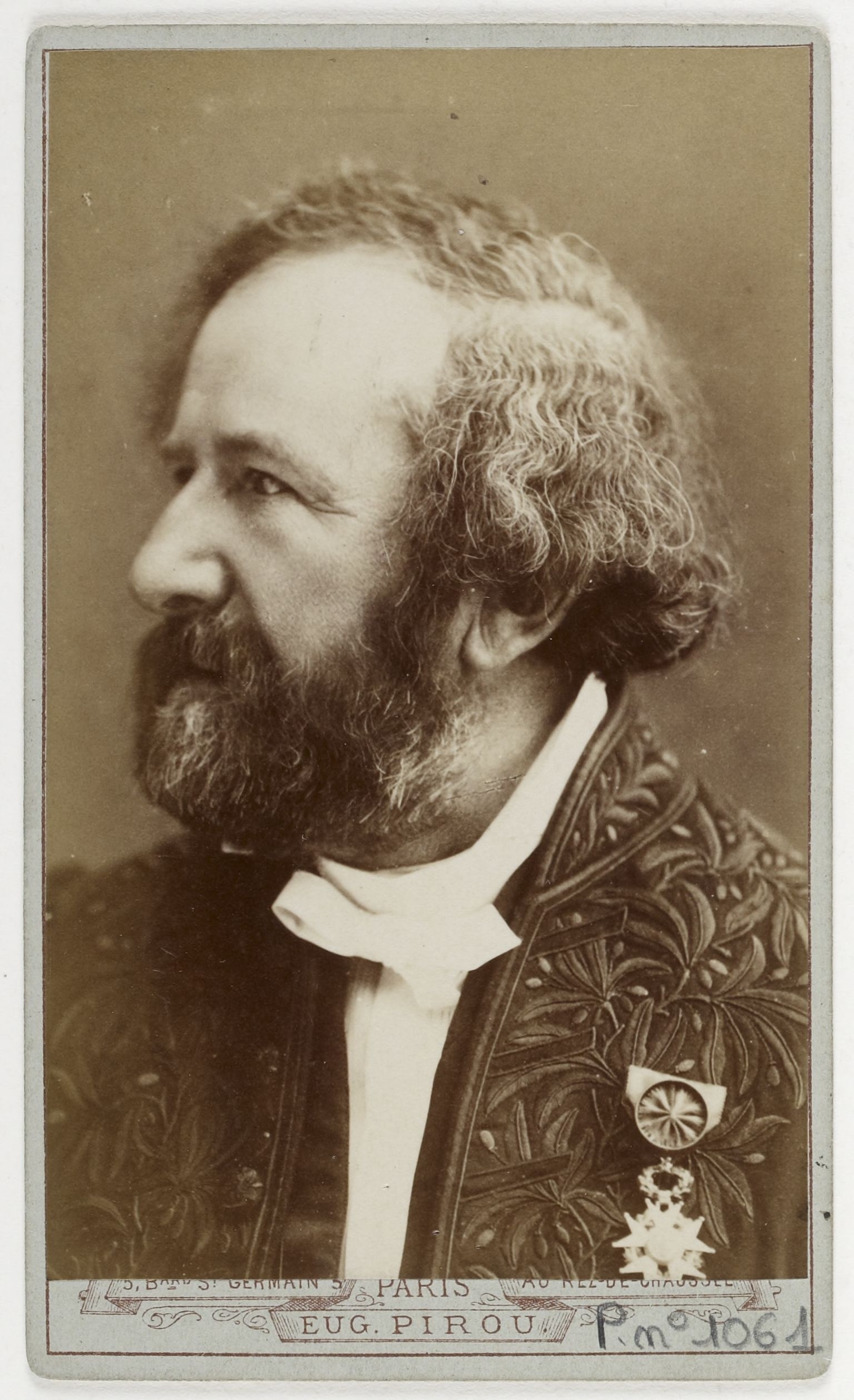
Eugène Pirou, Wikimedia Commons, public domainThen came the calculation. When Maxwell considered how fast a ripple ought to travel through Faraday's field, his formula required that conversion constant. He plugged in the German laboratory measurements, worked through the arithmetic, and got a wave speed of about 310,740 kilometres per second.
The two numbers had come from completely different worlds, one calculated from charges in glass jars on a bench, the other measured from a beam of light flashed across Paris. Yet they landed within about one percent of the same speed.
In early 1862, Maxwell published the conclusion that tied them together:
"...we can scarcely avoid the inference that light consists in the transverse undulations of the same medium which is the cause of electric and magnetic phenomena."
Light, in other words, could be an electromagnetic wave.
The field Faraday had imagined was no longer just a way of describing what a magnet did to a compass. It could carry a disturbance from one place to another, at a measurable speed. The next question was whether anyone could actually catch that disturbance moving through space.
For twenty-five years, Maxwell's electromagnetic wave remained an idea on paper. Maxwell himself died in 1879 without ever seeing it proven, and his complex system of twenty field equations was difficult to work with, remaining the preserve of a relatively small group of mathematical physicists.
Then, in late 1886 at the Polytechnic in Karlsruhe, Germany, Heinrich Hertz built a pair of simple instruments to test whether those invisible waves were real.
The transmitter was two metal rods with a small gap between them. When electricity was discharged across the gap, a spark jumped between the rods. The sudden electrical disturbance spread out into the room as a wave.
He placed a second device several metres away: a loop of wire with another tiny gap in it and watched the gap in a darkened room. Whenever the transmitter sparked, a tiny spark appeared in the receiving loop too.
The wave itself was invisible. The spark was its footprint.
Hertz did not stop at simply showing that the signal existed. To show that it really behaved like a wave, he hung large zinc sheets on the laboratory wall to bounce the signal back. Reflected waves met the waves travelling directly from the transmitter, producing places where the two reinforced each other and places where they cancelled out. By moving his receiving loop through these repeating peaks and troughs, he could measure the distance between them, working out the wavelength at around 4 metres.
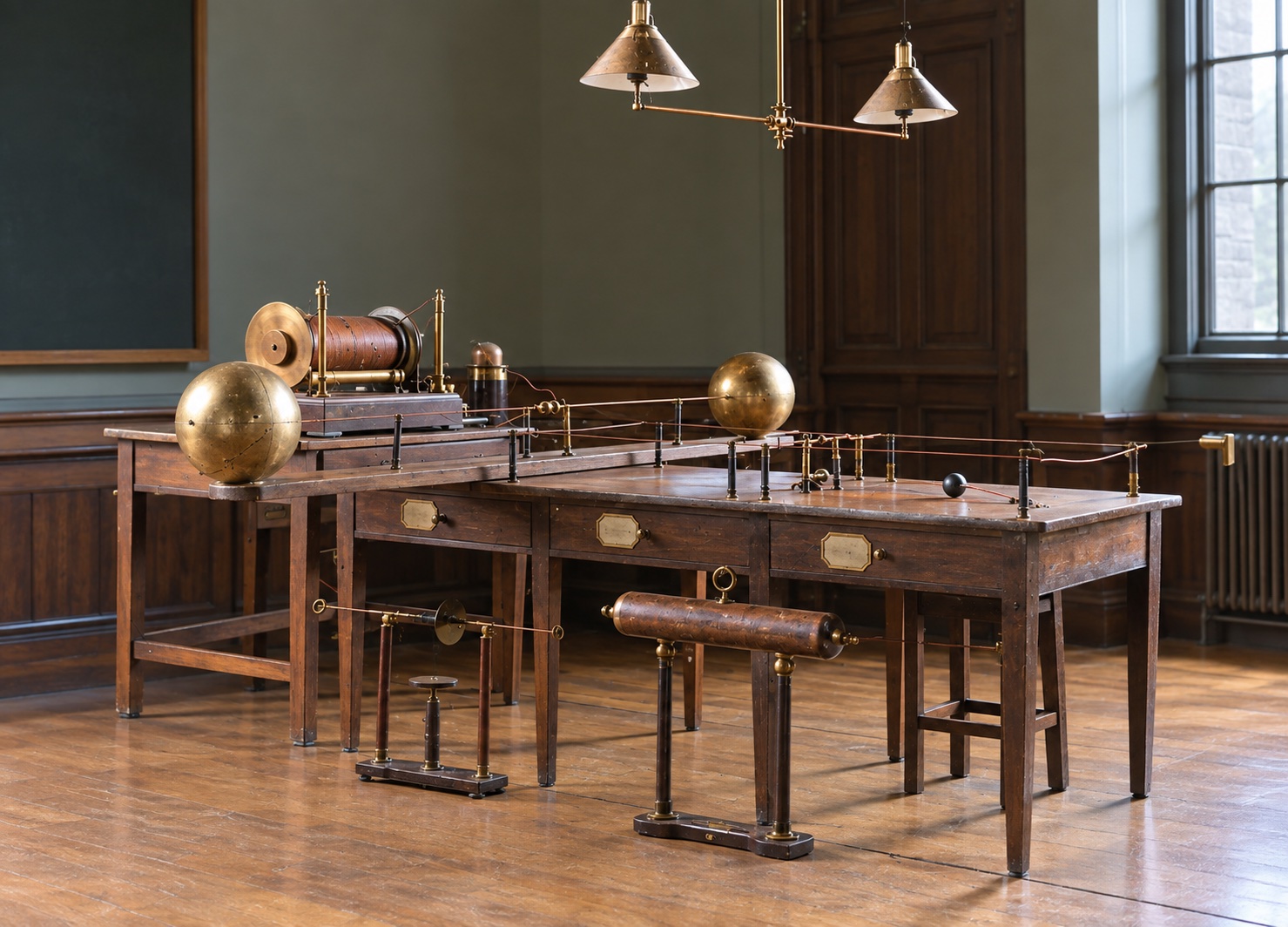
Hertz already knew how quickly his electrical circuit oscillated from the dimensions of the apparatus he had built. When that rate was multiplied by the wavelength, the result gave the speed at which the wave was travelling: about 300 million metres per second. It matched Maxwell's calculation and Fizeau's speed of light.
He then reflected the waves off metal mirrors, focused them through massive prisms of solid asphalt, and showed that they could be polarised just like visible light. They were, in every physical sense, light's invisible, long-wavelength cousin.
Maxwell's dense mathematical theory had spent decades in relative obscurity, but the wave was no longer something that existed only in a calculation.
Hertz's tiny sparks in a darkened room had made Maxwell's invisible field something that could be produced, detected and measured.
Over the next seventy years, telecommunications and wartime radar turned Hertz's laboratory experiment into technology that could send, receive and quantify signals over enormous distances.
Then, in 1961, astronomers pointed that technology at Venus.
For centuries, the relative shape of the Solar System had been understood. Kepler's laws showed how the planets were spaced in relation to one another, but no one knew precisely how many kilometres separated Earth from the Sun. That distance, the Astronomical Unit (AU), provided the basic scale for the Solar System.
Engineers at NASA's Jet Propulsion Laboratory realised that radar could provide an answer. Between 10 March and 10 May 1961, they used the 26-metre (85-foot) radio dishes at Goldstone, California, to send a signal towards Venus. The signal travelled across the Solar System, struck the planet and returned to Earth.
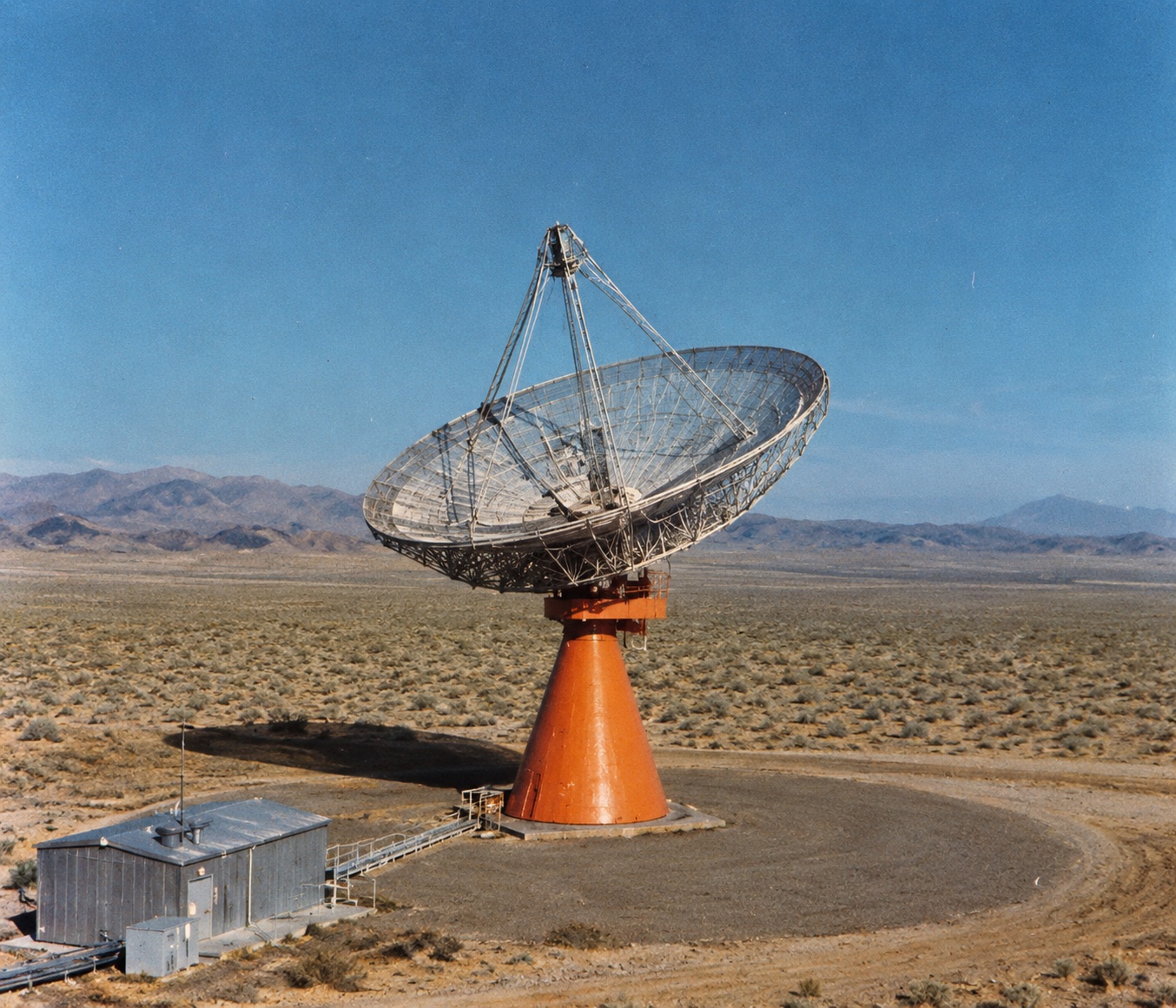
They recorded the round-trip travel time with high precision, multiplied it by the speed of light, then divided by two to find the distance to Venus.
This gave a value for the AU of 149,598,845 kilometres, give or take 250 kilometres. A two-month radar campaign made the Solar System's scale roughly a hundred times more precise than the best optical measurements that had come before.
In the time it took a radio wave to cross the inner Solar System twice, Kepler's ratios finally received their physical ruler. Maxwell's wave was no longer just a laboratory curiosity; it had become a tool of navigation and cosmic calibration.
A radio signal could now leave Earth, cross interplanetary space, bounce off another world and return carrying the distance with it.
When a craft travels tens or hundreds of millions of kilometres into space, it disappears from optical view. Even the largest Earth-based telescopes cannot resolve a machine the size of a car once it moves past the Moon. When a probe is too far away to see, its radio signal becomes the primary long-range measuring instrument of deep-space navigation.
A signal is sent towards the spacecraft, and the ground station records exactly when it leaves. When a response returns, the station records that time too. The difference between the two gives the signal's travel time. Multiply that by the speed of light and you have the total distance travelled; for a one-way trip, divide the result by two.
Distance tells us how far away the spacecraft is. But to know where it is going, we need another measurement.
The radio signal can provide that too. A transmitter sends its signal at a precisely controlled frequency, producing a regular sequence of cycles. If the spacecraft is moving towards Earth, those cycles arrive slightly closer together. If it is moving away, they arrive slightly farther apart. This is the Doppler effect, the same change in frequency that alters the pitch of a passing siren.
For a spacecraft, the change is tiny. Ground stations can detect it with extraordinary precision, gauging changes in the spacecraft's line-of-sight velocity of only a few micrometres per second.
But neither figure gives a complete position. Ranging tells us how far away the spacecraft is; Doppler tells us how quickly that distance is changing. To work out where it is in the sky, the same signal can be picked-up at widely separated ground stations. It reaches each antenna at a slightly different time, and that reveals the direction from which it came.
These measurements are repeated at regular intervals. Distance, velocity and direction are recorded over hours, days and weeks, with each observation adding another limit. Combined with a model of the spacecraft's motion, a trajectory begins to emerge: a path that fits all the gathered information.
A cycle is sent through space. Its travel time gives us distance; changes in its rate give us velocity. Repeated from different places and computed over time, those tiny changes are enough to trace the path of a machine hundreds of millions of kilometres away.
Repeat that cycle enough times and a machine's whole path emerges from the dark.
GPS depends on the same simple principle: a radio signal travels at a known speed, so the time it takes to reach a receiver gives the distance it has travelled.
Each satellite carries an atomic clock, keeping time with extraordinary precision. A receiver compares the time a signal was sent with the time it arrived. Do this with multiple satellites and you have several distances; combine them, and geometry fixes your position on the ground.
It is Maxwell's field theory working at global scale. The theory is pristine, and the electromagnetic waves cross space with flawless, predictable precision.
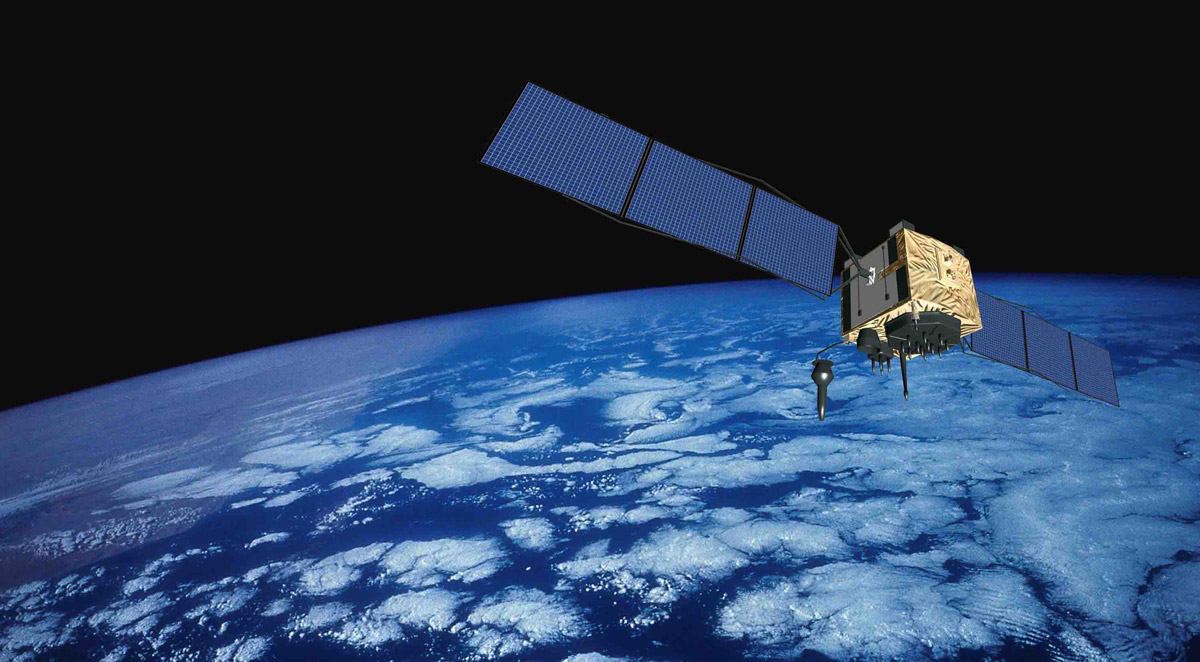
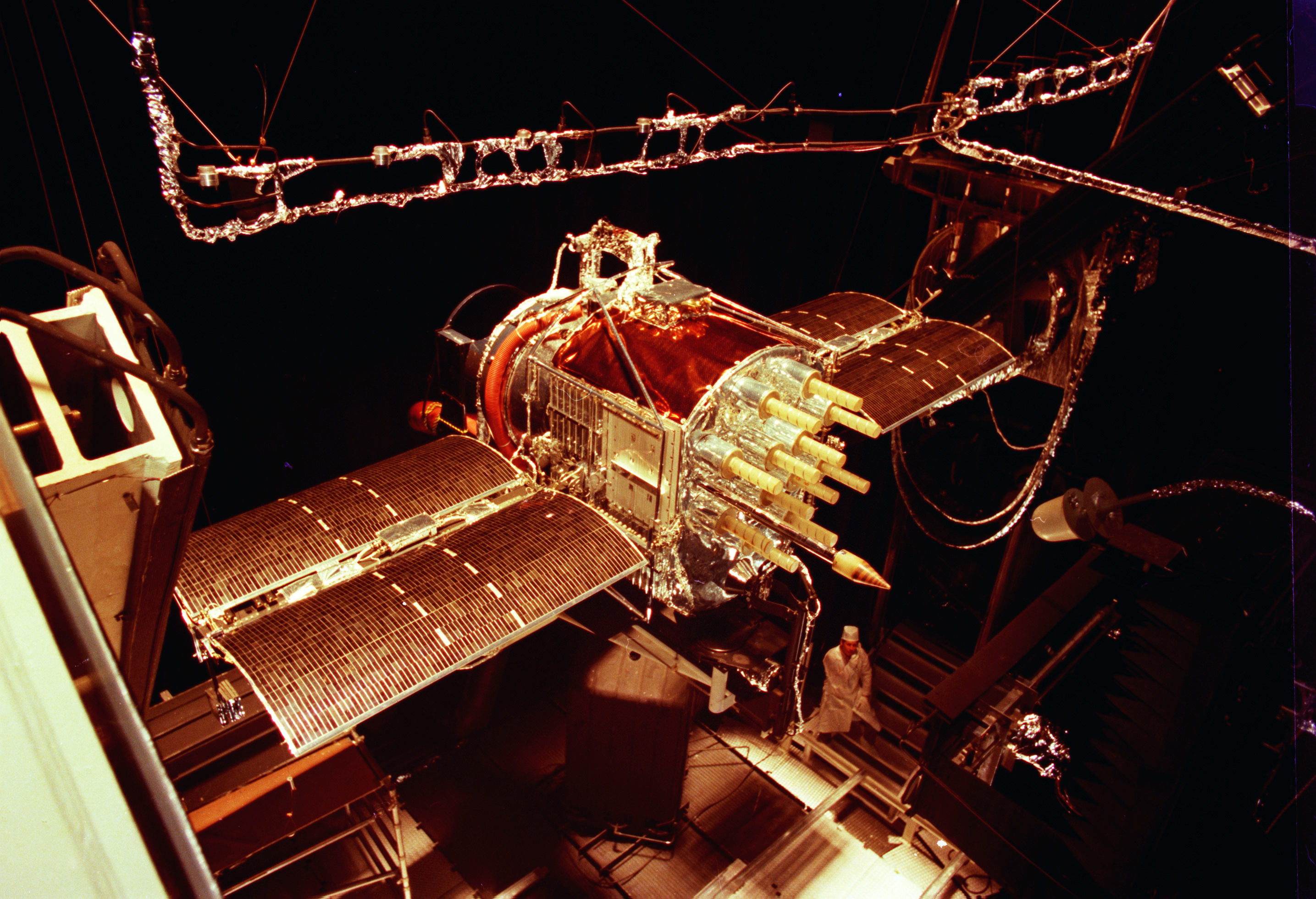
Except, when the system was brought online, the atomic clocks in orbit refused to stay in sync with identical instruments on the ground. Everything they knew about time said that identical clocks should tick at the same rate. Yet up in space, they ran differently, gaining approximately thirty-eight microseconds every day relative to those on Earth.
Thirty-eight millionths of a second doesn't sound like much. But a radio wave covers three hundred metres in a single microsecond and that timing drift multiplies into roughly eleven kilometres of position error every twenty-four hours.
The radio waves are doing exactly what Maxwell's physics says they should. They travel at the right speed. The issue is with the clocks that are timing their journey.
Something about the nature of time itself is missing from the picture.
So how do you find something when you can't see it?
You listen for it.
Even if that thing is more than 25 billion kilometres from Earth. At that range its signal takes nearly a day to reach Earth, where enormous radio dishes collect the faint twenty-watt whisper crossing the solar system. From the signal's travel time, frequency and direction, engineers can work out how fast the object is moving and how its trajectory is changing.
That object is Voyager.
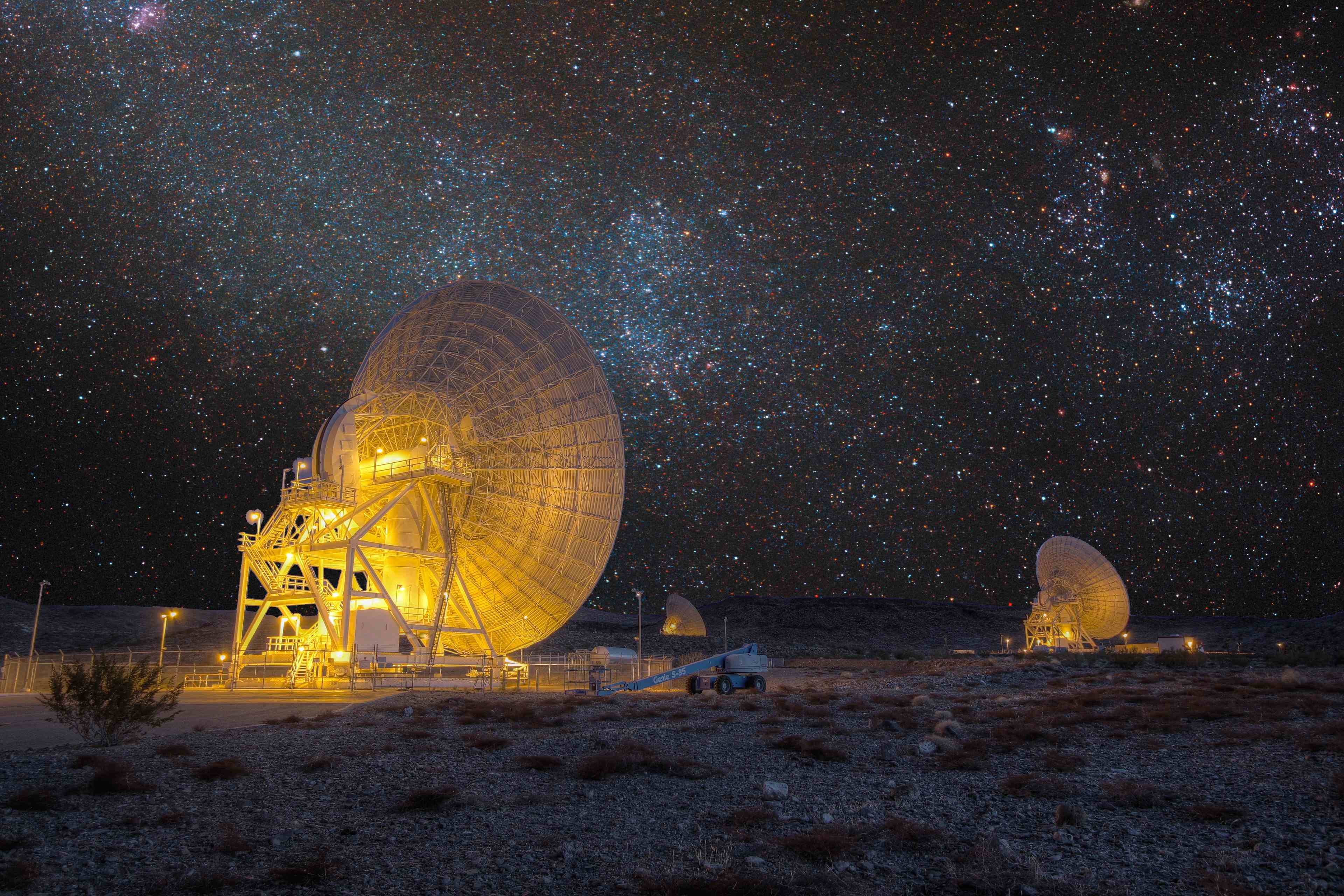
The scale is incredible. In Hertz's laboratory, the first electromagnetic waves were detected across a few metres. Today, a seventy-metre dish in the Deep Space Network locks onto Voyager's signal something like ten trillion times further away, yet the basic physical principle hasn't changed.
A compass needle responding to an invisible field was the first instrument we saw. Now an invisible wave from a machine beyond the planets can be detected. Ørsted watched a needle twitch beside a wire. The Deep Space Network watches the faintest trace of that same kind of physical disturbance arrive from billions of kilometres away.
Navigation in John Harrison's era meant building extraordinary precision directly into a box of silver clockwork. Deep-space navigation turns that problem inside out: absolute precision in tracking a machine that we will never see or touch again, purely by listening to the faint electromagnetic coughs it makes as it falls through the dark.
The machine itself has vanished forever into the void. But as long as it keeps murmuring away, space cannot hide it.