
Episode 04 · The Hand and the Stars
The Astrolabe
The first global positioning device, sixteen hundred years old, that tells you half of where you stand
You're in an unfamiliar field, trying to figure out the way home, so naturally you reach into your pocket.
Tapping the polished glass oblong provides the answers to three key questions: where am I, what time is it, and which way am I facing? Twenty thousand kilometres overhead, a fleet of satellites, each carrying their own atomic clock, obediently fix your position, erasing the immediate, irritating inconvenience of being lost.
You glance up from the screen as the reel starts to run backwards, the stars in the sky gently drifting to their positions sixteen hundred years earlier.


Eventually, you find yourself back in the fourth century. The satellites are gone and the air smells of woodsmoke and damp wool.
Your clothes are woven linen, and folded inside them is a heavy disc of cast brass, small enough to fit in the palm of your hand. Lift it by its cord, catch a known star's light across its engraved circles, and it hands back those same three answers.
Those questions pose a challenge as old as the human animal. But back here, the interaction is more organic. Modern devices do not need a manual reading of their surroundings whereas this analogue tech requires your eye in the loop.
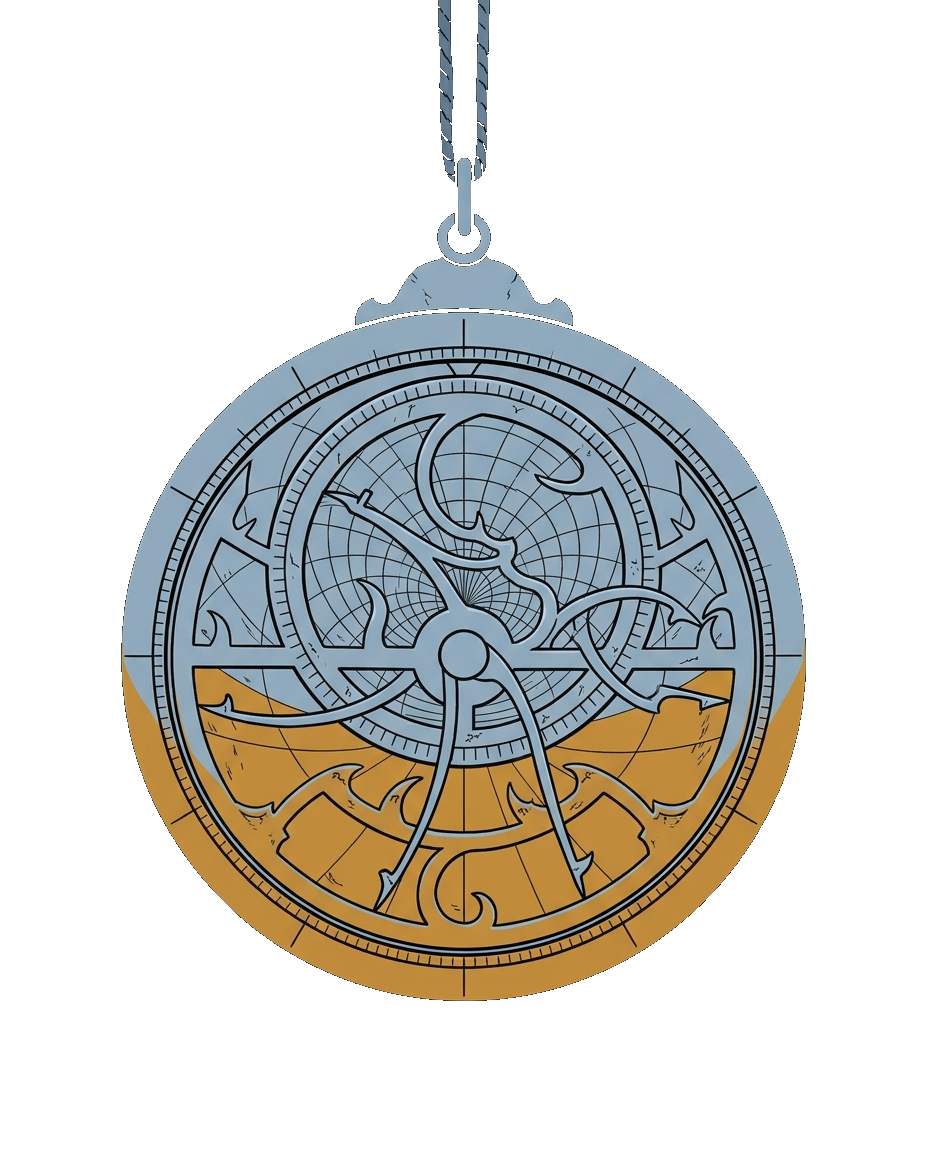
The origin story of that brass disc is elusive. Go looking for where it came from and you find a blank space in the historical record: no builder's mark, no date, no workshop archive.
The earliest surviving trace is a letter, written around the year 400 CE. A scholar, sending a present to an imperial official, attached a note explaining what a fine piece of work it was.
That gift was an astrolabe, worked in silver.
The primary instrument for the next fourteen hundred years first shows up in the historical record as somebody's present.
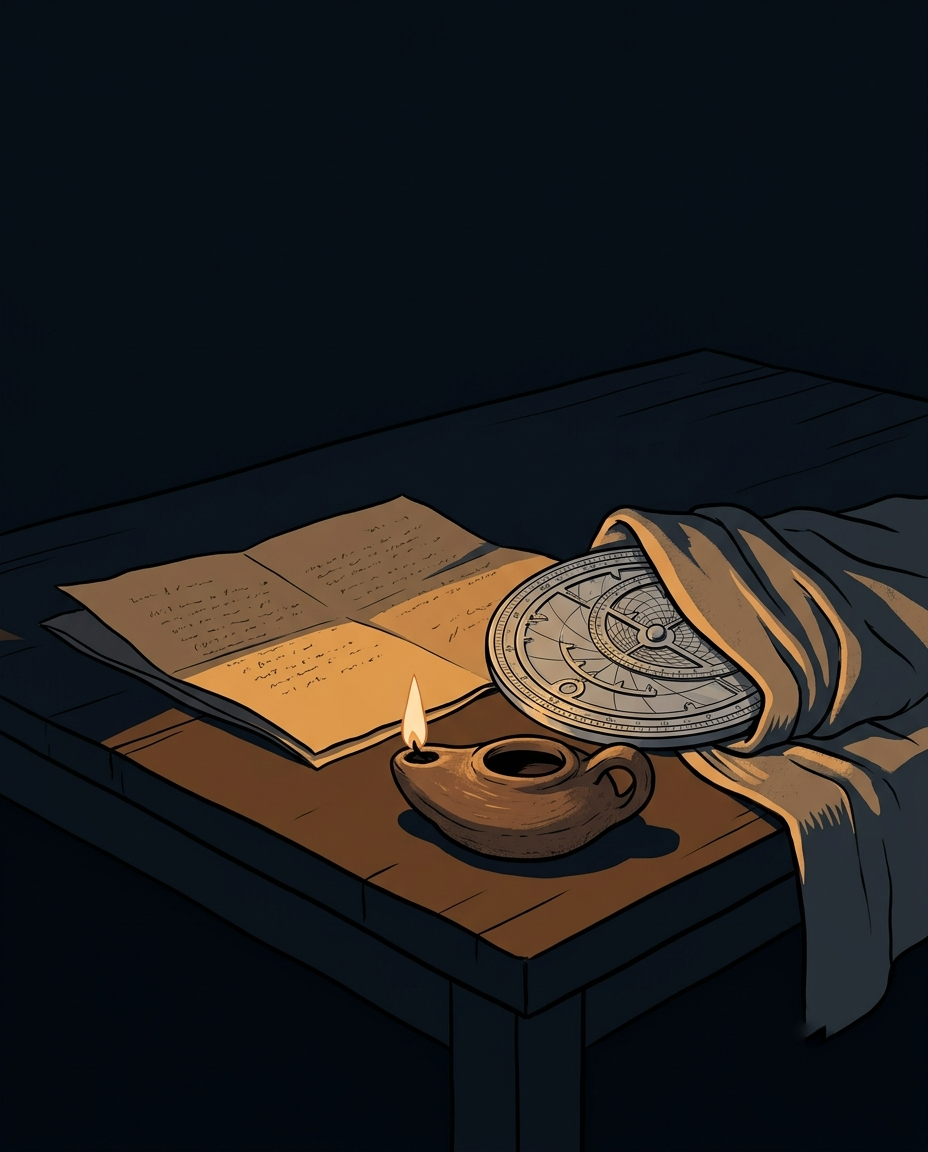
To be able to catch the star's light along the edge of the brass, you have to understand what you're looking at. How is that learned, and who taught that ability?

Long before anyone built a tool to answer those navigational questions, the entire expertise lived inside human memory. People crossed oceans and walked open continents carrying no physical instruments in their hands at all. Their maps came from observations of repeating patterns: stars rising from certain points on the horizon, how high the noon sun stood at the turn of each season, and what the moon's phases did to the water under their boats.
This knowledge stayed alive because it was handed down from one generation to the next, a continuous chain of living memory. If the chain broke for even one cycle, the art would vanish. Maintaining this memory required constant work; every generation had to rebuild the knowledge from scratch inside their heads.
The astrolabe sits on a continuous journey that stretches from a prehistoric handprint on a cave wall to a probe crossing the edge of the solar system, the moment where an invisible human skill became a physical tool you could hold.
One of the oldest and most valuable skills on Earth was gathered up and cast into brass, fundamentally altering how it travelled.
Know-how must be taught, but objects can be given away. This could explain why the earliest trace of this device is a silver gift shipped across an empire, rather than a master's manual or a school.
Both the manual and the school actually did exist, but they survive only as ghosts. Around the year 375 CE, a scholar named Theon of Alexandria wrote the earliest known book explaining the instrument. The text itself is completely lost; we only know it existed because its title was copied into a Byzantine encyclopaedia five centuries later. The instruction manual was mislaid but the gift note lived on.
Theon’s daughter, Hypatia, taught at a renowned Alexandrian school, where she instructed the mathematics of the sky to a young student named Synesius, the very man who would later write the letter accompanying the silver gift.
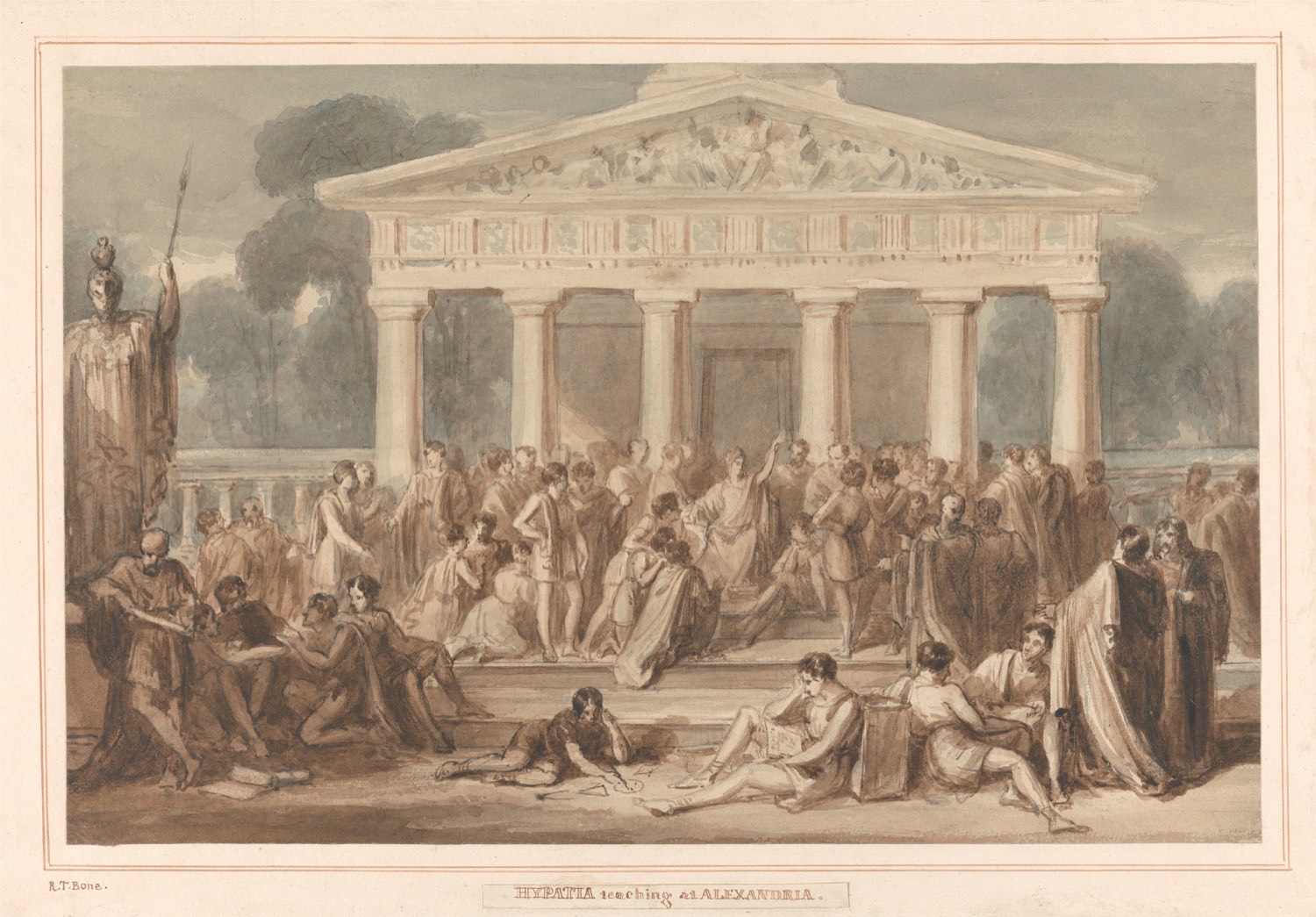
In later centuries, writers looking back at the blank space of the origin story credited Hypatia with inventing the device, probably because she was the most famous person associated with it.
The hole in the story only deepens the closer you look. The earliest surviving astrolabe you can actually pick up and hold was cast in the tenth century, more than five hundred years after Synesius sent his letter.
Even the word astrolabe is second-hand.
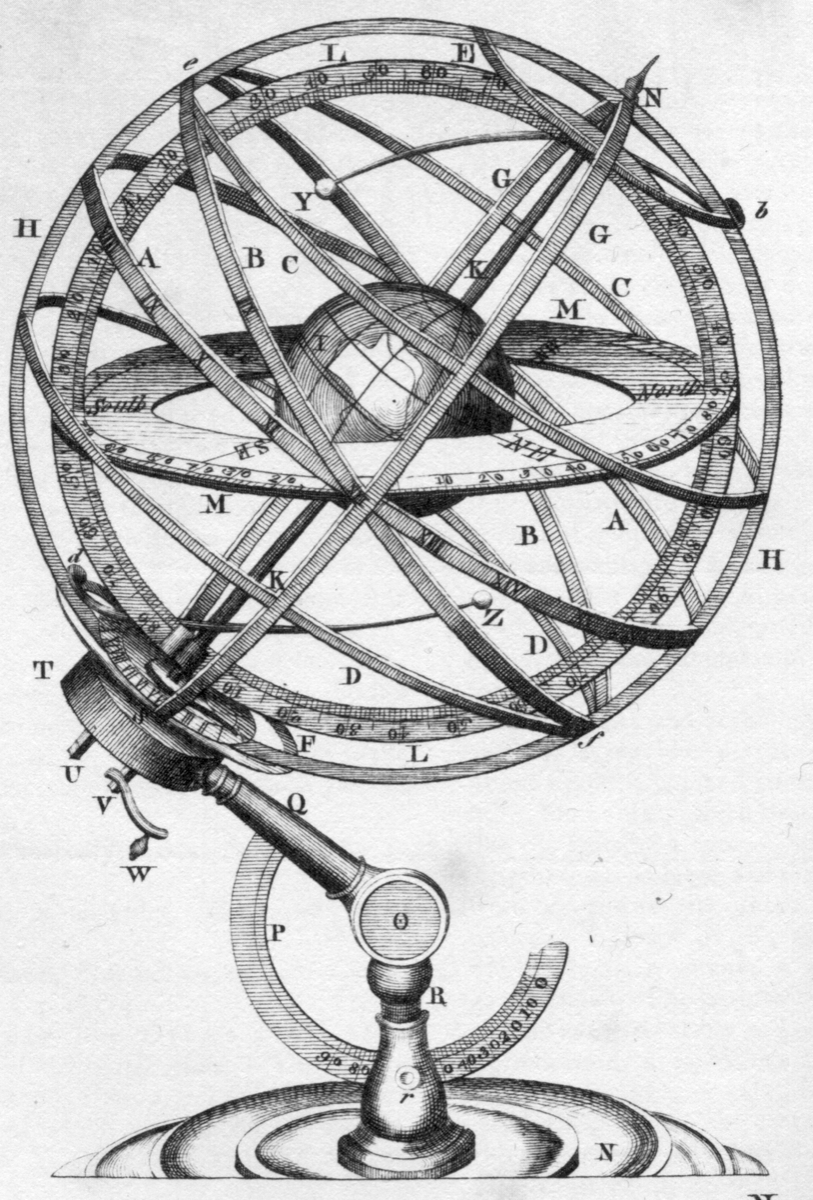
When the astronomer Ptolemy used the term in the second century, he meant a completely different device, a large, nested cage of brass rings we know as an armillary sphere.
The word, which translates from the Greek as star-taker, eventually walked away from the heavy sphere and settled on the flat pocket disc.
The tool itself is not a single invention, but a marriage of two ancient mechanisms from different eras.
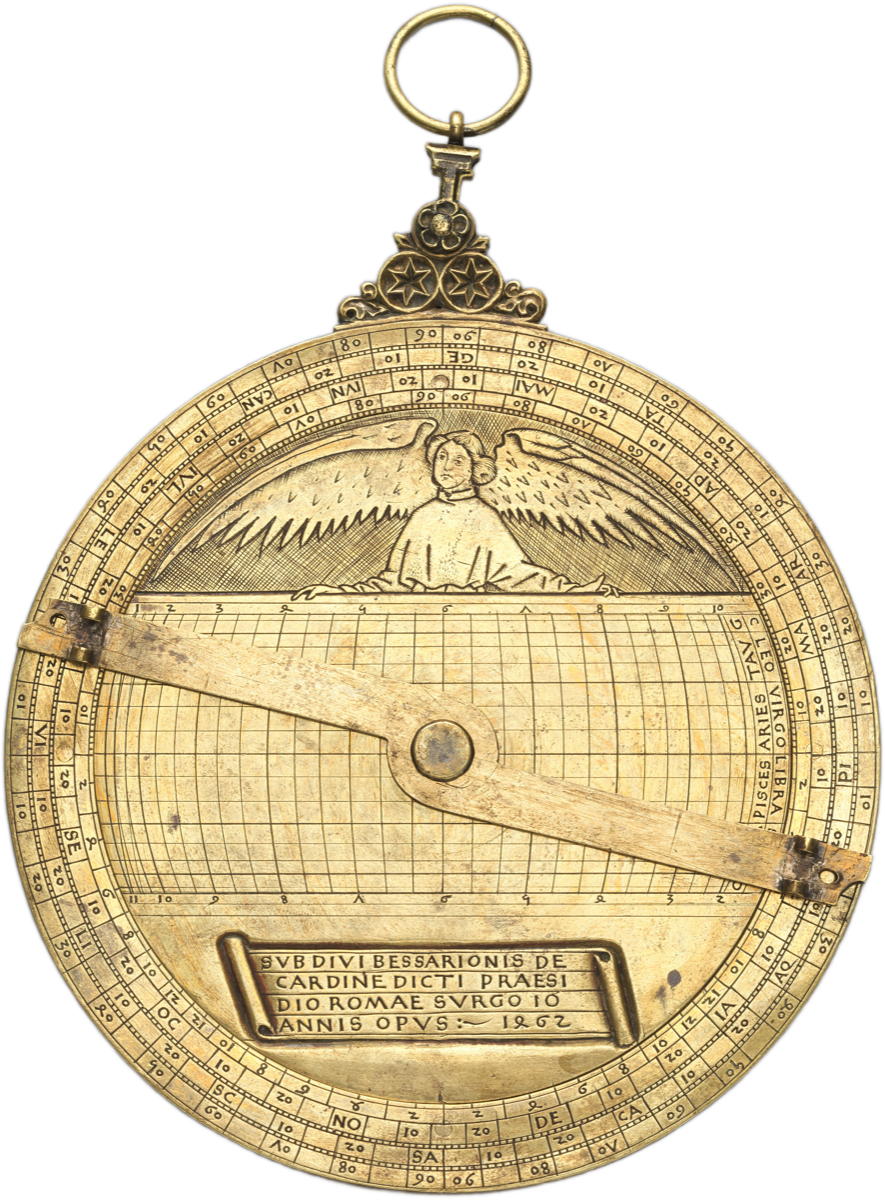
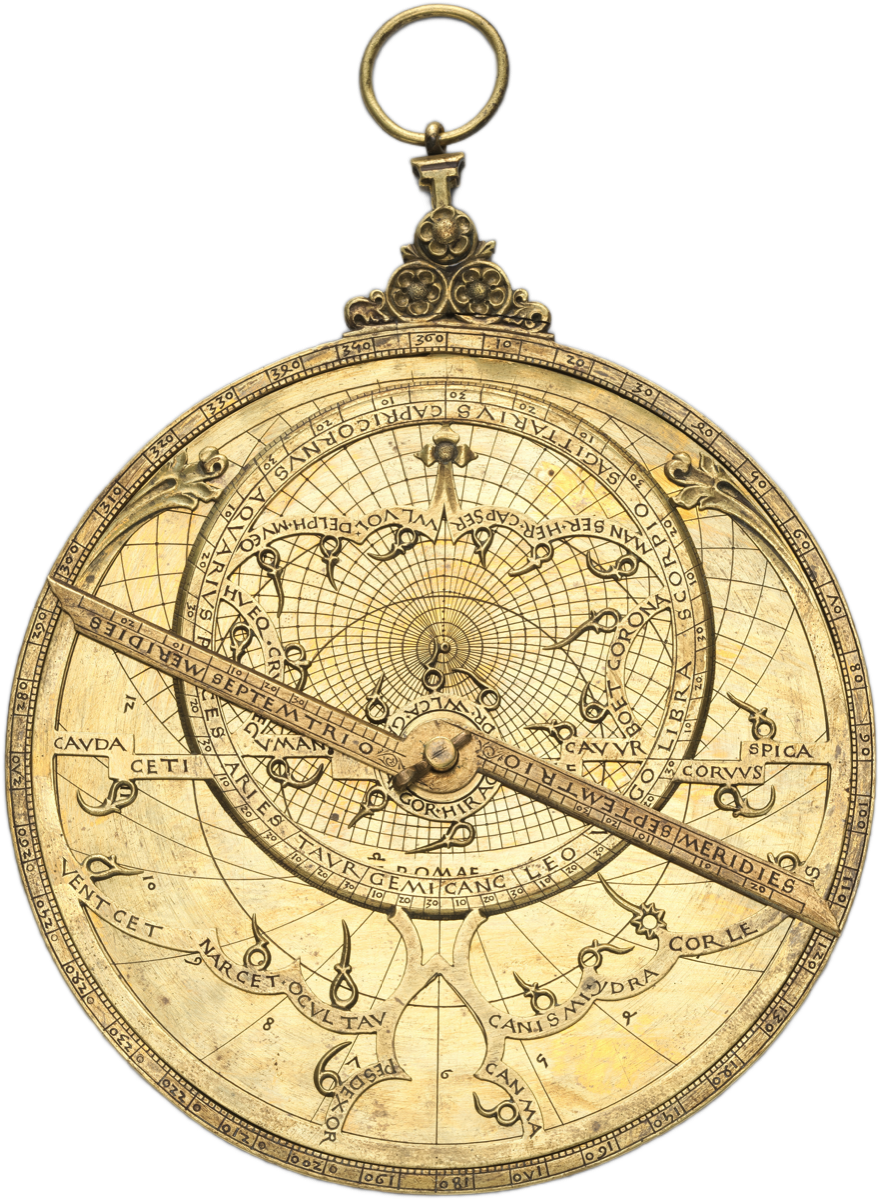
Turn the instrument over, and the back holds a sighting bar called an alidade, which traces its lineage back to the dioptra, a surveyor’s tool used since the third century BCE to measure angles to distant landmarks. Look at the front, and you find a map of the flattened sky, a mathematical projection worked out by Ptolemy in the mid-second century CE.
The two halves were created four hundred years apart.
Sometime before the year 370 CE, someone lost to history attached the surveyor's sighting bar to the back of Ptolemy’s map. Modern scholars still debate whether Ptolemy engineered the union or if it came later; it's a mystery swallowed by a gap in the historical record.
It is no great tragedy that we're unsure who made it, because tools like this often don't have a single inventor. They tend to evolve slowly over generations in workshops through trial and error.
The name star-taker migrated from the large sphere to the flat disc because the two objects share the exact same job. The sphere models the sky well, as a three-dimensional dome, but a cage of brass rings is not exactly transportable. To make the heavy sphere fit in a pouch required a clever geometry trick called stereographic projection.
Imagine laying a sheet of paper right across the equator, and putting a pinpoint light at the South Pole. If you trace straight lines from that bottom light out through every star in the sky, where those lines punch through the flat paper gives an accurate map of the heavens.
Around the outer edge of the plate, artisans cut 360 small notches, following a division handed down from ancient Babylonian astronomers. But flattening the sky was only the first step, they also had to choose what to leave out. The night sky holds thousands of stars, but if you tried to carve them all, the metal would become a wall of unreadable visual clutter.
Every astrolabe is a design choice about what is essential. Synesius’s gift showed sixteen stars, a medieval piece from 1062 showed fourteen, and later writers suggested capping it at twelve to keep the metal pointers from blocking the view. Sticking to about a dozen stars became the standard because a simple sky is much easier to read.
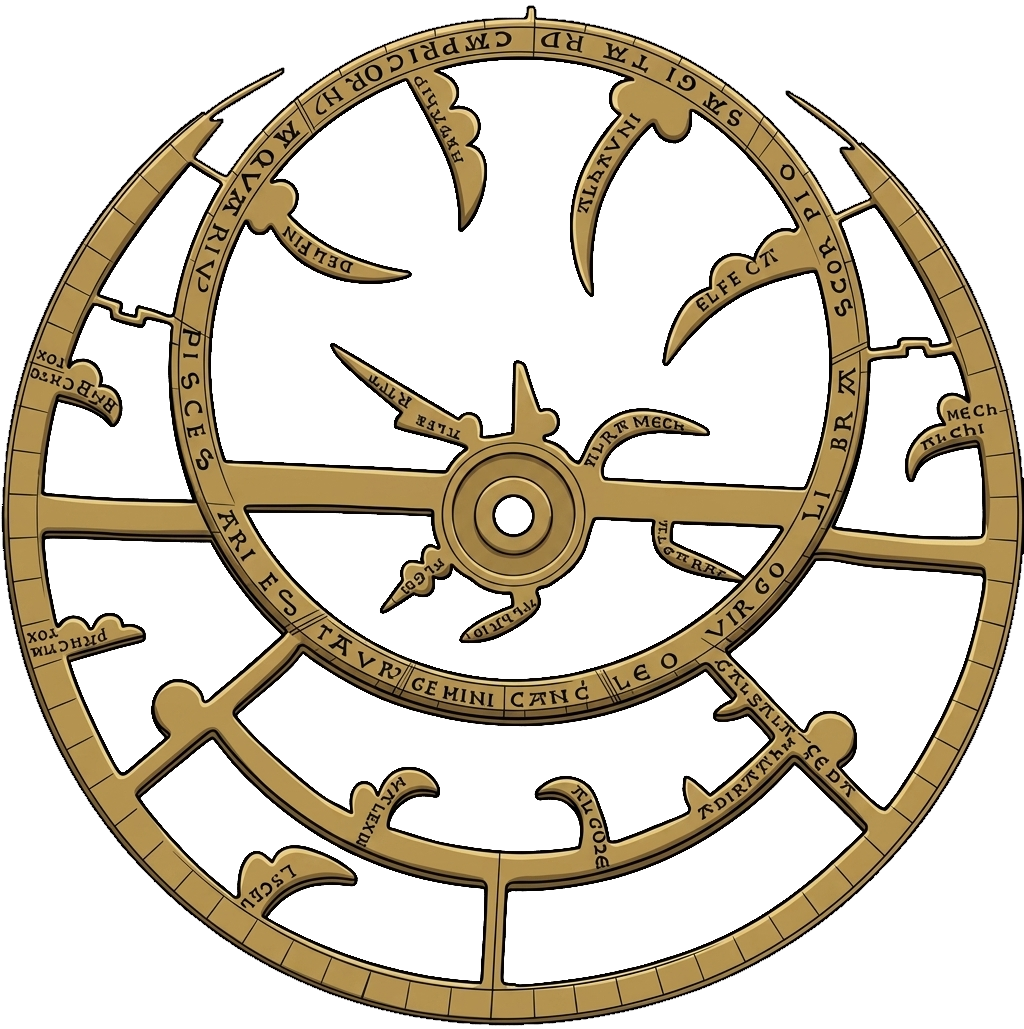
By clearing away the clutter, the makers built a precision instrument: a dozen key stars, a horizon, your latitude, and you as the human in the loop, waiting for your eye to bring it to life.
Part II · The reading
Lift the instrument by its top ring so that gravity makes it hang perfectly straight.
With the tool hanging plumb and vertical, rotate it to the back to take your star reading. There is a turning bar, the alidade, with pinholes at the ends.
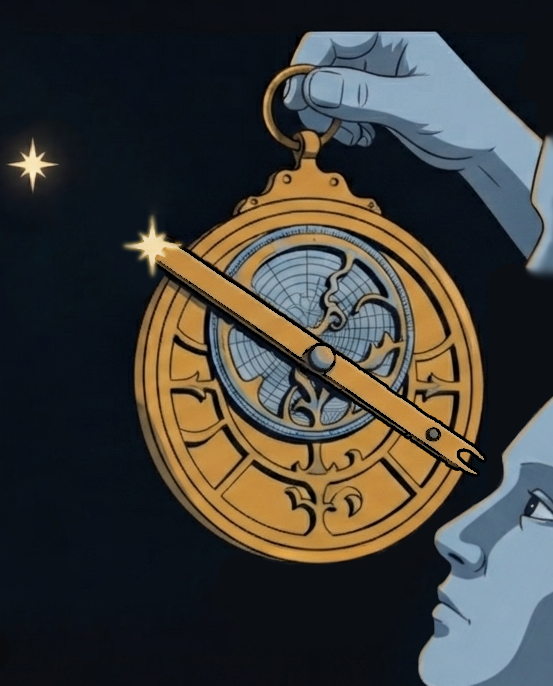
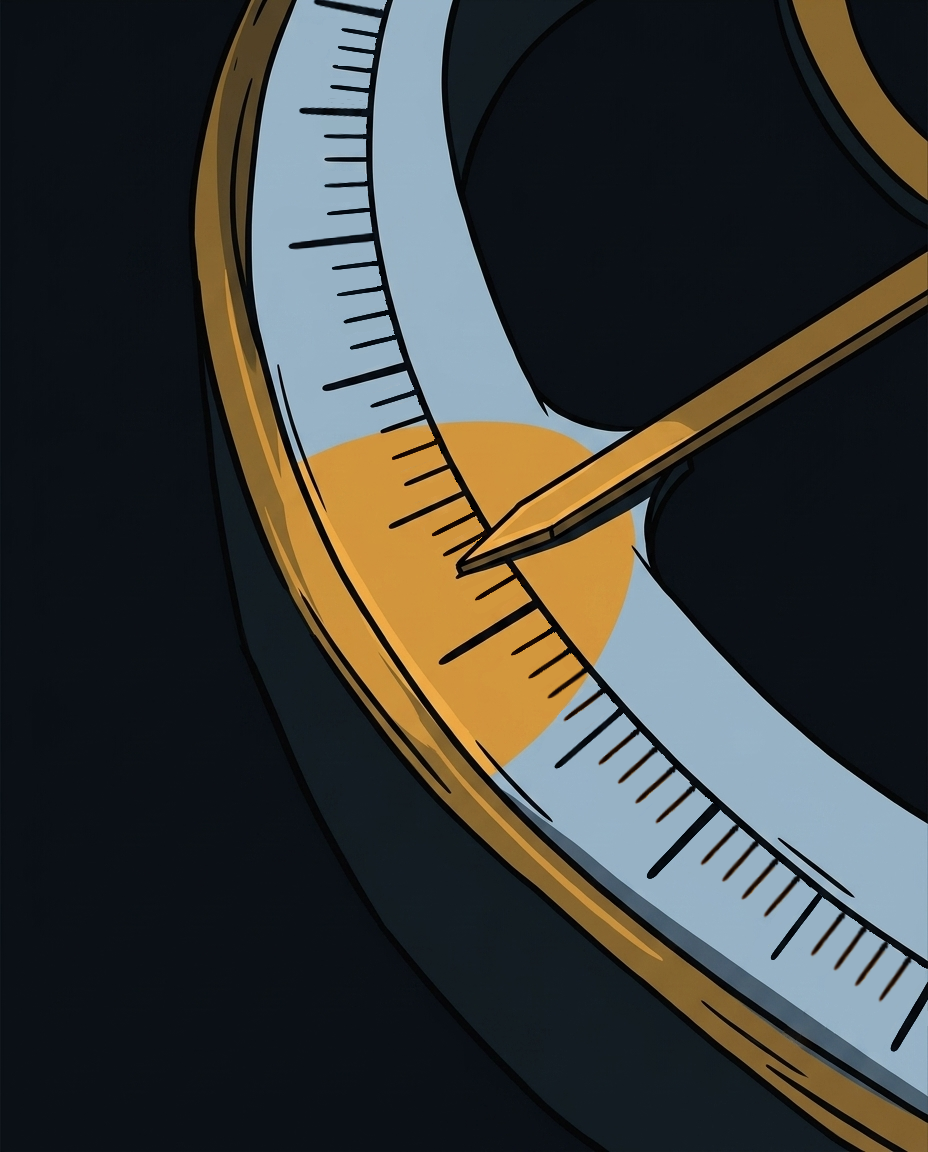
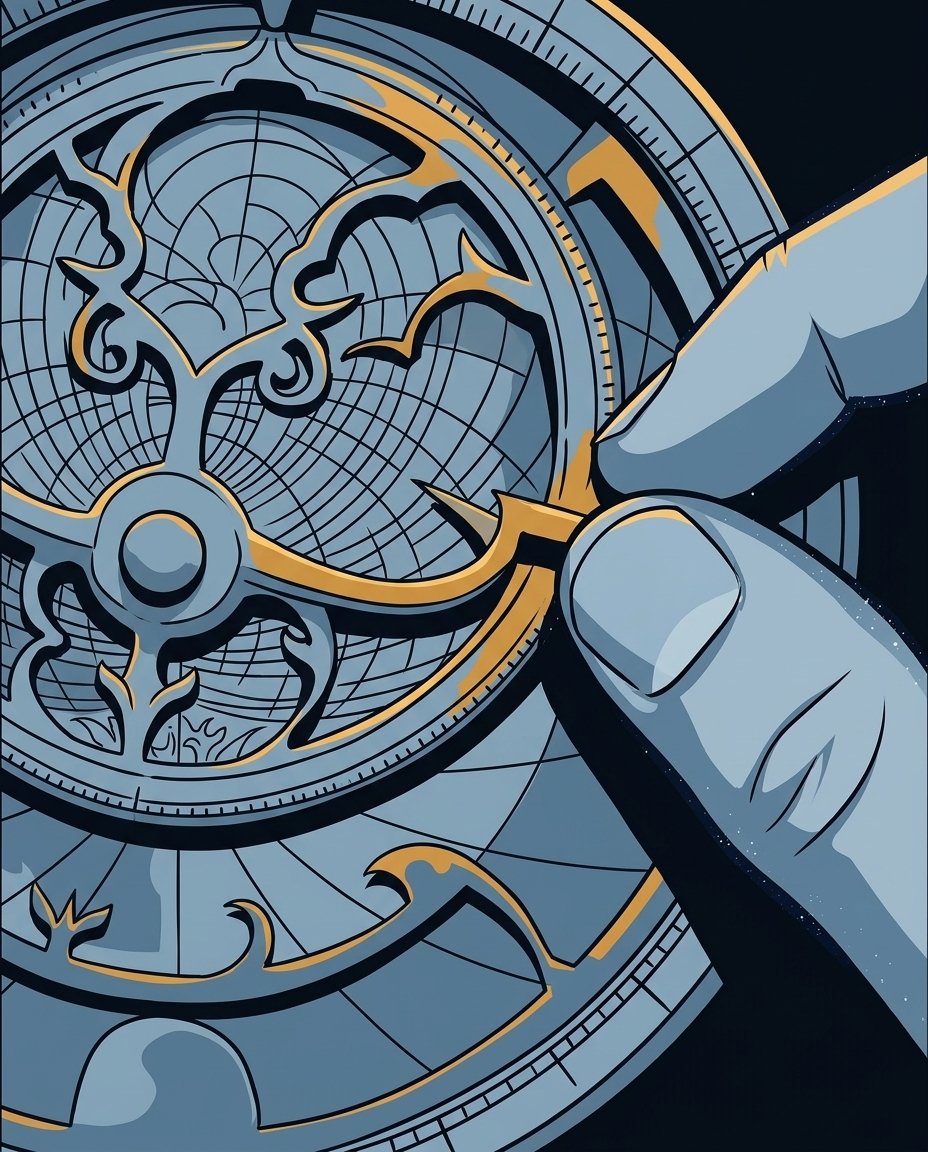
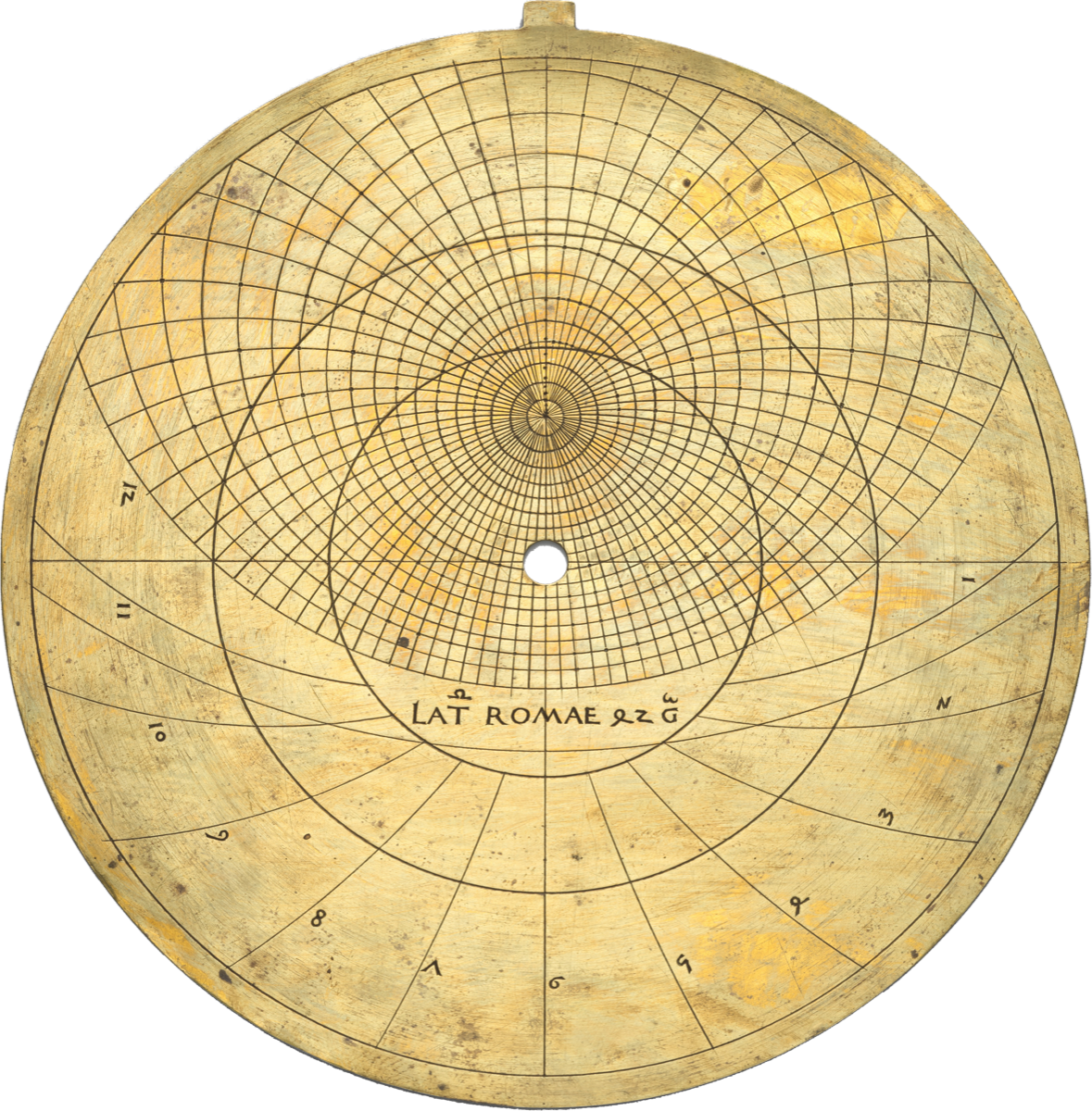
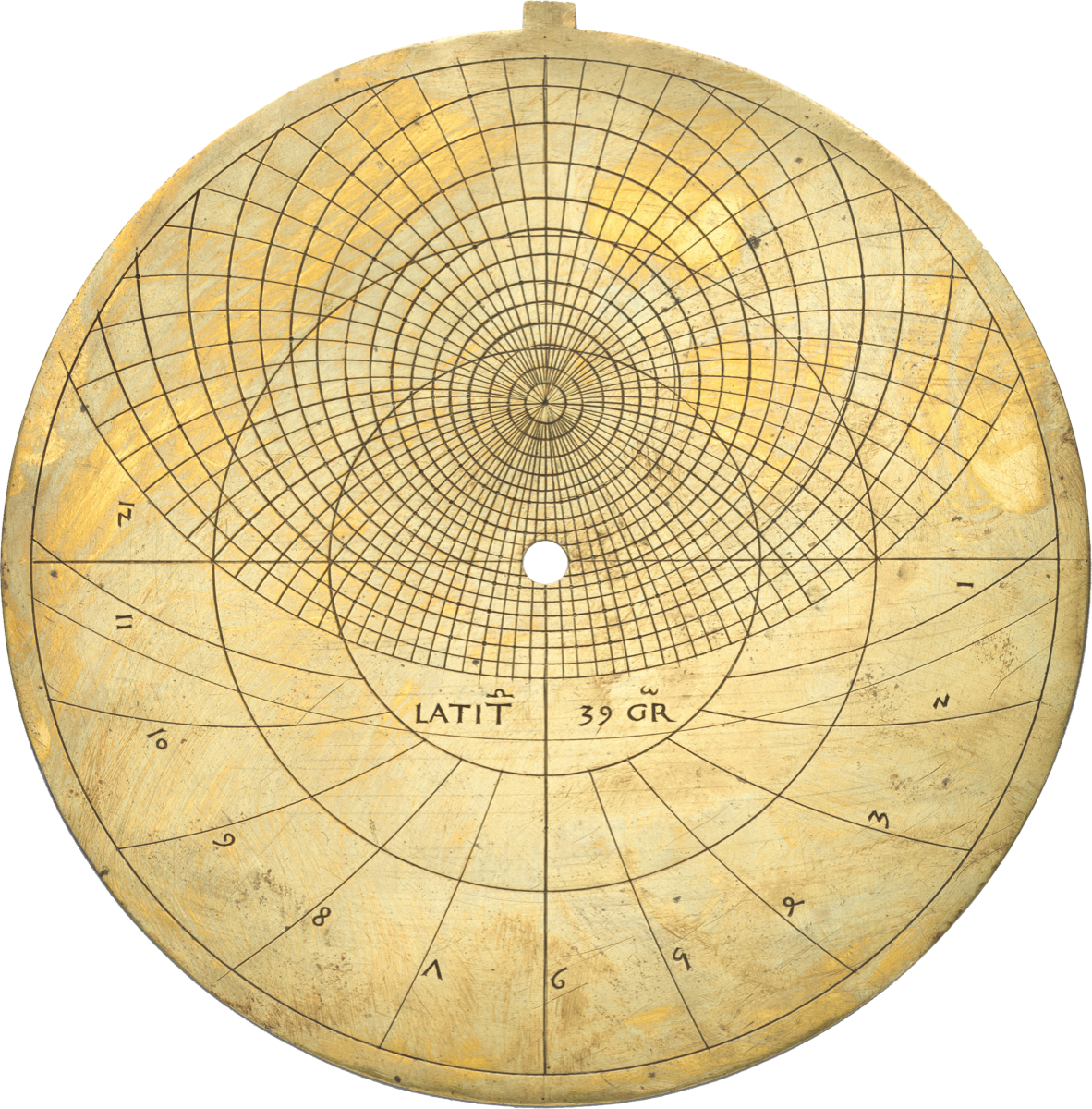
Find a star that you know, raise the heavy disc to eye level, and tilt the alidade until the starlight shines cleanly through both pinholes. Holding perfectly steady, look down at the scale on the rim to read the number where the bar intersects the markings on the edge. That reading gives you your star's altitude. The final step is to set this reading by rotating the astrolabe to its front, which consists of a layered assembly of discs. The bottom layer is a fixed plate called a tympan, marked with the horizon lines for your location. On top of it rotates a brass web of pointers, called the rete or spider. Find the pointer for the star you just measured and rotate the spider until that pointer lines up with the altitude line you found.
Congratulations, your astrolabe is now a mechanical model of the entire sky in your hand, showing you stars, the hour, and the sun's position. If you change your latitude, you just swap the tympan inside for a new one. They are interchangeable worlds operating under a single sky. Without your eyes seeing the star and your hands holding the heavy disc steady, the brass plates are just well-designed metal. You have to provide the target, the measurement, and the location; only then does the instrument turn into a working model of the cosmos.
Part III · Why three continents wanted it
To understand why people across three continents wanted this object, you have to look at how they related to the sky. It was not scenery; it was a clock, a calendar, and a timetable rolled into one. The stars were believed to govern everything from a child's temperament to the shifting rhythm of daily work and prayer.
People picked up the brass disc to ask three very different questions: what the future held, when duty called, and how to track the passing night.
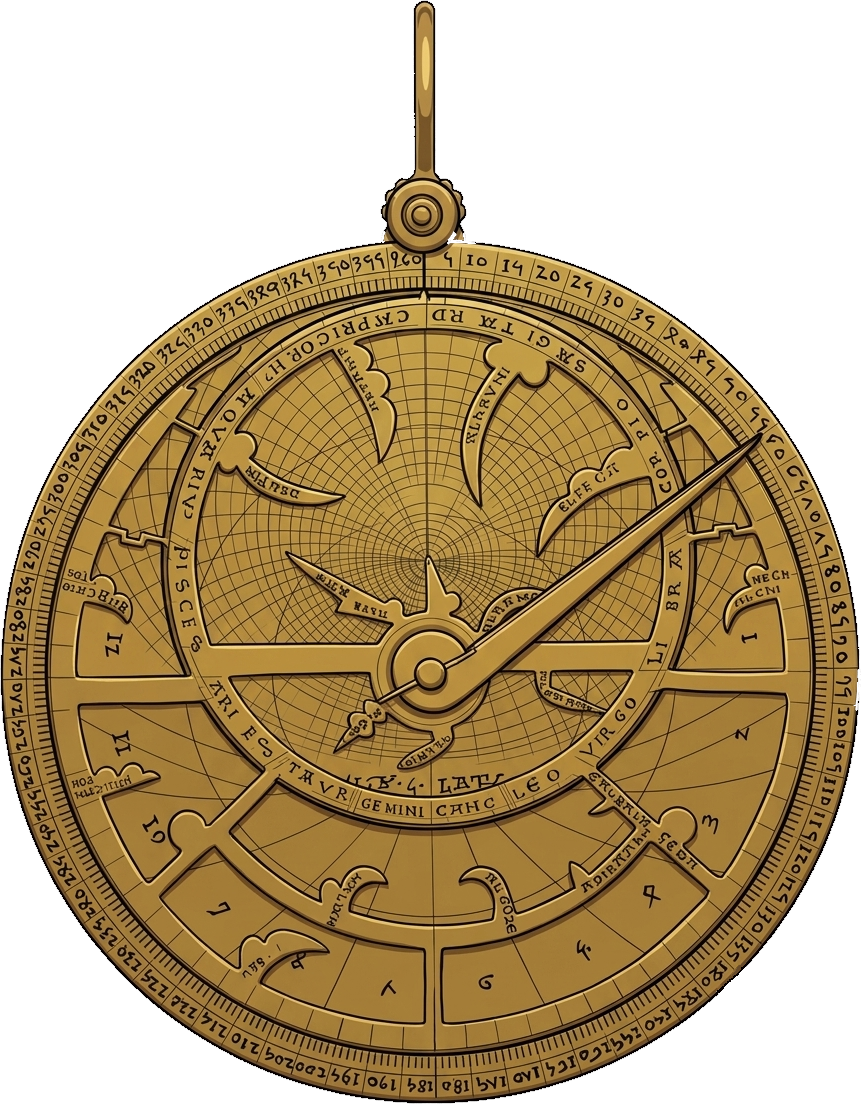
Astronomers used the astrolabe to map the heavens, but most people who bought them wanted something else entirely: answers about the future.
An astrologer could set the spider for the exact minute of a child’s birth, and the horoscope assembled itself while the parents waited. Calculations that once took a specialist ages to compute were delivered in minutes to anyone who could afford the brass. Centuries later, astronomers like Tycho Brahe and Johannes Kepler still drew their salaries as court astrologers, casting charts for rulers. This brilliant scientific instrument spread across three continents thanks to the one thing it couldn't actually do: predict the future.
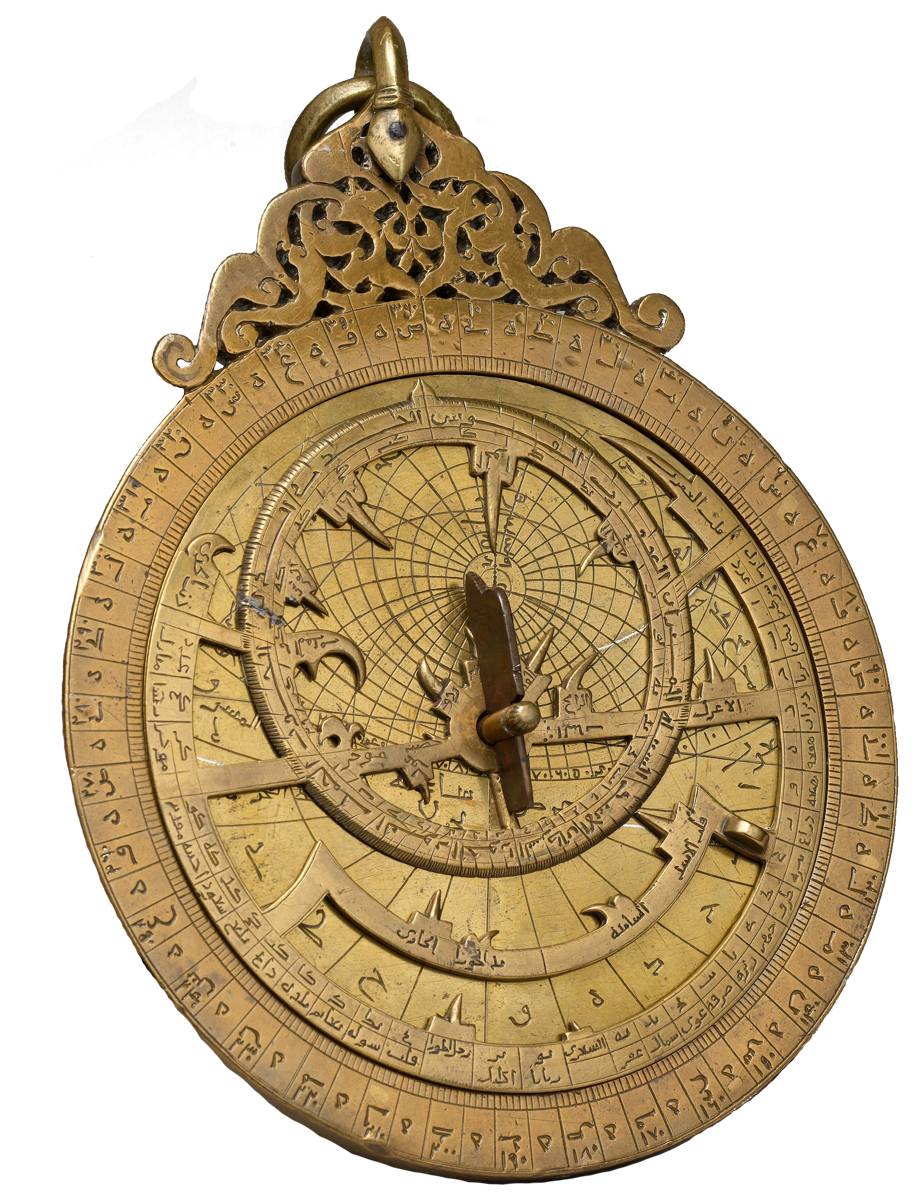
For the medieval Islamic world, watching the sun and stars wasn't optional.
It was how people knew when to pray. The five daily prayers were defined entirely by the sun’s position, and the astrolabe carried dedicated scales built to match exact religious rules. Artisans engraved two separate lines for the afternoon prayer because different Islamic traditions disagreed on how to measure shadow lengths. They marked twilight, most often taken as the sun eighteen degrees below the horizon, and listed the direction of Mecca city by city. By the second half of the thirteenth century, major mosques employed a professional timekeeper called a muwaqqit. He practised a named discipline, 'ilm al-miqat, the science of appointed times. The astrolabe did more than track the heavens for faith; it turned stargazing into a proper career that could support a household.
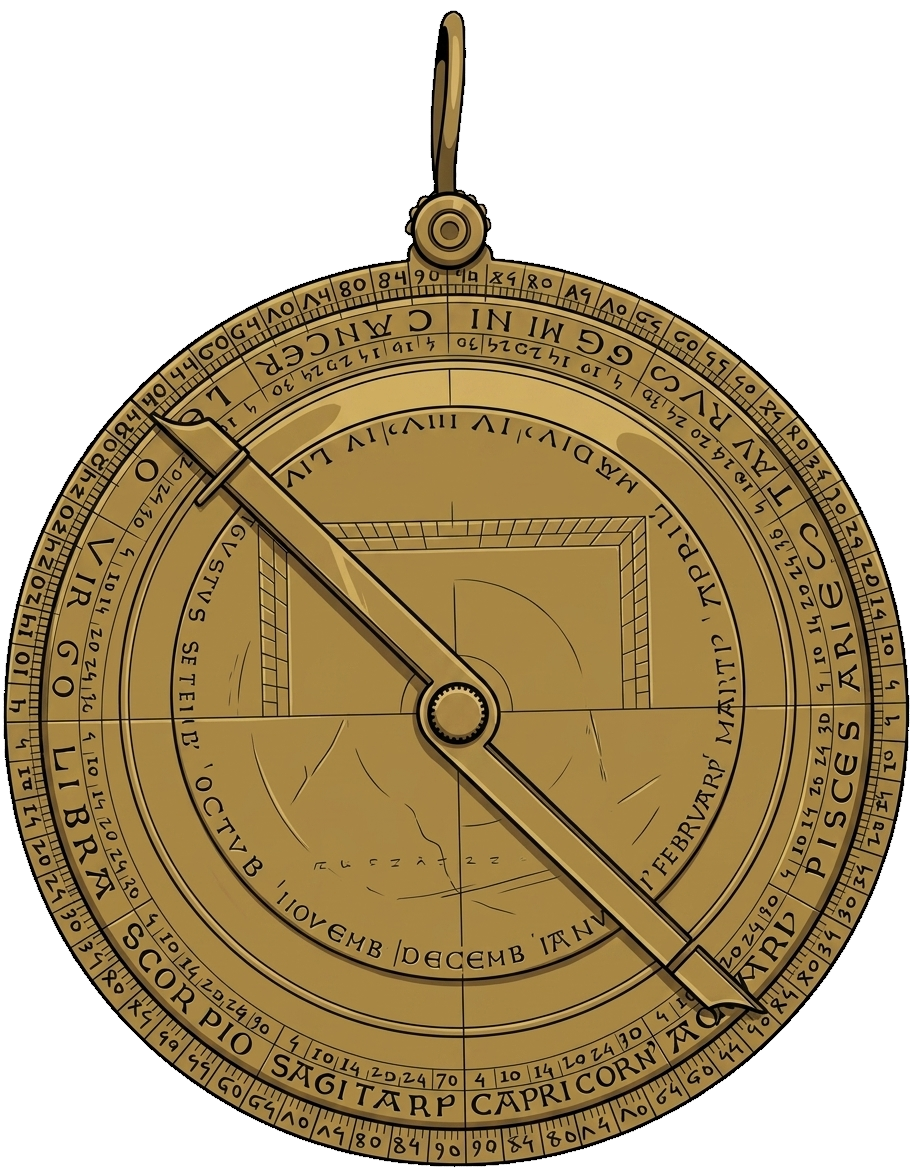
In European monasteries, keeping time was serious business.
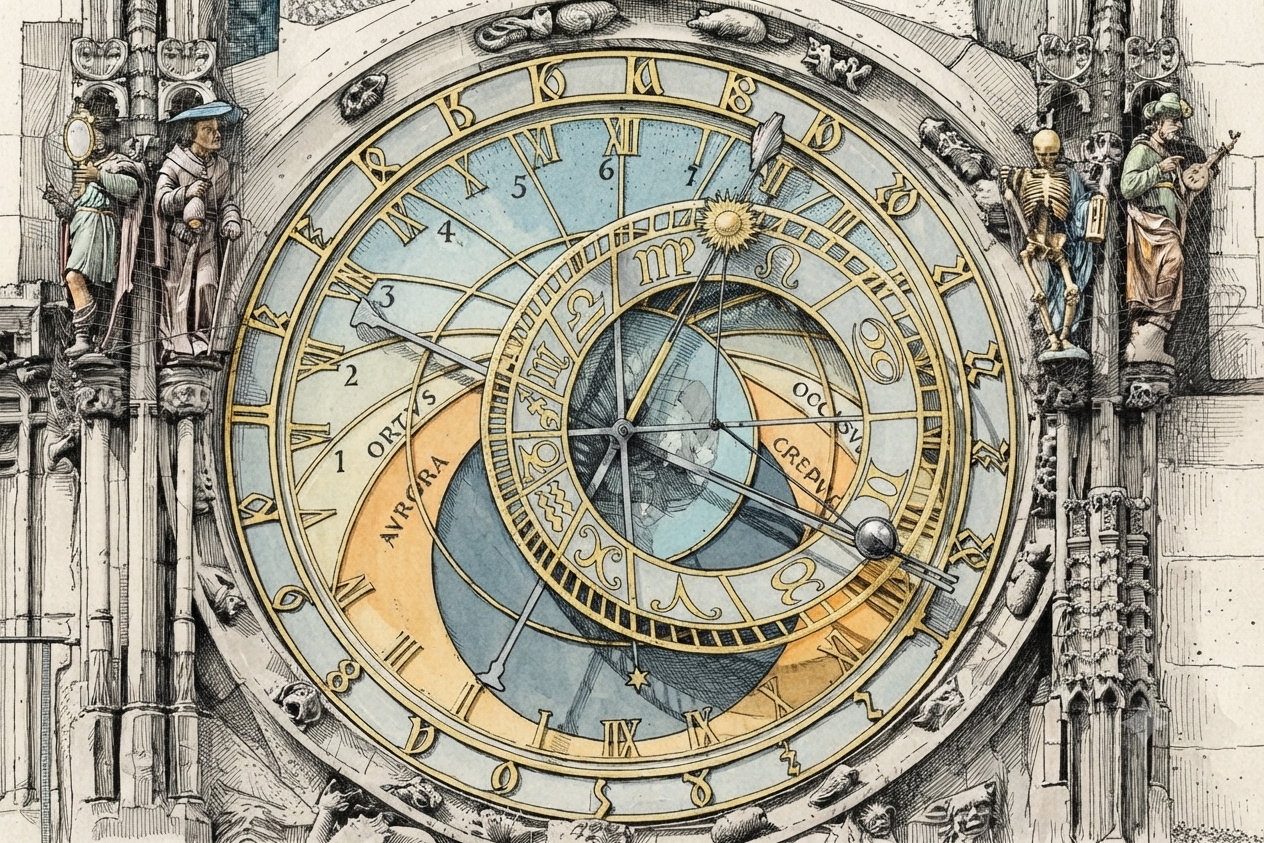
Monks had to wake up in the middle of the night to sing prayers at exact hours. On clear nights, they used an astrolabe to check the stars. But on cloudy nights, they had to rely on an erratic backup: a marked candle burning down ring by ring, forever threatened by stray gusts of wind. To solve the problem, inventors built a machine that wasn't affected by weather: the mechanical clock. The old star-maps weren't left behind though; instead, they translated the astrolabe's circles and dials into gears. That is why you can still see a working astrolabe face built right onto the front of the famous clock in Prague's town square today; an enduring link between the stars and the machine.
Part IV · Using without understanding
The familiar refrain about technology making us lazy has been around long before modern devices. In Baghdad, a mere century after the astrolabe arrived, an astronomer called al-Farghani saw people using it by rote, without understanding the geometry hidden in its rotating brass plates.
He tried to fix the issue by writing a book that explained the workings, but users didn't care. They just wanted the answers the instrument provided. That’s what makes a great tool: it wraps up complicated theory so you don't have to think about it. The consequence is that little by little, the underlying knowledge softly fades away.
At the time, the Pyrenees mountains marked a sharp frontier. On one side was Europe, where much ancient math had faded; on the other, the Islamic world, which had preserved and brilliantly expanded on it. Catalonia sat right in the middle, a Christian region that stayed in close touch with Muslim al-Andalus, with monasteries like Ripoll collecting Arabic texts as gateways for new ideas.
Around the year 1000, a scholar named Gerbert of Aurillac (who later became Pope Sylvester II) carried this star-knowledge across those mountains.
He saw the astrolabe's power for keeping religious hours, even if he believed ordinary folk didn't need such precision. However, once time could be measured so precisely, there was no going back. The stage was set for the mechanical clocks and the schedules that we now live by.
Part V · The chain of hands
No single person carried the astrolabe as it travelled across the three continents. Instead, it moved along trade routes like a relay, from workshop to workshop. Greek writers first mentioned it around the year 550, and by the mid-seventh century, Syriac texts showed it transformed into a finely crafted brass tool. By the eighth century, it had arrived in Baghdad, where al-Fazari became the first instrument maker whose name survived historically.
In Baghdad's workshops, makers added new direction lines called azimuth scales. That final addition completed the tool, which was now capable of pinning down a location, telling the time, and pointing the right way home.
From there, the journey branched outward. In India, a 1370 Sanskrit text celebrated it as "the king of instruments." It entered Europe through Ripoll, following that same mountain gateway to make its way north until it reached England by the late eleventh century.
For centuries, Europe’s standard textbook on the astrolabe was a translation of a manual written by ibn al-Saffar in 1026. Yet the copies circulated under the name of Masha'allah, an astrologer who had died two hundred years before the book was written. The text became a foundational cornerstone of European science, its instructions copied and trusted for generations. The historical mix-up was finally realised in 1981, when historian Paul Kunitzsch corrected the record about the ghost-writer's name.
Different makers shaped the tool to fit different worlds. In the sixteenth century, Georg Hartmann’s Nuremberg workshop began manufacturing standard parts so instruments could be turned out in series. In Lahore, two brothers built a device in 1612 that was eighteen inches across and weighed over eighteen pounds, tracking 38 stars and the locations of 94 cities with every line cut by hand down to a third of a degree; an instrument that sold at auction in April 2026 for 2.75 million dollars.
At sea, however, the delicate precision of the standard astrolabe was useless. Wind caught its wide face, and rolling waves made fine alignment impossible. Sailors needed something that could survive a gale. Instrument makers stripped away the star maps, leaving a heavy, open-spoke ring that let the wind pass right through.
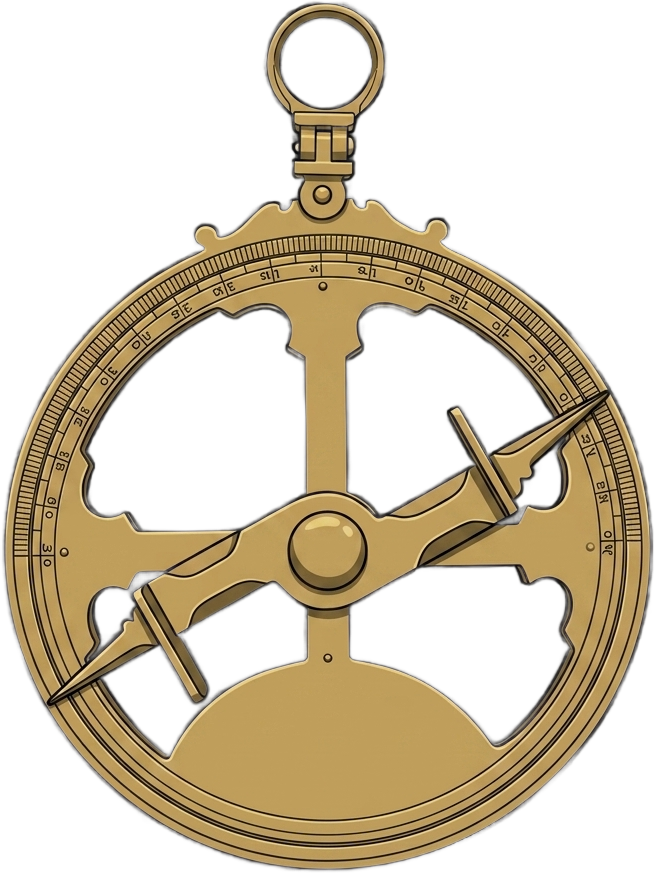
Instead of mapping the whole sky, this version focused entirely on measuring the sun's height to find latitude, helping ships navigate open water and pushing open the age of global exploration. Christopher Columbus carried one; so did Amerigo Vespucci.
Away from the workshops and ship decks, the instrument also entered domestic life. By the late fourteenth century, the astrolabe was famous enough that the English poet Geoffrey Chaucer decided to write an instruction manual. He didn't write it for a university professor or a royal court, but for his ten-year-old son, little Lewis, explaining how to use the brass disk in forty-eight simple lessons. A later scribe added the subtitle "Bread and Milk for Children." State-of-the-art science had turned into a tool a ten-year-old could learn how to use.
A machine could map the cosmos, but the knowledge to use it still required passing down the generations.
In 2023, a historian identified a rare eleventh-century astrolabe in a Verona museum that tells a story of endurance and versatility. Crafted in al-Andalus during the 1060s or 1070s, its plates were originally engraved in Arabic for the latitudes of Toledo and Córdoba. Later owners added Hebrew inscriptions in two distinct hands to translate the scales, alongside a signed dedication in Arabic script: For Isaac, the work of Jonah. Eventually, the tool made its way into Christian Europe. Scholars count four separate owners across three different faiths, who maintained, translated, and corrected it over generations.
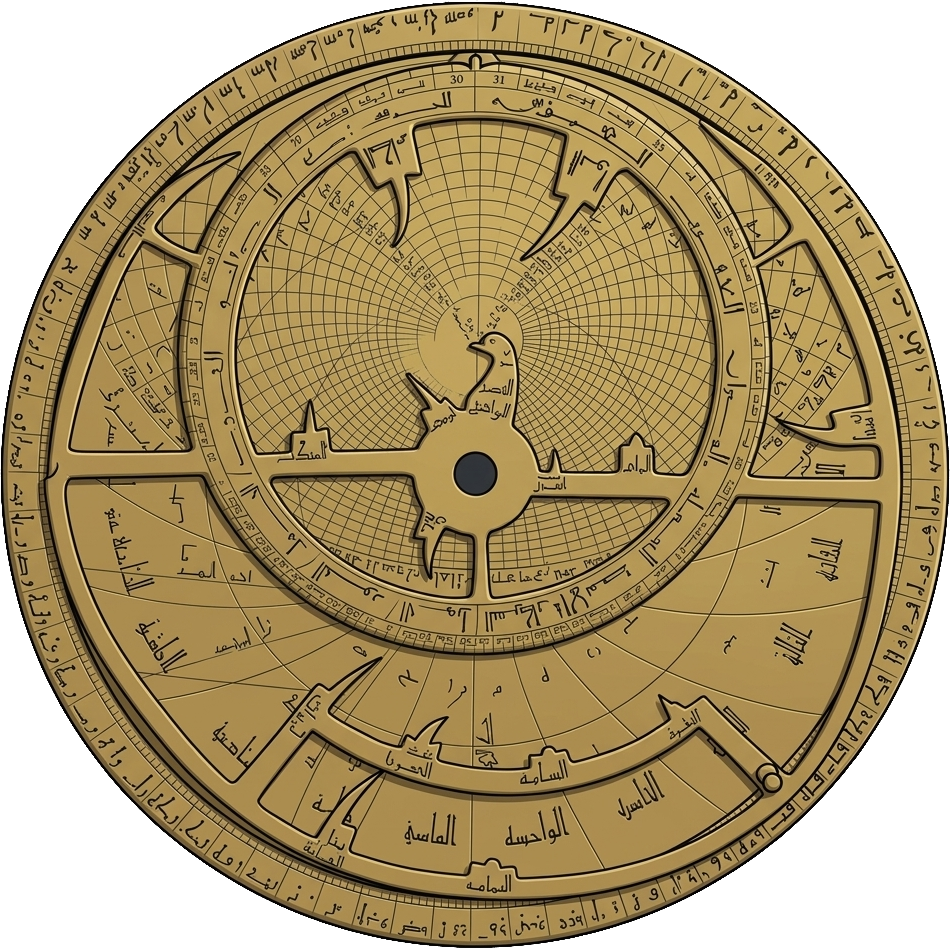
Because the Earth wobbles on its axis, the stars slowly shift positions over centuries, leaving modern skies misaligned with the original star pointers. By matching the metal map to the movement of the heavens, historians traced the spider back to the eleventh century. Although it lacks a standard maker's mark, the instrument instead preserves the personal names of its creator and original client.
That kind of active survival is the exception rather than the rule. Among the roughly 900 historic astrolabes cataloged by David King, the vast majority show no signs of use. A presentation piece given to Mahmud Agha in 1698 remains completely pristine. The instruments used by sailors and scholars wore down, broke, or vanished long ago. The astrolabes filling museum cabinets today are largely the ones that were always display items.
For all its ingenuity, the brass disc left a crucial question unanswered. It could tell you where you were north or south by measuring the height of a known star above the horizon, but east and west remained out of reach. To find longitude, a traveller needed to know both local time and home-port time at the exact same split second. The astrolabe was great at reading the sky directly overhead but it could not see another place’s present.
Eventually, the instrument just ran out of work. The invention of the telescope replaced naked-eye alignment. In the 1650s, pendulums gave mechanical clocks a steadiness that no longer required daily calibration against the stars. As astronomy diverged from astrology, the mass market for astrolabes collapsed. By 1700, European production had virtually ceased, though Islamic metalworkers kept building them into the 1800s to track the daily times for prayer. A tool lives only as long as it has work to do.
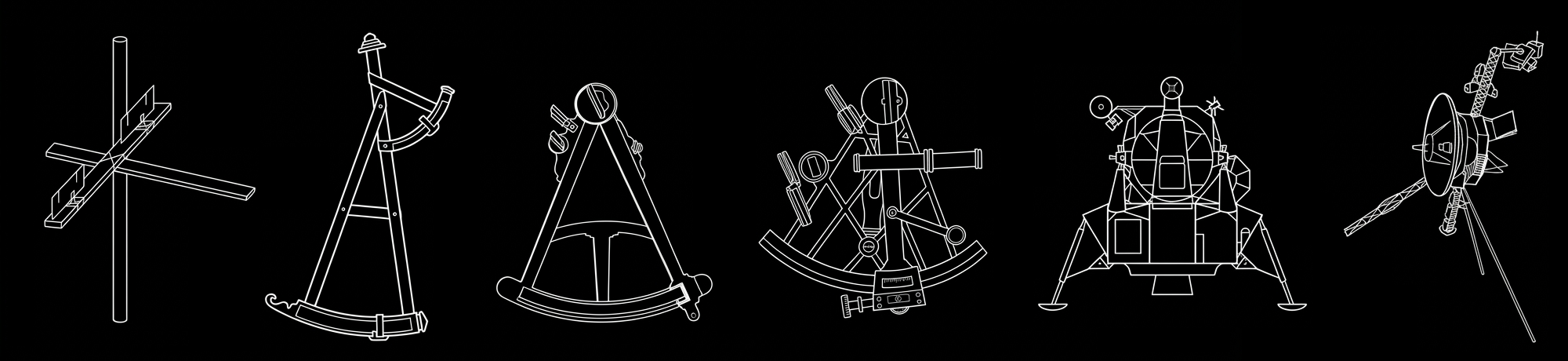
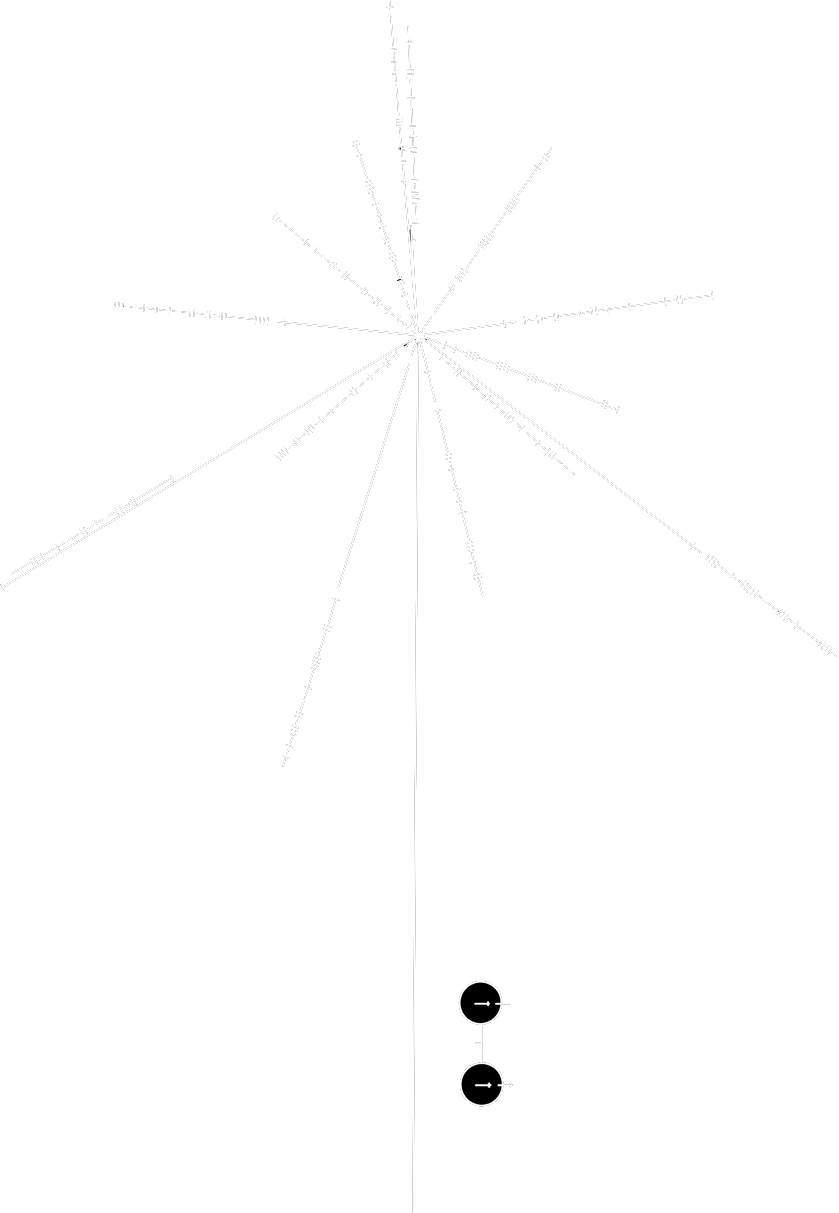
Even after the astrolabe retired, the way people navigated stayed the same. For centuries, every new tool required the exact same discipline: hold up the device, line up the star, and read the angle. Sailors used the cross-staff, the backstaff, the octant, and the sextant. Apollo astronauts carried sextants to the Moon, feeding the angles into their onboard computers. Even Voyager, the most distant human-made object, carries a map of the stars engraved on the cover of its Golden Record directing back to whence it came.
Modern navigation no longer relies on eyes searching for stars in constellations, but instead on pocket devices talking to constellations of satellites overhead. In trading the stars for satellites, the oldest habit in human travel, looking to the night sky to find our place, finally came to an end.