
The Number
Tracking the loop: how a Bronze Age counting tool left the mud to become humanity's most enduring routine
Look down at your wrist, or perhaps at the clock on the wall across the room. If it's an analog clock, you are looking at a very old piece of technology. The second hand takes exactly sixty beats to complete its cycle around the dial. Sixty seconds make up a minute; sixty minutes an hour. The hand reaches the top, resets, and then starts the circle again. The rhythm is so familiar that we rarely stop to notice it.
Ours is a decimal civilisation. Money, measurements, and arithmetic all prioritise the number ten. We count on our fingers, measure weight in kilograms, and calculate distance in kilometres. It's a neat, sensible way to manage reality. But the moment we look at a compass or a globe, that system disappears. A full turn is measured as three hundred and sixty degrees, which is just sixty multiplied by six. Time and direction refuse to bend to ten.
Why choose a number that feels so completely out of place in our decimal lives, rather than a hundred?
The most obvious answer is that sixty is highly practical. It splits cleanly into halves, thirds, quarters, fifths, and sixths. A hundred cannot match that versatility. Imagine an alternative hour made of a hundred minutes. Dividing it into three equal parts leaves you instantly stuck with thirty-three and a third. Sixty avoids these messy fractions, which is why the clock face and the compass carve up so neatly.
Yet convenience in hindsight is not the same as a reason for invention. Divisibility explains why the system still works today, but it does not explain why anyone first reached for it. Plenty of other numbers divide well (such as twelve), so numbers that split cleanly are not rare. What is rare is sixty itself. No other civilisation in human history ever built a true system around it. While other cultures looked at their own bodies and counted in tens or twenties for their fingers and toes, one ancient culture alone reached for sixty.
So the real question survives the obvious answer. It is not whether sixty is a useful number; it plainly is. The true riddle is why the Babylonians, why then, and why never again.
And that, we don't actually know.
Look down at your wrist, or perhaps at the clock on the wall across the room. If it's an analog clock, you are looking at a very old piece of technology. The second hand takes exactly sixty beats to complete its cycle around the dial. Sixty seconds make up a minute; sixty minutes an hour. The hand reaches the top, resets, and then starts the circle again. The rhythm is so familiar that we rarely stop to notice it.
Ours is a decimal civilisation. Money, measurements, and arithmetic all prioritise the number ten. We count on our fingers, measure weight in kilograms, and calculate distance in kilometres. It's a neat, sensible way to manage reality. But the moment we look at a compass or a globe, that system disappears. A full turn is measured as three hundred and sixty degrees, which is just sixty multiplied by six. Time and direction refuse to bend to ten.
Why sixty? Why choose a number that feels so completely out of place in our decimal lives, rather than a hundred?
The most obvious answer is that sixty is highly practical. It splits cleanly into halves, thirds, quarters, fifths, and sixths. A hundred cannot match that versatility. Imagine an alternative hour made of a hundred minutes. Dividing it into three equal parts leaves you instantly stuck with thirty-three and a third. Sixty avoids these messy fractions, which is why the clock face and the compass carve up so neatly.
Yet convenience in hindsight is not the same as a reason for invention. Divisibility explains why the system still works today, but it does not explain why anyone first reached for it. Plenty of other numbers divide well (such as twelve), so numbers that split cleanly are not rare. What is rare is sixty itself. No other civilisation in human history ever built a true system around it. While other cultures looked at their own bodies and counted in tens or twenties for their fingers and toes, one ancient culture alone reached for sixty.
So the real question survives the obvious answer. It is not whether sixty is a useful number; it plainly is. The true riddle is why the Babylonians, why then, and why never again.
And that, we don't actually know.
The puzzle of the number we carry can distract us from a more peculiar question: what a number actually is.
Look at the clock again: the second hand ticking around the dial does not count sixty independent objects. You might say it's counting seconds, but a second has no shape or body of its own: it only exists because the number system created it.
In The Word, we watched this transformation begin. Long ago, numbers were bound to the physical world. A mark was always a tally of something real: jars of oil, sacks of grain, sheep in a flock. But over time, the objects dropped away while the marks remained. The numeral came loose from the jar, leaving behind a symbol that simply meant the number itself.
Once a number is no longer tied to a physical object, it becomes a thing in its own right: an idea you can hold, move, and work with, independent of the world it came from. Because numbers broke free from solid things, they could go on to measure realities that have no shape we can hold: duration, direction, and eventually even the future itself.
The sixty ticking on our wrists is the proof. Every time we check the time, we trust this five-thousand-year-old abstraction without a single thought, relying on a count that points to nothing to ensure we're not late. To see where this concept was born, we have to travel back to the moment numbers first came loose from their objects.
It begins with a small patch of grey mud. In the city of Uruk, around five thousand years ago, a scribe sits over a lump of wet river clay. He's not looking at the stars, and doesn't own a clock. He is simply managing an inventory. Near him sit piles of grain sacks or rows of oil jars: the physical wealth of a growing city.
The scribe holds a stylus carved from a sturdy reed. With a firm, practised motion, he presses the corner of the reed into the damp clay, leaving a sharp, wedge-shaped groove. Another press leaves a small circle. The clay is heavy, cool, and smells of the river. It has a substantial physical weight. But the marks he's making are weightless.
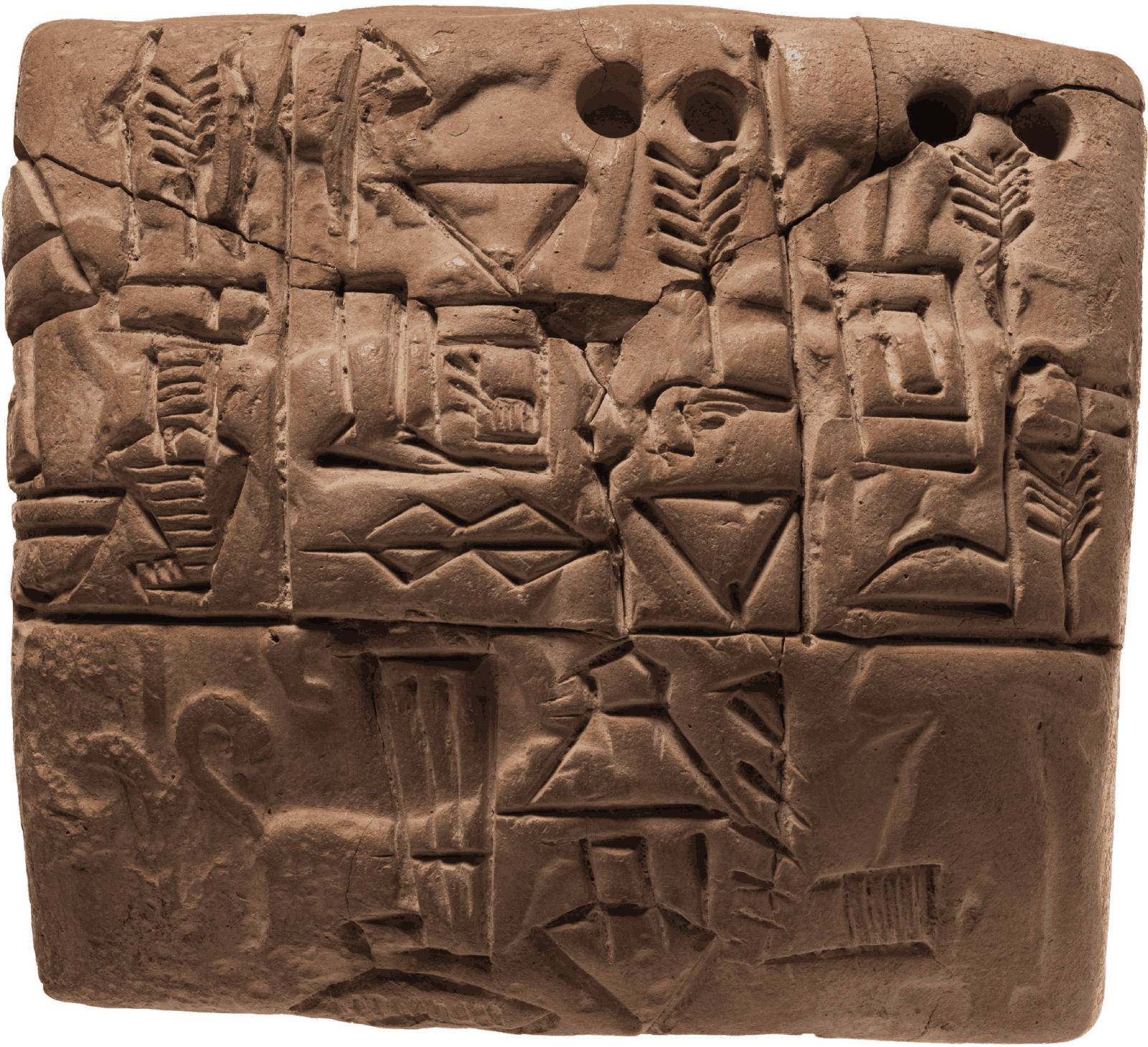
He is counting in sixties the way we count in tens. A single small wedge represents one. Ten of those wedges become a small circle. Then, six of those circles combine to become something new: a large wedge, which stands for sixty. The baskets and jars will eventually be emptied, sold, or broken, but the patterns on the clay will remain frozen in place. He has built a system where the count resets at sixty, climbing to the next level.
We don't know why sixty was chosen, but we can make an educated guess. It requires no instruments or astronomy, only a look at our own hands.
Look at your left hand, palm facing you. If you use your thumb as a pointer, you can count the segments of your other four fingers. Each finger is divided into three distinct sections. If you run your thumb down them, you get one, two, three on the index finger, then four, five, six on the next. By the time you reach the tip of your little finger, you have counted to twelve.
If you raise one finger on your right hand to remember that twelve, and then count through the segments of your left hand a second time, you keep ascending. If you repeat the cycle until all five fingers of your right hand are raised, you eventually land on sixty.
There is no definitive proof that this is how the system began. The material evidence is thin, leaving it as a beautiful theory rather than a proven fact. But it presents an intriguing possibility: the number that shapes our global maps and regulates our days might simply be an accident of human anatomy. The ticking of the wristwatch might have drawn its rhythm from the segments of the fingers just beneath it.
Two thousand years is a difficult span of time to imagine. It is roughly the same amount of time that separates our modern world from the days of Jesus and Julius Caesar. For all those centuries, the number system remained entirely ordinary. It lived on the ground, inside mud-brick storehouses, running the mundane bureaucracy of taxation and trade. It tracked wheat, barley, and beer. The scribes had built the machinery of sixty, but it would sit on these clay shelves before it ever climbed into the sky.
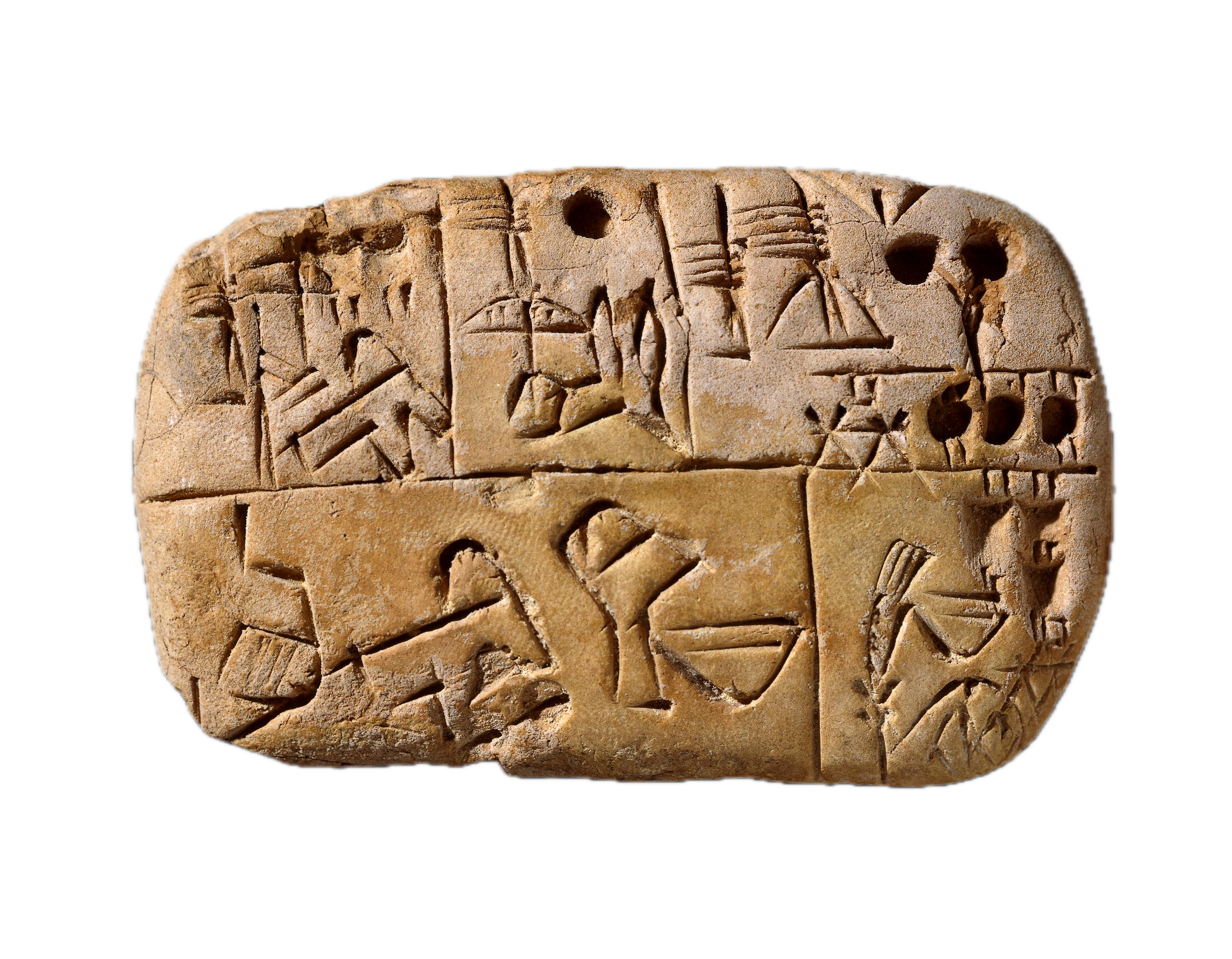
The things we associate with sixty today, the three-hundred-and-sixty-degree circle or the sixty-minute hour, did not exist yet. Both came much later, during the Greek and Hellenistic period. Historians who study this period point out a pointed truth: when it was created, this system had nothing to do with astronomy.
It is as if human beings had discovered electricity, but for two thousand years used it only to power a single doorbell in a small office, never once thinking to build a lightbulb.
Yet this long delay was not a dead void. It was a period of slow, deep hardening. The sixty-count dug its heels so far into the administrative machinery of the ancient world that it became impossible to scrape out. It was the language of law, commerce, and daily calculation. Generation after generation of scribes trained their hands to write it and their minds to think in it.
By the time the sky-watchers finally needed a precise mathematical language to record the movements of the heavens, base-60 was the only engine large enough and established enough to do the job. It was not chosen because it suited the stars. It was chosen because it was already there.
When those astronomers finally turned this old warehouse tool toward the night sky, they discovered that a single number could bind completely different aspects of reality together.
Whether looking at a clock face, a compass dial, or the sweeping arc the sun travels across the sky, the exact same shape appears. Time, space, and the sky all resolve into a circle. A clock and an orbit are fundamentally the same thing: a pattern that repeats.
This was not a late coincidence or a shortcut invented by modern scientists. Centuries before the rise of Greece, ancient Babylonian clay tablets known as the MUL.APIN show that this identity was already built deep into their system. The Babylonians split the day into twelve double-hours, known as bēru. They divided each of these bēru into thirty parts, and each of those parts into sixty. They used the exact same units to measure how long a star took to cross the night sky and how far that star had travelled along its arc across the dome of the sky.
Space and time were mapped using the exact same grid. Once this blueprint was locked into place, it became the foundation for every timing instrument that followed, each one a more precise way of counting the same repeating cycle.
Tying the messy reality of the universe to a neat mathematical system like sixty does require some strange compromises. The natural world is notoriously untidy. The Earth takes roughly three hundred and sixty-five and a quarter days to circle the sun, and the moon takes a distinctly uneven twenty-nine and a half days to circle the Earth. They do not play nicely.
This created a major headache for ancient accountants trying to calculate wages, rations, and taxes. To solve it, the ancient world ran two different calendars at the same time.
One was the real calendar, based on looking out the window and observing the crescent moon in the night sky. This version was bumpy and unpredictable, requiring priests to manually insert an extra thirteenth month every few years to keep the seasons from drifting.
The second calendar was a deliberate fiction. In this administrative system, the year was locked at exactly twelve months with thirty days each. Twelve multiplied by thirty is... three hundred and sixty.
They kept a false map of the year alongside the real one purely because the arithmetic was easier. It was simpler to run an empire on a neat, fictional cycle of three hundred and sixty days than to wrestle with uneven reality. The three hundred and sixty days of their calendar and the three hundred and sixty degrees we use to measure a circle today share the exact same root. They are parallel ways of taking a repeating cycle and forcing it into the clean, manageable maths of sixty. They shaped their maps and schedules to match the beauty of the number system, rather than the messy truth.
For decades, historians were baffled by four ancient Babylonian clay tablets. The texts didn't contain simple lists of goods; instead, they outlined a geometric recipe for drawing a four-sided shape called a trapezoid. Because trapezoids were normally used to measure flat plots of farmland along the Euphrates River, scholars assumed these were land-surveying records. But there were no farms attached, and the dimensions shifted in ways that made no sense for a physical field.
Then, in 2015, a researcher named Mathieu Ossendrijver was looking through photographs of unstudied tablets from the British Museum when he spotted a fifth fragment. This new piece didn't mention geometry at all. It simply listed a long string of ordinary calculations done the plain, arithmetic way. But right next to those numbers, it explicitly named its subject: the planet Jupiter.
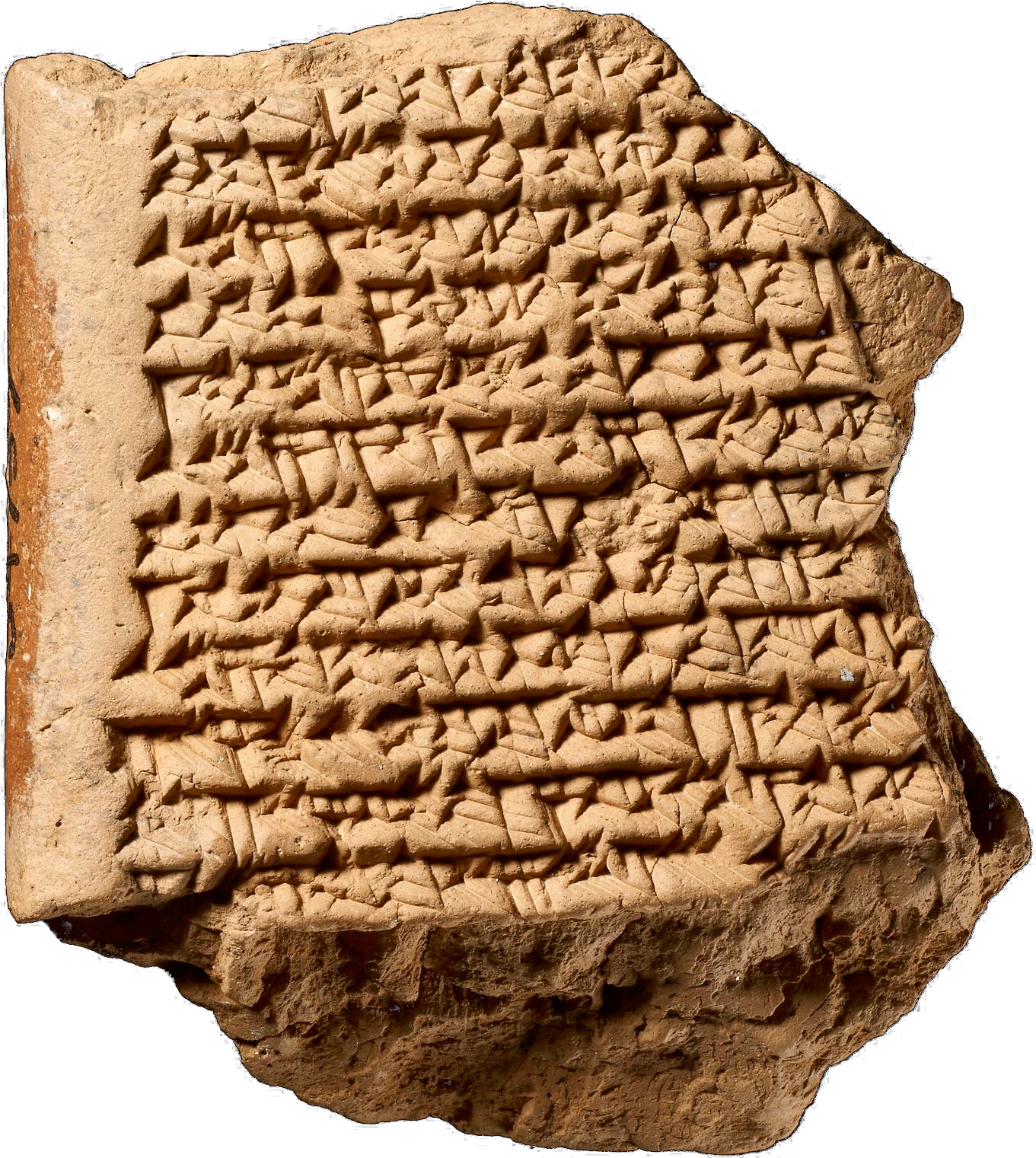
When Ossendrijver compared the figures, the pieces clicked. The numbers on this humble arithmetic tablet perfectly matched the results of the strange geometric formulas on the other four. The fifth tablet was the key that unlocked the mystery.
It was the counterpoint to the moment five thousand years earlier when the first scribe pressed a reed into wet clay to record sacks of grain. That scribe was freezing a physical fact so it wouldn't be forgotten. The marks on these new tablets weren't looking backward at what had already been gathered. They were looking forward.
With the planet finally identified, the true meaning of those four geometric tablets came to light. The instructions told the reader to track Jupiter from the moment it first climbs above the horizon in the pre-dawn sky. At first, the planet moves at a specific speed relative to the background stars. But night after night, it begins to flag. It loses momentum, and its speed steadily drops. This is caused by the complex combination of Earth's own orbital movement with that of Jupiter.
To calculate exactly how far the planet would travel across the sky during its first sixty days of visibility, the Babylonian astronomer didn't just look at the horizon. He built a shape. The baseline along the bottom of this shape is not a physical measurement of distance; it represents a span of time, exactly sixty days. The vertical walls do not measure physical height; they represent speed, how many degrees the planet shifts per day. The left wall is tall, representing the planet's high starting speed. The right wall is shorter, representing its slower speed sixty days later. A sloping line connects the tops of the two walls, completing the shape.
The moment you make time one of the sides of a shape, the geometry ceases to be a drawing of a static object. It becomes a map of change itself. By calculating the total area enclosed within those four lines, the Babylonian astronomer was multiplying speed by time. The resulting number gave them the total distance Jupiter would travel before those sixty days had even passed.
They even used this shape to predict when the planet would reach the exact halfway point of its journey. Because Jupiter moves faster during the first few weeks, the line dividing the trapezoid into two equal-area halves had to be drawn well before day thirty. The maths caught the precise nuance of a changing speed.
In modern mathematics, finding the area under a changing curve to measure total distance is called an integral, one of the core pillars of calculus. Historians long believed this conceptual leap was made for the first time in fourteenth-century Europe by a group of scholars known as the Oxford Calculators. Yet here it was, happily operating more than fourteen hundred years earlier.
This was not the full invention of calculus. The Babylonians lacked the universal algebraic equations that would later allow scientists to map any celestial object. But it was the moment a number completely broke out of its original cage. It was no longer a passive counting of sheep or tracking of grain after the harvest. It had become an engine capable of describing motion, tracking change, and telling the future before it occurred.
This mathematical breakthrough was not born out of pure scientific curiosity. It was driven by a deep sense of religious duty.

To the Babylonians, Jupiter was Marduk, the patron god of Babylon, the lord of the gods. The movements of the planets were the literal handwriting of the divine, tracing out warnings, promises, and shifts in the fate of the empire. If a priest lost track of Marduk in the glare of the sun, or failed to predict where he would appear next, the empire was functionally blind to the will of the heavens. The scribes sitting in the dark temple towers calculated the area of those trapezoids with meticulous earnestness because they were tracking a god. Precision was a matter of national survival.
Yet, for all its sophistication, this method of charting motion appears to have been a dead-end trail. When the temples finally crumbled and the cuneiform writing system died out around 100 CE, this geometric technique vanished with it. Whether a thin thread of it survived into any later tradition remains an open, unverified speculation among historians. As far as the written record shows, the map of motion disappeared entirely from human consciousness, waiting well over a millennium to be independently discovered all over again.
While the technique itself was lost, the raw infrastructure of sixty lived on. The base-60 system on our clocks and the modern digits we use to write it down travelled entirely different paths to reach us. While the Babylonians were among the first to use a positional layout for maths, other cultures in China and Central America independently hit upon the same principle centuries later. It was scholars in India who finished the thought, treating the empty void, zero, as a number in its own right.
How the sixty-count jumped from the clay tablets of Babylon into the minds of the ancient Greek astronomers remains a ghost story. The historian of science, Otto Neugebauer, summarised the problem flatly: the transmission "cannot be answered from our sources." We have unearthed over half a million cuneiform objects, yet not a single scrap of Greek text survives that explains how scholars read them.
The traditional guess was a Babylonian priest named Berossos who settled on a Greek island around 270 BCE, but his surviving fragments show he knew plenty about local myths and nothing about mathematical astronomy.
And yet, the handoff happened somehow. The mathematical constants used by later cultures match the Babylonian records down to the last digit. The fingerprints are everywhere, but the body is missing. This passing of data left no physical trail, leaving its origin as an echoing void.
Once this number system took hold of our schedules, it proved immovable, even when pitted against a revolution.
In the autumn of 1793, the leaders of the French Revolution set out to redesign reality. They successfully decimalised French money, weights, and measures, turning everything into units of ten. Then they took on the twin strongholds of sixty: the circle and the clock.
The revolutionaries decreed that a day would have ten hours, with each hour divided into one hundred minutes, and each minute into one hundred seconds. They even divided the circle into four hundred parts instead of three hundred and sixty. Clockmakers built strange, hybrid timepieces with dual dials just to help citizens convert the time.
The experiment lasted about five hundred days before it collapsed. The public found the decimal day unworkable, and the metric system only survived because the law that repealed decimal time preserved the rest of France's new measurements.
As the engineer Bouquet de la Grye later pointed out, the metric system succeeded because it replaced a chaotic mess of regional weights, but decimal time failed because the world already used the exact same system. Sixty won because it was already established.
Even the modern International System of Units, the metric standard of modern science, kept the ancient second as its core unit of time. It turned out that while separating a monarch from his head was relatively straightforward, separating the public from a Bronze Age second was completely impossible.
Which brings us back to the steady, rhythmic sweep of the second hand on our wrist. Every instrument that humans have built to navigate the world, the brass rings of the medieval astrolabe, the sea-tested marine chronometers of John Harrison, and the flight computers that guided astronauts to the moon, has kept time by slicing up a repeating loop using this same ancient number. It is the oldest abstraction still in continuous human use.
We still do not know why those early people settled on sixty. It remains part of a long series of human origins that turn out to be voids, with only a few clues left at the edge.
Maybe it all started with a thumb counting twelve finger joints. Maybe it started somewhere else entirely. History is notoriously reluctant to leave receipts. But every time you glance at your watch to discover that you are, once again, late for something entirely of your own making, you are quietly consulting a mathematical system devised in ancient Iraq several thousand years before the invention of the train.