House of Wisdom
How a captured student, a borrowed zero and one desk in Baghdad built the algorithm.
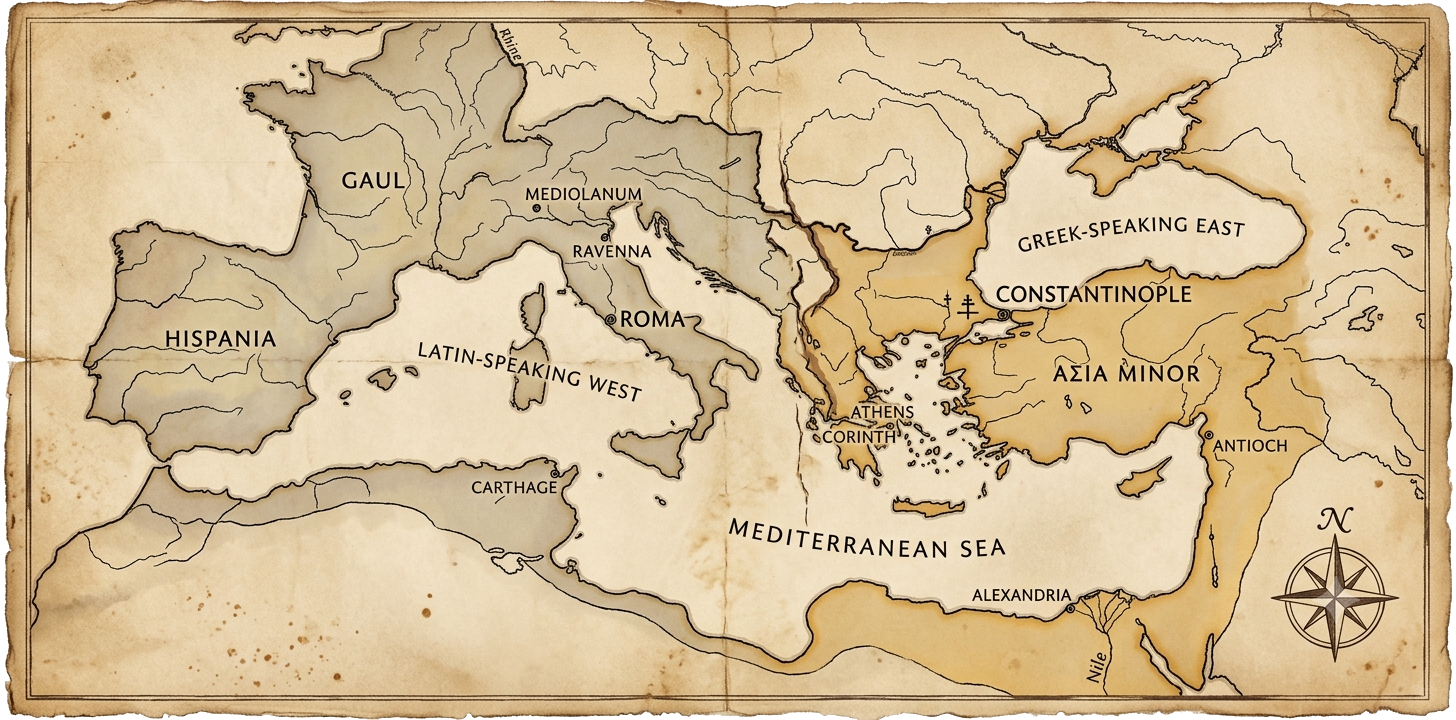
Around the end of the 4th century, the Roman Empire had grown to an unmanageable size and was split into Eastern and Western halves.
This had the unintended consequence of dividing the accumulated ancient knowledge down a linguistic fault line. The Greek-speaking East could continue to read the advanced geometry, astronomy, and mathematics inherited from the ancient world, while the Latin-speaking West slowly lost the connection to these texts. The Western infrastructure became fractured as it dealt with attacks, and its ability to perform technical calculations suffered. Meanwhile, the Eastern capital of Constantinople preserved the knowledge in its libraries, treated as an archive, protected but stagnant and underused.
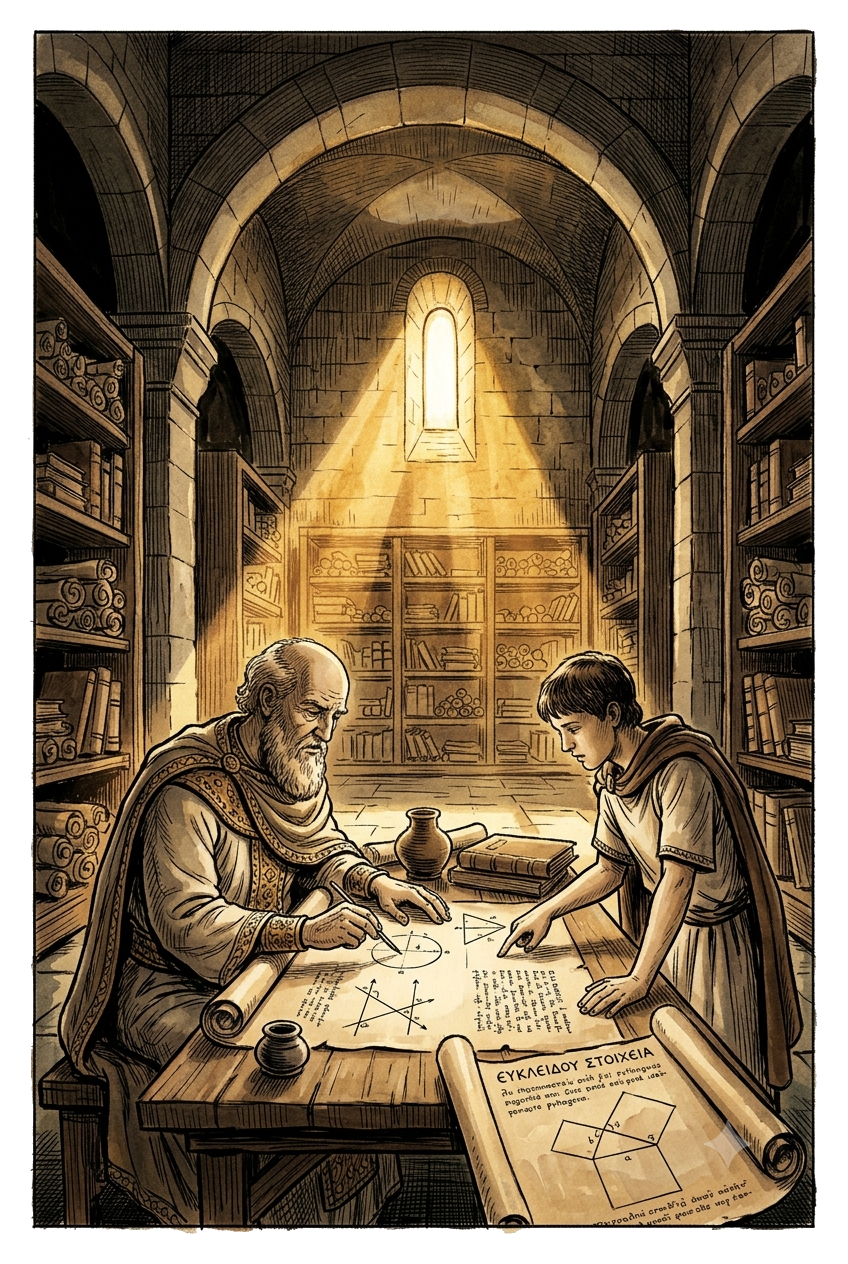
An ancient scroll lies unrolled in the gloom, its stiff edges curling, as two figures trace the geometry of Euclid by the light of oil lamps. Leo the Mathematician is passing down a discipline worked out in Alexandria a thousand years previously.
He has spent a lifetime in forgotten library vaults, gathering fragments of old wisdom for a small circle of private students; he is unknown and of no interest to the glittering court at Constantinople.
Then a border war breaks the quiet apart. One of his students is captured on the frontier, marched east, and sold into slavery in Baghdad.
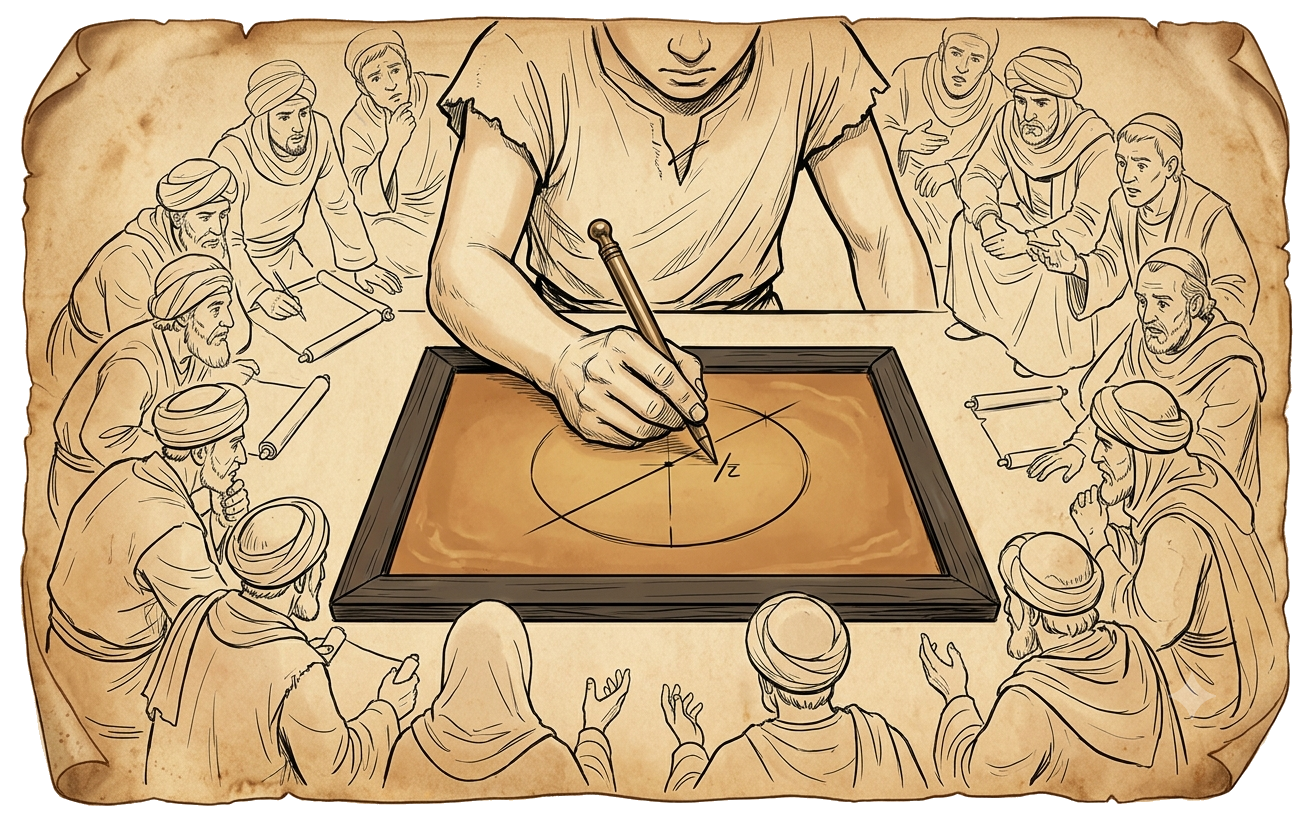
Inside the Caliph's palace, the boy understands he must make the most of his knowledge. He is patient, waiting for his moment. Overhearing the court's mathematicians locked in a heated argument, he can tell they are stuck, and he can see why. Seizing his chance, he steps forward, takes up a bronze stylus, and on a wax tablet draws the figure Leo had drilled into him: a circle, with a bisecting line and a ratio that holds.
The room goes quiet.
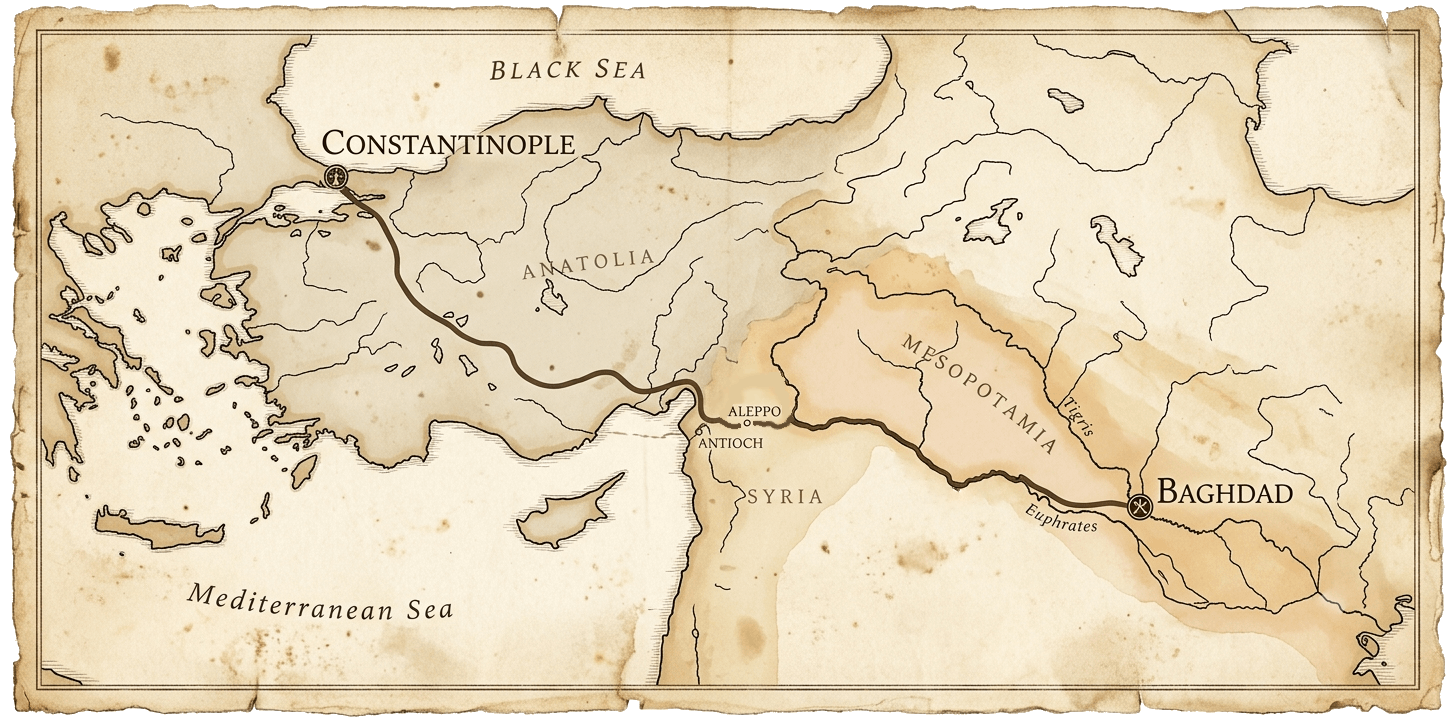
Astonished and half in disbelief, the scholars begin to test him. They set their hardest problems and he answers them, one after another. They demand to know how a slave could hold such knowledge, and the boy tells them of his teacher, Leo the Mathematician. Within days, the chroniclers say, the Caliph's emissaries are riding for Constantinople, carrying an extraordinary offer: two thousand pounds of gold and a lasting peace, in exchange for the loan of one obscure tutor.
When the offer reaches Emperor Theophilos, it opens his eyes and spurs him into action.
The man Baghdad wants so badly has been teaching in his own city, unnoticed and unpaid. He moves quickly, installing Leo in a public position with the wealth of the empire behind him. Leo turns it to the work of his life, assembling, copying, and preserving the oldest manuscripts in Constantinople before time can take them.
The spark of competition was enough to wake an empire to the treasure sitting in its own libraries, and scrolls that had been disintegrating in the dark were rescued. If the Romans did not quite appreciate what they had, the expanding empire to their east certainly did.
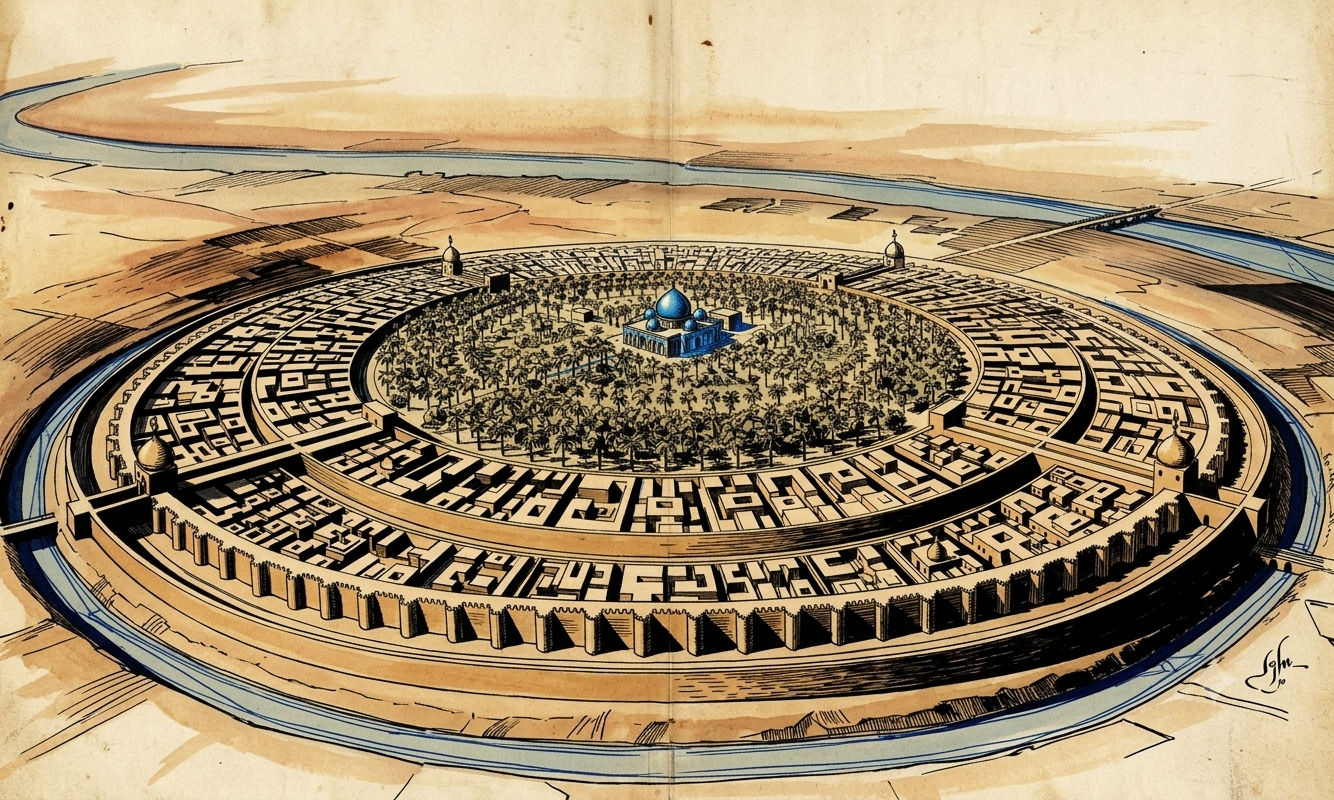
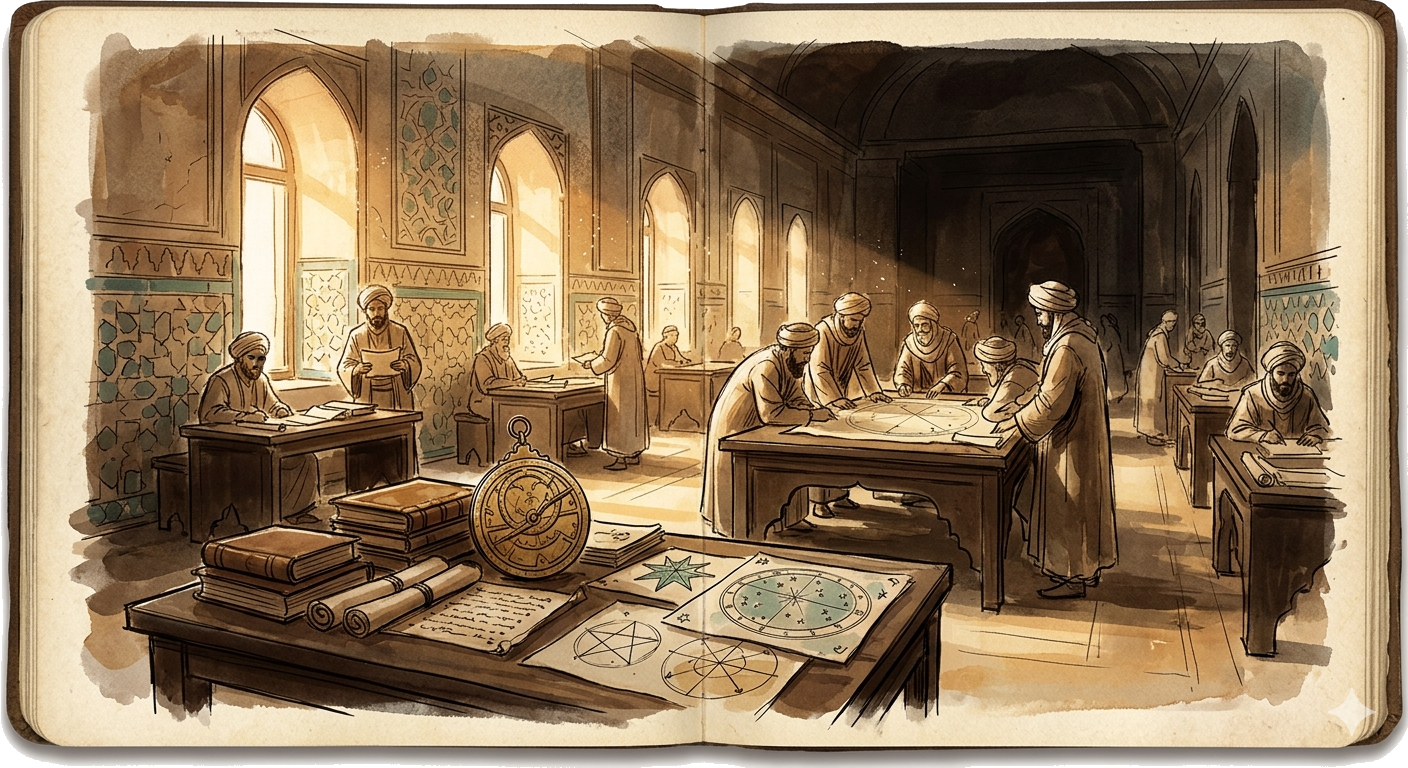
Baghdad under Caliph al-Ma'mun had become a centre of philosophy, learning, and debate, attracting the world's brightest minds. While modern historians still debate the exact nature of the institution known as the House of Wisdom, the massive effort to gather and protect the world's books was undeniably real. Whether by sending elite teams of book-hunters to trade lavish royal gifts, or forcing enemies to pay their war debts in ancient texts, al-Ma'mun used both diplomatic and military power to secure the world's ancient knowledge, translating it into a single language: Arabic.
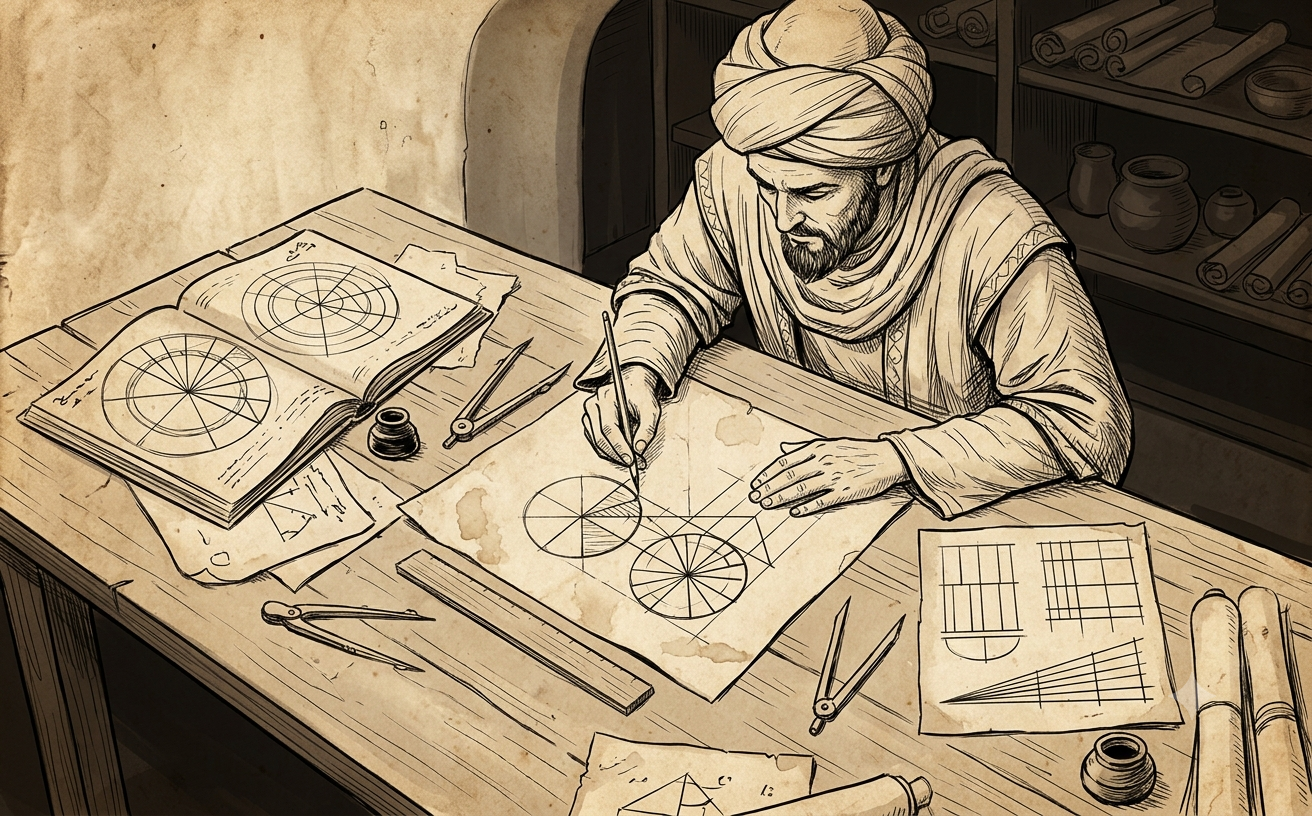
At the centre of this movement was a brilliant Persian scholar in al-Ma'mun's circle named Al-Khwarizmi.
Tasked with building practical manuals to solve everyday problems like fairly dividing a family's inheritance or accurately measuring farmland, Al-Khwarizmi sat at a desk where two entirely different streams of ancient mathematical theory converged.
The first stream was Indian. In 825 CE, he published a work based on the writings of an Indian mathematician named Brahmagupta, who had defined zero as a genuine number by showing that 1 minus 1 equals 0. The concept of zero feels natural to us today, but it has only been considered a true number for about 1,400 years. The second stream was Babylonian. In his star tables, Al-Khwarizmi took the Indian decimal math and arranged it inside traditional Babylonian base-60 charts, the grid of circles and degrees used by ancient navigators.
By fusing these two systems, he created a combined toolkit that unlocked the power of modern positional arithmetic.
The power of this arithmetic is that fixed columns split a massive problem into a series of identical tasks. Zero is vital because it holds the empty places open, keeping every other digit locked in its proper position. Without zero to lock the columns open, a number like 402 collapses into 42, stripping the 4 of its hundreds value simply because it shifted one space to the right.
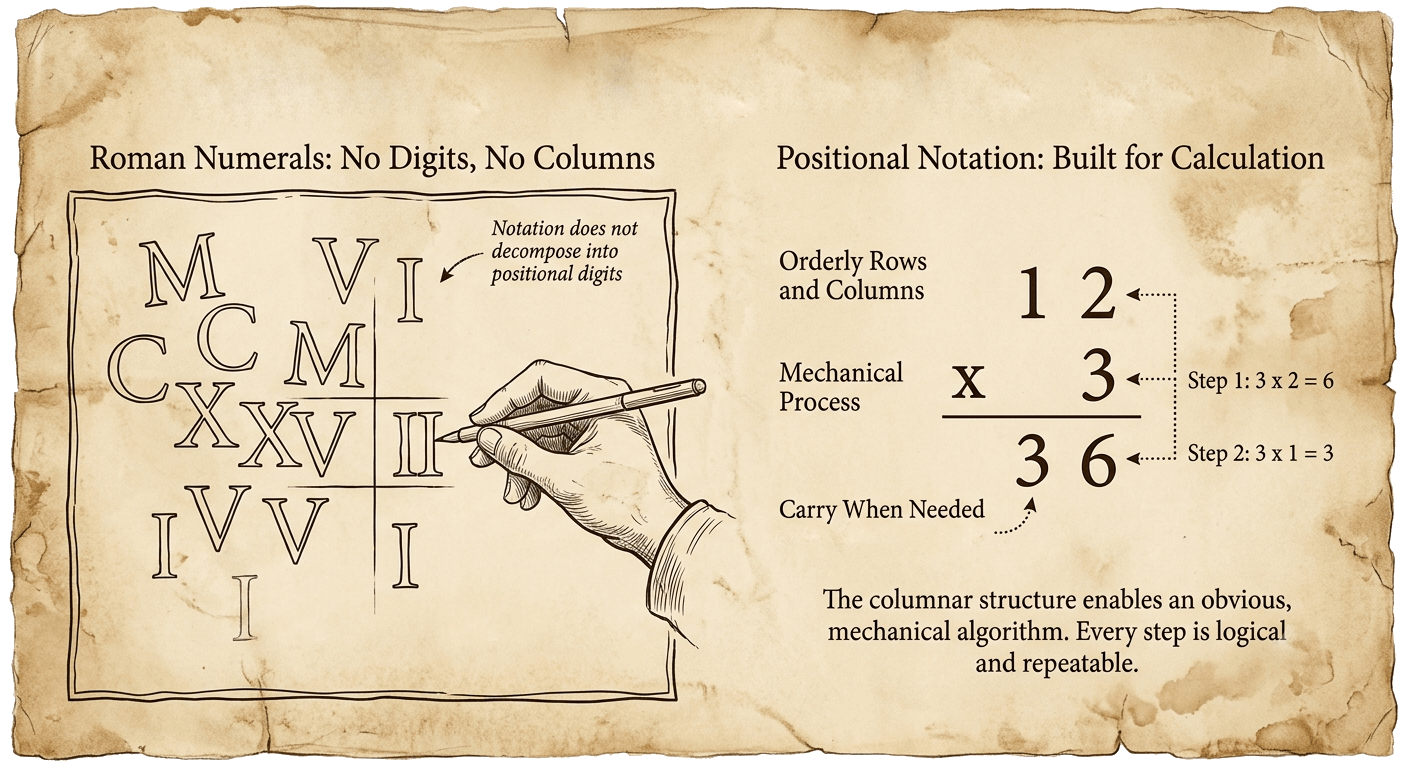
Roman numerals have no place value and no zero. To feel the difference, try multiplying MCMXLVII by XXIII: with no columns to break the numbers into smaller pieces, there is no mechanical procedure to follow. Older tools like the abacus could calculate quickly, but they left no written track and could not scale when hundreds of operations had to be chained together.
Once the mathematical engine had columns and zero, calculations could scale to a completely new magnitude. This layout provided the reliable framework where digits could be multiplied, carried over, and shifted, turning math into a repeatable routine.
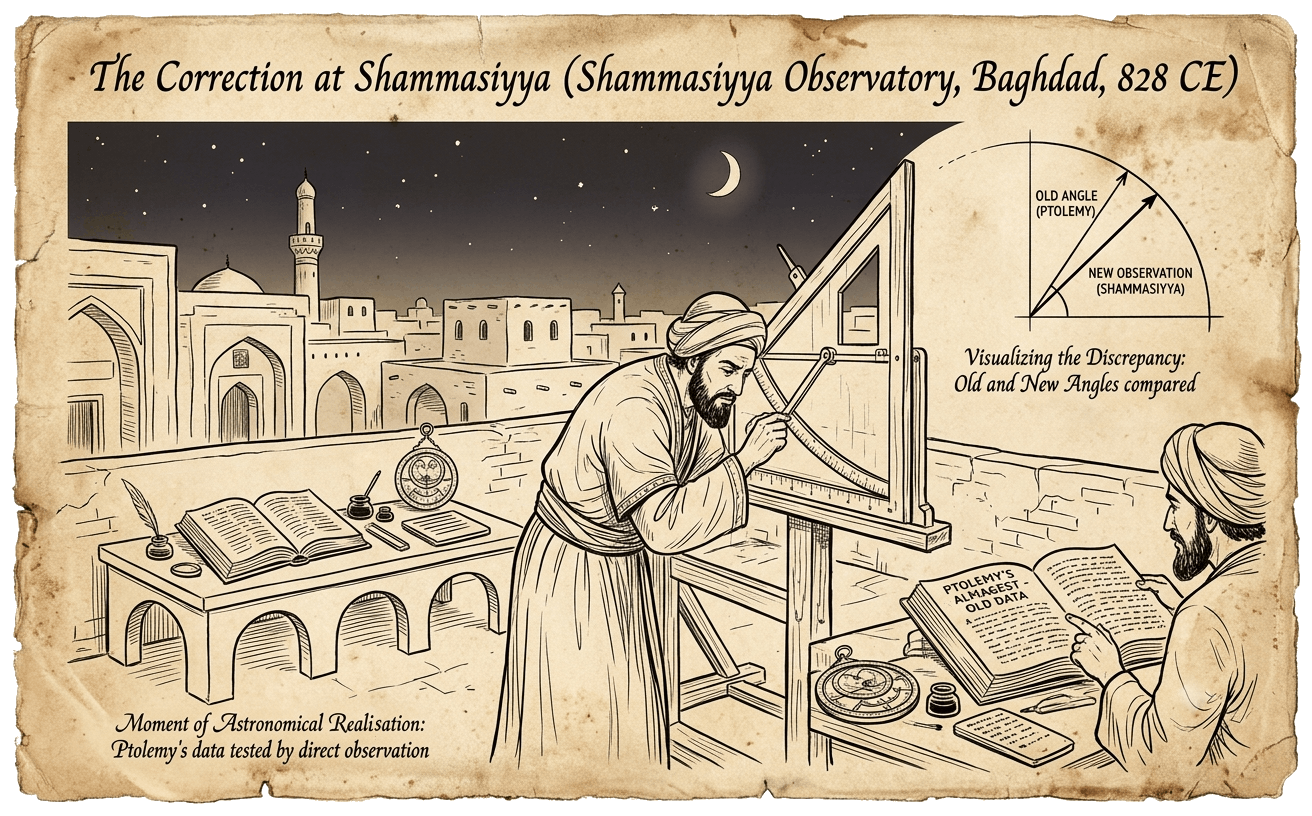
This new scaling power was immediately tested by real-world problems. As the empire expanded north, the simple shadow rules used to time the afternoon asr prayer broke down because the sun's angle had shifted. To calculate correct prayer times at these new latitudes, and to find the qibla (the exact direction to face Mecca across thousands of miles), astronomers had to map the sun's path across the sky precisely. This practical task required knowing one foundational fact: the exact angle of the Earth's tilt.
Instead of taking Ptolemy's 700-year-old textbook, the Almagest, on trust, Baghdad astronomers at the Shammasiyya observatory in 828 CE pointed their own instruments at the sky to verify the data. They discovered the ancient authority was wrong: Ptolemy had set the Earth's tilt at 23 degrees and 51 minutes, but their new measurements corrected it to 23 degrees and 35 minutes. This amended angle finally gave them the exact geometry they needed to fix the prayer times and map their latitude on Earth, gathering the corrected numbers into the Verified Tables.
They had mastered latitude, even if the mystery of longitude remained a challenge for future generations.
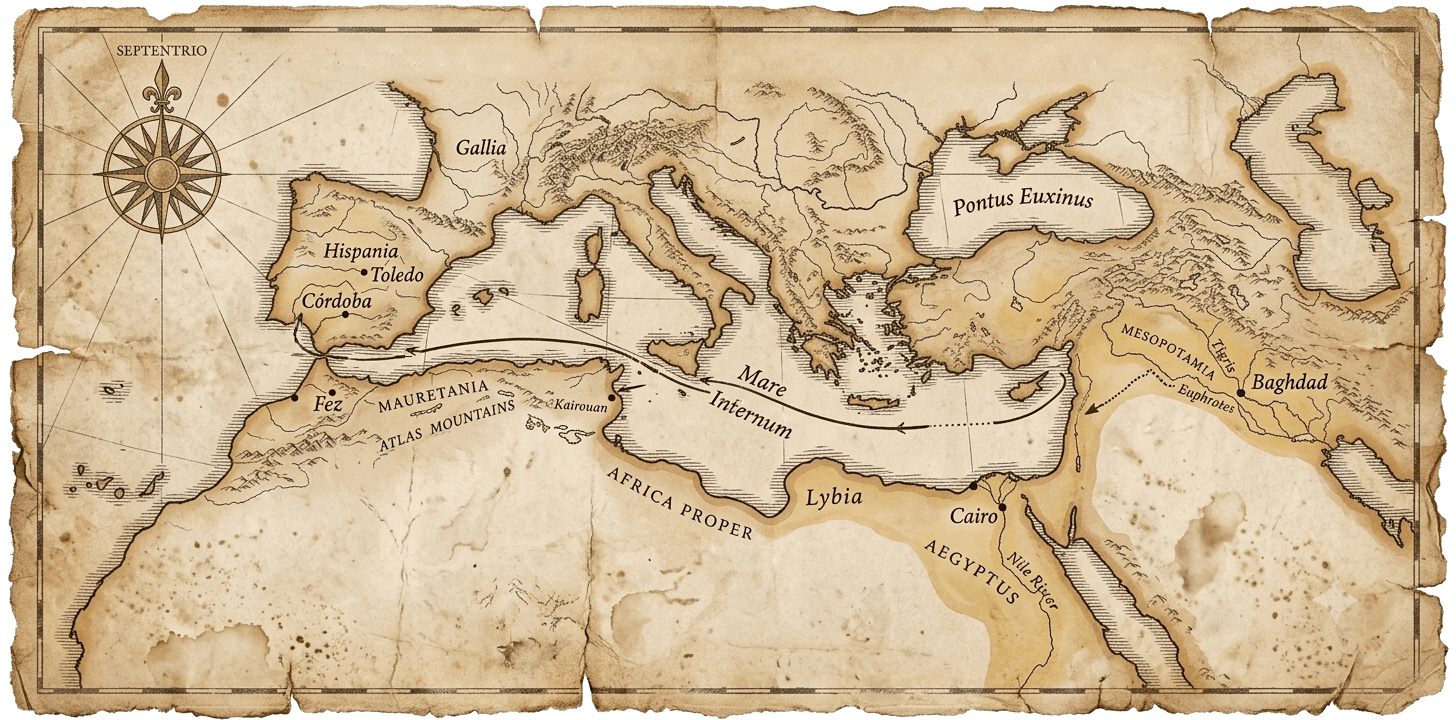
Al-Khwarizmi's highly regarded mathematical handbooks began to travel the world. Around 820 CE, he published The Compendious Book on Calculation by Completion and Balancing. He used al-jabr to "restore" broken negative numbers by moving them to the other side of an equation to make them positive, and al-muqabala to "balance" the scale by canceling out identical pieces. Together, these two operational words gave birth to our modern word algebra.
This knowledge traveled a long, circuitous road back to the West, moving across North Africa and into Spain, where Robert of Chester translated it into Latin in 1145. Al-Jabr remained in use in European universities into the 16th century. This algebraic foundation and positional arithmetic provided the structural tools that Isaac Newton later built on in his Principia to calculate the movement of the planets, a straight line of mechanical calculation stretching all the way to the Apollo Guidance Computer.
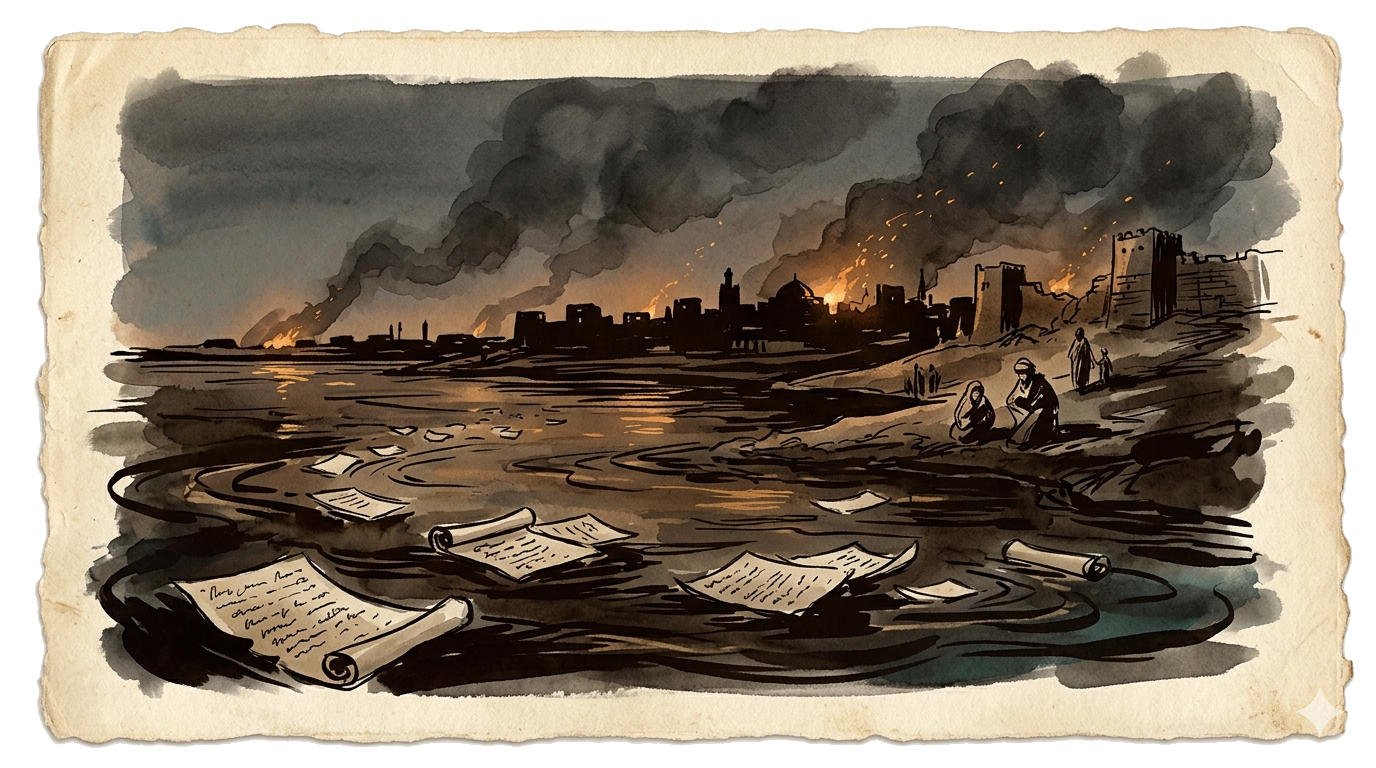
Then, history broke the centre apart. On February 13, 1258, Mongol forces under Hulagu broke through the walls of Baghdad.
The capital city's fall shattered a golden age that had flourished for centuries. Baghdad, a beautiful experiment in shared wisdom and peace was lost forever.
Survivors later told of a destruction so absolute that the River Tigris ran black with the ink of thousands of books, and red with the blood of the people.
The mathematical system itself survived because it had already started travelling. While the western transmission had arrived in Europe, in the east it was protected by a scholar named Nasir al-Din al-Tusi. In a strange paradox, al-Tusi entered with the very army that burned Baghdad, but he used his role as a scientific adviser to rescue manuscripts and build a massive new observatory at Maragheh afterward.
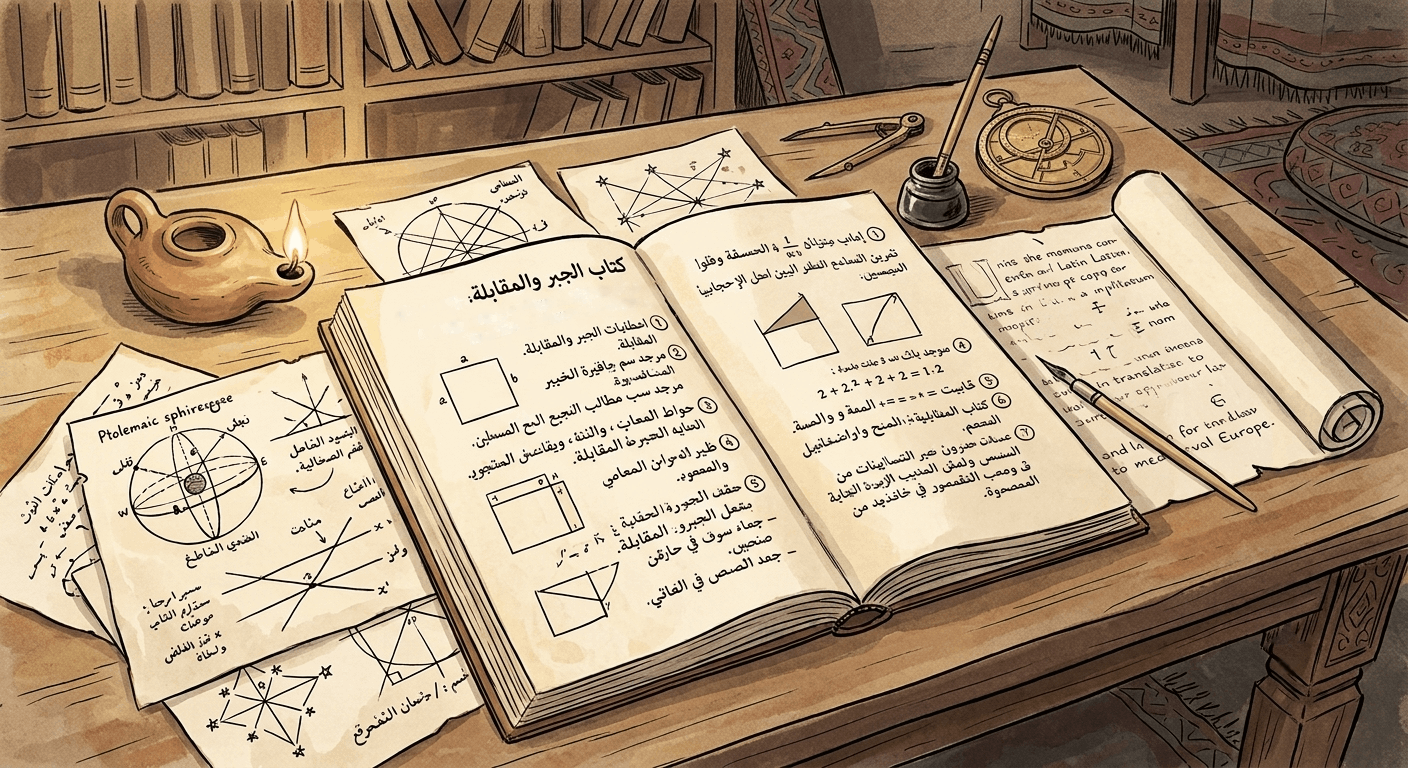
Surviving in more than one place at once saved this mathematics from being lost. When European scholars translated al-Khwarizmi's handbooks, they Latinised his name to algorismus, which became a word we still use every day: algorithm. The step-by-step routine that sorts a search, renders a game, and tells a phone how to process a photo.
Twelve centuries on, the positional logic worked out at a desk in Baghdad runs inside the devices we rely on, and few that use them have ever heard his name.