The Sky Reframed
Two thousand years of perfect circles, squashed by a gap a quarter the width of the moon.
For two thousand years, anyone who paid close attention to the night sky noticed a minor glitch. The mathematics predicting where planets should be never quite matched where they actually were. The gap was tiny. For Mars, the error was just eight arc-minutes wide, which is about a quarter of the width of a full moon.
Every astronomer in history looked at that tiny gap, shrugged, and ignored it. They assumed the instruments were slightly clumsy or the heavens were simply messy.
Eight arc-minutes
Both measures drawn to the same scale. Set the gap against the Moon and it comes to roughly a quarter of its width.
Full Moon by Gregory H. Revera, licensed CC BY-SA 3.0.
Then came Johannes Kepler. He looked at an error of eight arc-minutes and decided it was the most important thing in the world.
To understand the consequence of that choice, we should look at what came before. Decades earlier, Nicolaus Copernicus published a revolutionary idea suggesting the Sun sat at the centre of the solar system, and the Earth moved around it. It was a massive, if controversial, leap forward. But Copernicus had a blind spot. He was still attached to some of the ancient conventions meaning he kept the planetary orbits as perfect circles, adding loops and extra little circles called epicycles to force the maths to work. He changed the centre of the universe, but kept it locked in traditional shapes.
Enter Tycho Brahe. Tycho was a brilliant astronomer who built an island fortress of observation, spending twenty years charting the cosmos without a single lens. With massive, custom-engineered brass and iron instruments, he achieved an astonishing precision of about one arc-minute. He was also remarkably eccentric. After a heated debate about whose mathematical formula was best escalated into a sword duel with his cousin in 1566, Tycho found himself parted from his nose, which he replaced with a metal prosthetic. Concluding that anyone willing to draw a sword over arithmetic was also bound to try to steal his homework, he proceeded to guard his priceless data like a dragon sitting atop a pile of gold. When Tycho died in Prague in 1601, his massive archive of observations fell into the hands of his assistant, Johannes Kepler.
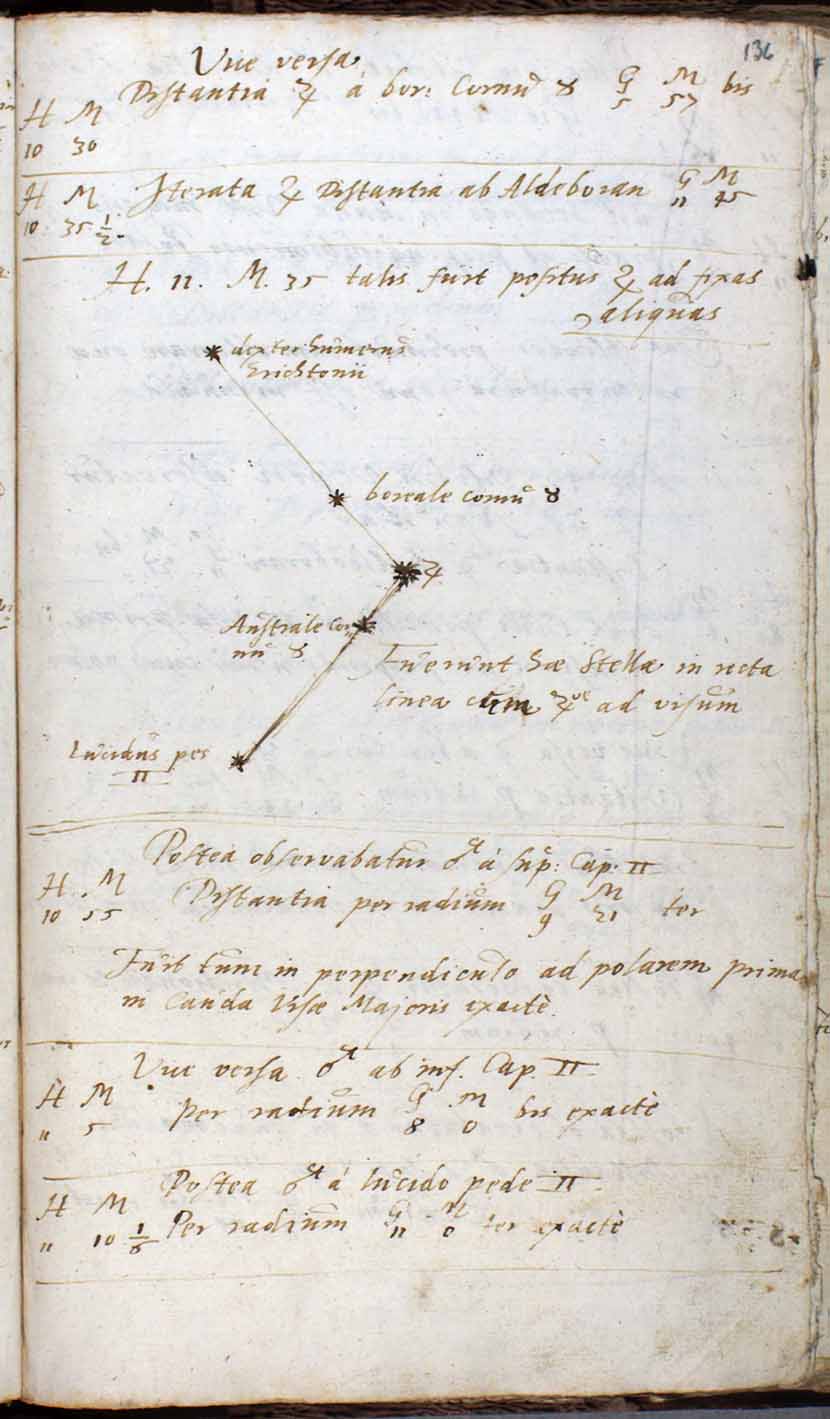
Kepler was a man of strange contradictions. To pay his rent, he earned a living writing astrological horoscopes for wealthy patrons while privately dismissing popular astrology as astronomy's foolish daughter, noting that the mother would starve if the daughter did not earn anything.
Yet he and Tycho shared a rare and vital virtue: they believed the sky over the book. Tycho spent twenty years building an archive with intense discipline because he refused to trust old maps over his own eyes.
When Kepler sat down with that data, he faced the exact same test. When he tried to fit Tycho's observations into the traditional circular model, the numbers refused to line up. That stubborn eight arc-minute gap surfaced again.
A weaker scientist would have assumed Tycho made a mistake, or would have fudged the numbers to save the old theory. Kepler did something radical. He knew Tycho's instruments were the best on Earth. He trusted the measurement over the model.
He wrote later: "These eight minutes alone will lead us to reform the whole of astronomy."
Johannes KeplerKepler in effect discarded the circle.
The old model
Planets defied the demanded circular orbit, the red dashed one, so astronomers grafted smaller circles on top. The blue line maps the resulting loops, engineered to make the system fit the observations.
What Kepler found
He dropped the extra circles. A single squashed ellipse with an off-centre Sun matched observations on its own. No artificial fixes required.
The squash is exaggerated here for visibility. Mars's actual orbit deviates by just 0.44 per cent, indistinguishable from a circle by eye.
He spent years calculating through complicated geometry until he found the real shape of planetary motion. In 1609, he published Astronomia Nova, revealing his first two laws.
Ten years later, in 1619, Kepler published Harmonices Mundi, introducing his third law: the square of a planet's orbital period is proportional to the cube of its semi-major axis (T² ∝ a³). This law acts like a ratio rather than an absolute ruler. It told Kepler how planetary sizes related to each other in proportions, even if the exact distance from the Earth to the Sun was still unknown.
Kepler believed he was uncovering the actual musical harmony of the universe, driven by divine geometry. He wrote the book while fighting a terrifying legal battle to save his elderly mother from being executed for witchcraft. Today, we separate the hard maths from his mystical daydreams, but in Kepler's mind, they were the exact same thing.
That mathematical ratio proved to be a master key. Decades later, Isaac Newton would take Kepler's third law and combine it with his own equations of motion to prove that gravity pulls with an inverse-square strength. But Newton's story belongs to another chapter.
Mercury drawn larger than life. In reality it's about 1/192 of the width of the Sun: a speck.
Five hours early
The crossing ran about five hours ahead of Kepler's calculation, and lasted five and a half hours, so Mercury had passed before the expected window. Compared to older, far less precise tables, hitting the mark this closely was still a major triumph.
Pierre Gassendi observed the transit from Paris on 7 November 1631, projecting the Sun's image in a darkened room: the first transit of Mercury ever seen (British Astronomical Association). Contact times and the five-hour figure from F. Mignard's recomputation, Observatoire de la Côte d'Azur.
Kepler put his new geometry to the test in the 1627 Rudolphine Tables. When astronomers used them to watch Mercury cross the face of the Sun in 1631, the prediction happened, but ran nearly five hours ahead of schedule due to Mercury's notoriously difficult, highly eccentric, and fast-moving orbit. Where older models routinely missed by a wide margin, a five hour miss was a staggering triumph. It was an imperfect victory that proved the method worked even with visible seams.
Today, the exact same equation runs unmodified from a candlelit desk in the seventeenth century to a live mission control. When a modern probe calculates a Hohmann transfer window to fly to Mars, half of its journey is plotted along a Keplerian ellipse.
The Hohmann transfer
Engines fire twice: once leaving Earth, once on arrival at Mars. In between, you coast on an elliptical path whose opposite ends naturally bridge both planets across the Sun.
Flying the full ellipse would take you back to Earth. Since Mars travels about 136 degrees round its own orbit while you cross, you have to aim for where it will be, not where it is.
Those eight arc-minutes stood as the permanent boundary between a tidy celestial clockwork and the messy truth of the sky. Today's craft may chart a thousand varied, non-elliptical courses across the abyss, yet every voyage is anchored to the hard-fought seventeenth-century mechanics that brought reality into focus.