The Language of Motion
From a London coffeehouse in 1684 to a seven-minute thruster burn four billion kilometres away: the three-century reach of a single geometric law
In August 1684, following a London coffeehouse challenge that had left a tricky orbital puzzle unsolved all spring, Edmond Halley travelled to Cambridge to ask Isaac Newton a direct question. He wanted to know what shape the planets would trace if the invisible force pulling them toward the Sun fell away as the square of their distance.
Newton replied instantly that the path would be an ellipse. When Halley asked how he knew, Newton answered plainly that he had already calculated it. Halley asked to inspect the workings, but when Newton searched through his papers he could not find the calculation. He promised instead to work the whole thing out from scratch and send it on.
The exact geometric path that Johannes Kepler had chased through years of grinding computation and stubborn observational errors had already been mapped, and misplaced.
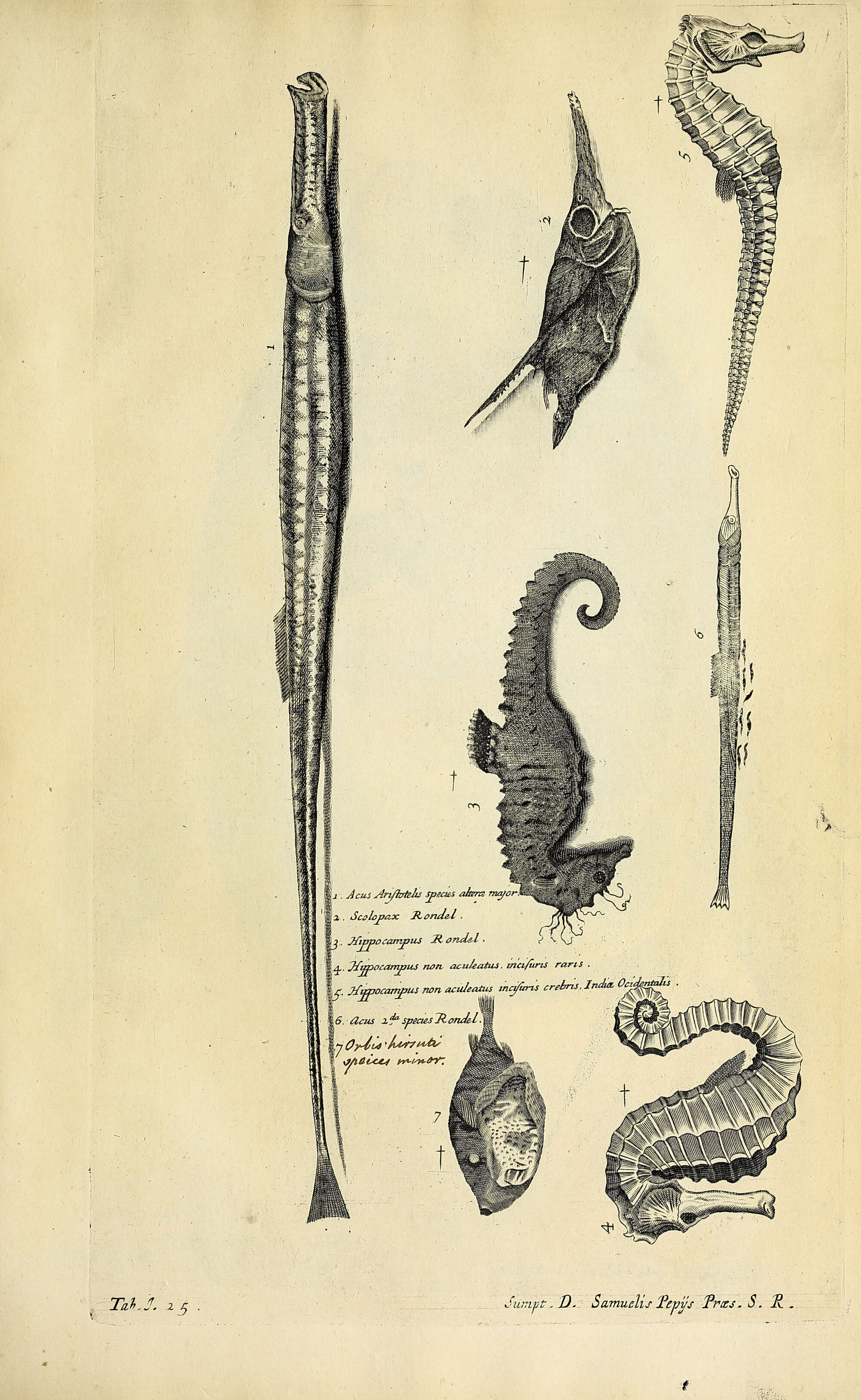
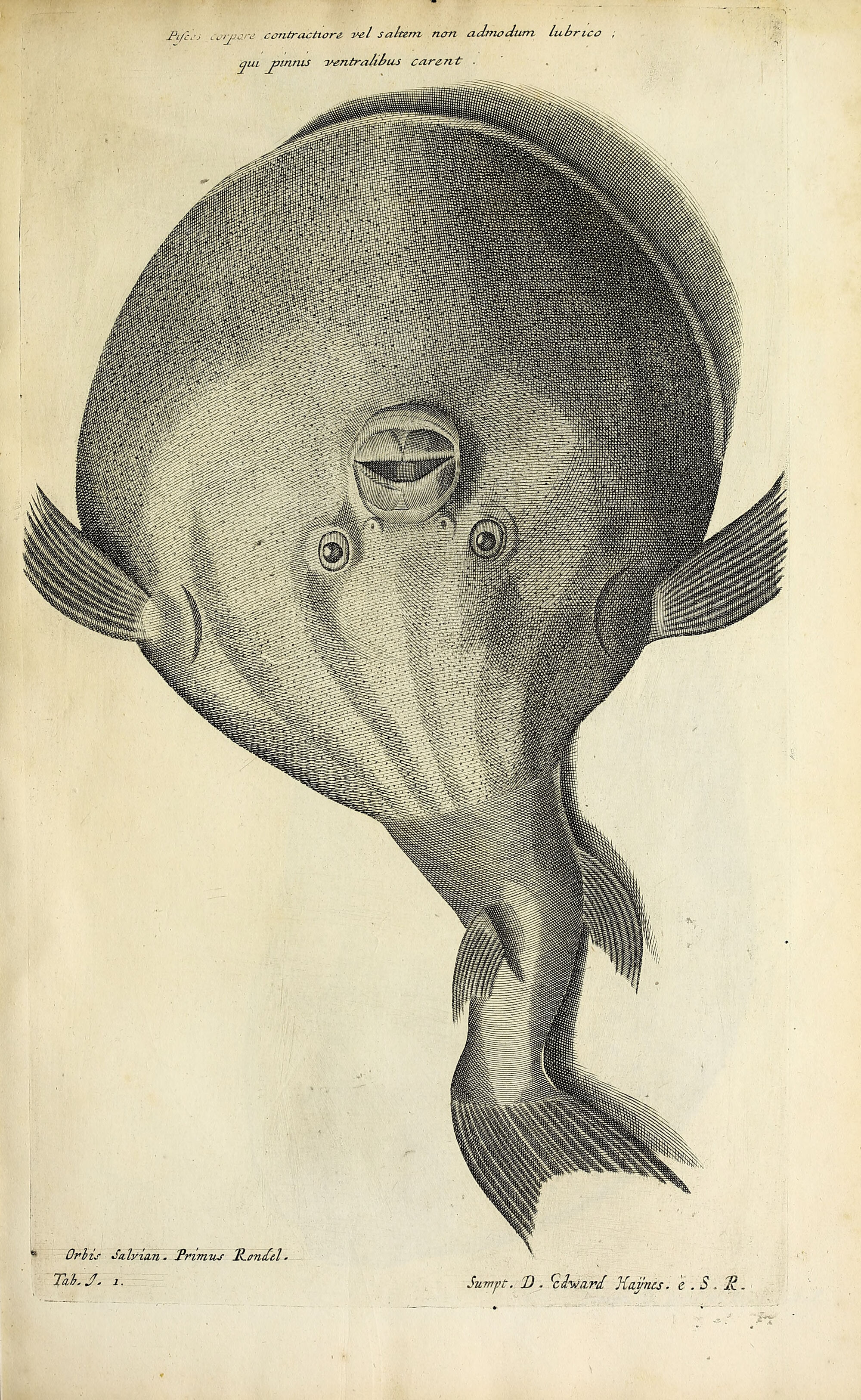
The rewritten proof reached Halley that November, nine pages of it, carried down from Trinity by a colleague. Over the next two and a half years, Newton expanded those pages into a massive manuscript intended for publication. But when the project reached the Royal Society for sponsorship, the institution faced a severe cash flow problem. They had spent their entire budget on De Historia Piscium, an exhaustively detailed, lavishly illustrated natural-history volume on fish begun by Francis Willughby and finished by John Ray. The book was expensive, sold poorly, and had pushed the Society to the brink of financial ruin.
Halley was in no position to play the wealthy patron. He was a salaried clerk on a promised fifty pounds a year whose late father's estate had gone into chancery, leaving his personal finances tied up and uncertain. Yet when the Society balked at the printing costs, Halley chose to finance the entire publication completely out of his own pocket. He would never see that money returned.
Samuel Pepys signed the official printing license in July 1686, and the book appeared a year later. It soon transpired that the Society couldn't afford to pay Halley his salary in legal tender; instead, they compensated him with unwanted books about fish.
In 1666, with Cambridge closed by the plague and the university empty, Isaac Newton sat in the orchard at Woolsthorpe and watched an apple drop straight down toward the centre of the Earth. He wondered whether that same invisible reach might extend all the way out past the treetops, reaching even as far as the Moon. The story, recorded by William Stukeley from Newton's own recollections decades later, marks the beginning of a quiet realisation.
- 60.3 times further out. That is the Moon's distance, counted in Earths.
- 3,640 times weaker. Twice the distance is a quarter of the pull, so sixty times the distance is sixty squared.
- And then the test. The rule predicts 0.00269. The Moon's own motion, timed over a 27.3217 day month and never mentioning gravity, gives 0.00272. Two sums that share no working, agreeing to 1 per cent.
Before this, Johannes Kepler had mapped the precise geometry of planetary paths across years of computation, but he had never known why the bodies moved that way. Newton connected the fall of the orchard fruit to the orbital sweep of the Moon, recognising that the exact same force governed both, falling away as the square of the distance. The book claimed this law held for everything, everywhere, without exception.
If you understand the underlying law, you no longer have to chase the planets with a pencil, recording where they are tonight and plotting where they might drift. You can compute the path of a celestial body you have never even observed, extrapolating its trajectory indefinitely far ahead through space and time. Positions stop being passive records of the past and start being active derivations of the future.
Newton constructed his entire theory while missing a crucial piece of the puzzle. He never knew the strength of gravity itself.
Seventy-one years after Newton had died, a reclusive scientist named Henry Cavendish sealed himself out of a shed in Clapham and weighed the Earth. His experiment involved massive lead spheres attracting two much smaller ones faintly towards them; he worked the machinery from outside so that no stray current of air or other interference could cause a disturbance, and watched the balance through telescopes set into the walls. When he applied the result to Newton's law of gravitation, the figure he arrived at for the density of the Earth was close to the one we use today. The universal constant fell out of those numbers later.
Newton had built a working celestial machine out of pure proportions, leaving a blank space at its centre where the absolute strength of gravity belonged.
In 1705, Edmond Halley tracked historical records across three separate sightings, recognising them as a single returning body, and urged future generations to watch for its return around 1758. He died sixteen years short of it, on 25 January 1742.
By June 1757, the work had become a matter of relentless calculation inside a Paris room. For six months, Alexis Clairaut, Joseph Jérôme Lalande, and Nicole-Reine Lepaute crunched numbers from morning to night, sometimes right through meals, tracking the gravitational tugs of Jupiter and Saturn degree by degree. Lalande later wrote that without Lepaute, he would never have been able to undertake the enormous labour. Together, they announced in November 1758 that the comet would reach perihelion in mid-April 1759.
It was sighted on Christmas night 1758 by Johann Georg Palitzsch. A working smallholder who had taught himself Latin from books he could afford and built his own botanical garden, laboratory, library, and museum on his land, Palitzsch beat every professional in Europe to the sighting.
The comet reached perihelion on 13 March 1759, about a month earlier than they had predicted. Jupiter and Saturn had delayed it by 618 days, a lag computed across 150 years of orbital history. When Clairaut published the definitive calculations in 1760, he omitted Lepaute's name entirely.
For decades, Uranus had refused to behave. Its orbit was warped, pulled out of alignment by an unseen weight. Astronomers were split: some, like Airy at Greenwich, suspected the inverse-square law might break down at large distances, while others tracked a hidden body. Urbain Le Verrier treated the deviation as a message. Working backward through the mathematics across ten months and three dense memoirs, he calculated a position for the body causing the pull, and posted his coordinates to Berlin.
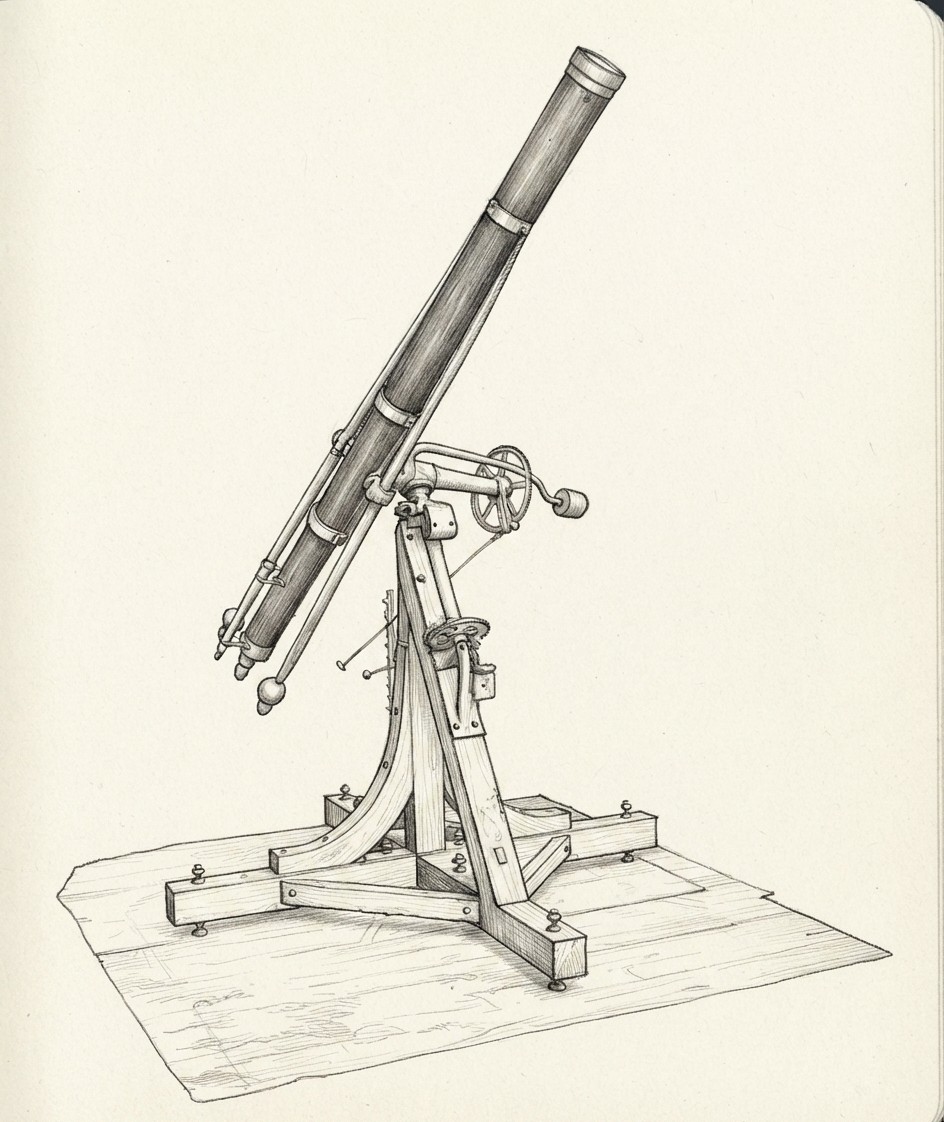
The letter reached Johann Gottfried Galle on the morning of 23 September 1846. That night, with Heinrich d'Arrest at his side and the Fraunhofer refractor at their disposal, they opened the dome. The method was d'Arrest's: compare the field against the chart, and look for the star that should not be there. Their advantage lay not in glass but in paper: a sheet of the new Berlin star charts, engraved and printed the previous November and then never sent out. It had sat in Berlin for ten months with nobody thinking of it. Cambridge had looked at the same patch of sky six weeks earlier and recorded the planet twice without recognising it, left blind for want of a current map.
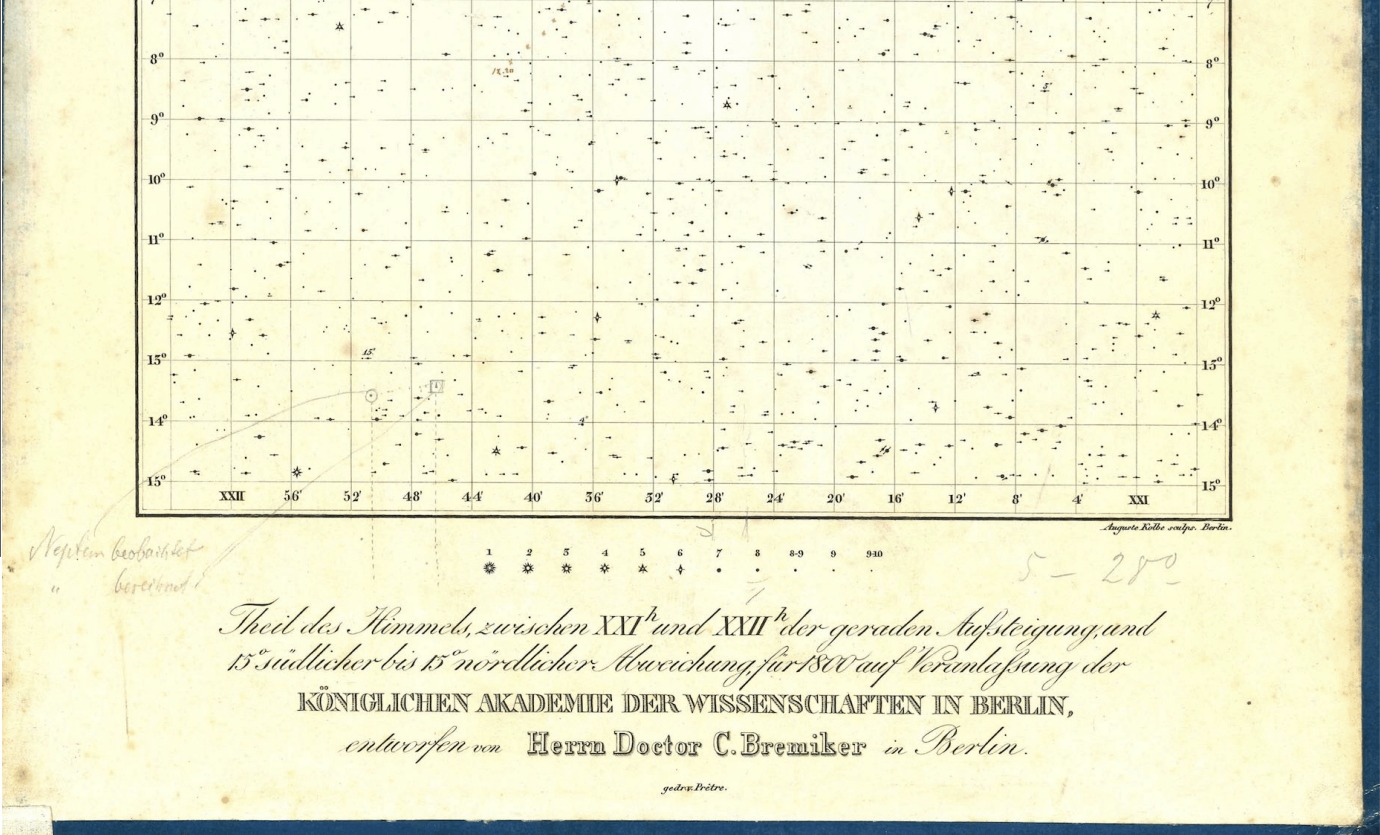
They scanned the field, alternating their focus between the pinpricks of paper and the stars in the lens.
It took under an hour.
An eighth-magnitude point of light blinked back at them, less than one degree from Le Verrier's calculated place. Two days later, Galle wrote to Paris: "La planète, dont vous avez signalé la position, réellement existe." Le Verrier answered on 1 October: "Thanks to you, we are definitively in possession of that new world."
- ◯Neptun beobachtet, Neptune observed. Where Galle and d'Arrest actually found it.
- □berechnet, calculated. Where Le Verrier's arithmetic said it would be.
- ↔The gap between them is about one degree of sky.
The triumph of Neptune carried a quiet, structural flaw. The prediction had been brilliantly right about where to look, but wrong about almost everything else. Le Verrier had assumed Bode's law, placing the planet at 38.8 astronomical units when it actually sits at 30.1. The distance was a fifth wrong, the derived mass wrong with it, and the coordinate had held only because the errors conveniently cancelled across the brief arc anyone had tested.
When the identical procedure was turned toward the inner system in 1859, it produced a phantom. Mercury's perihelion advanced by 38 arcseconds per century more than Newton's laws allowed, as Le Verrier measured it then. An unexplained motion demanded an unseen mass; an unseen mass demanded a planet, which Le Verrier promptly named Vulcan.
When a country physician in Orgères-en-Beauce wrote to claim he had watched a dark dot cross the face of the Sun, Le Verrier did not trust the letter. He took the train, walked twelve miles from the railway station, interrogated Lescarbault, and demanded character witnesses from the neighbours to satisfy himself it wasn't a hoax. Convinced, he announced Vulcan to the Académie on 2 January 1860, and Lescarbault was decorated with the Légion d'honneur.
For half a century, careful astronomers chased a world that was never there. They packed heavy instruments into the paths of total eclipses across the globe, staring into the white corona year after year until Lick Observatory closed the search in 1908. Le Verrier died on 23 September 1877. It was exactly thirty-one years to the day after Galle had found Neptune in Berlin. He died with Vulcan still unfound and still believed in.
- An orbit has a closest point. Mercury swings in near the Sun, then back out. That near point should stay where it is, year after year.
- It does not. It creeps forward by 43 arcseconds every hundred years. That is about a hundredth of a degree: far too small to see, and far too large to ignore.
- Give it long enough. At that rate the closest point takes 3 million years to work its way once around the Sun.
The explanation arrived in 1915, when general relativity produced the missing motion out of the curvature of spacetime. Yet the old book was not discarded. Engineers still built and launched ships on Newton's ratios, and both descriptions remain in active use, the older mathematics acting as an approximation accurate enough to fly spacecraft.
On 20 August 1977, Voyager 2 left Earth. For twelve years and more than seven billion kilometres, it fell outward through the dark, its path governed by the arithmetic of the system. In early August 1989, weeks before landfall, controllers executed TCM-18, a trajectory correction that nudged the arrival clock by eighty-two seconds.
When the spacecraft swept past Neptune on 25 August 1989, it hit its mark within one hundred kilometres. The world it met was the one Le Verrier had calculated in 1846, carried across the void on the strength of the physics Halley had paid to print in 1687.
That geometry traced back to a meeting in Cambridge. When Edmond Halley asked what curve a planet traces in the sky, Newton answered instantly: an ellipse. He never found the workings. He fulfilled his word anyway, writing the work anew and expanding it into the Principia, building a universal engine out of ratios and proportions. Three centuries later, a spacecraft navigating by those same ratios met a world that mathematics had derived before any telescope found it, turning a book into a course across the solar system.