The Glass Eye
How a ground lens and a tube found Jupiter's moons, only for a human heartbeat to scupper the sky clock and inadvertently reveal the speed of light
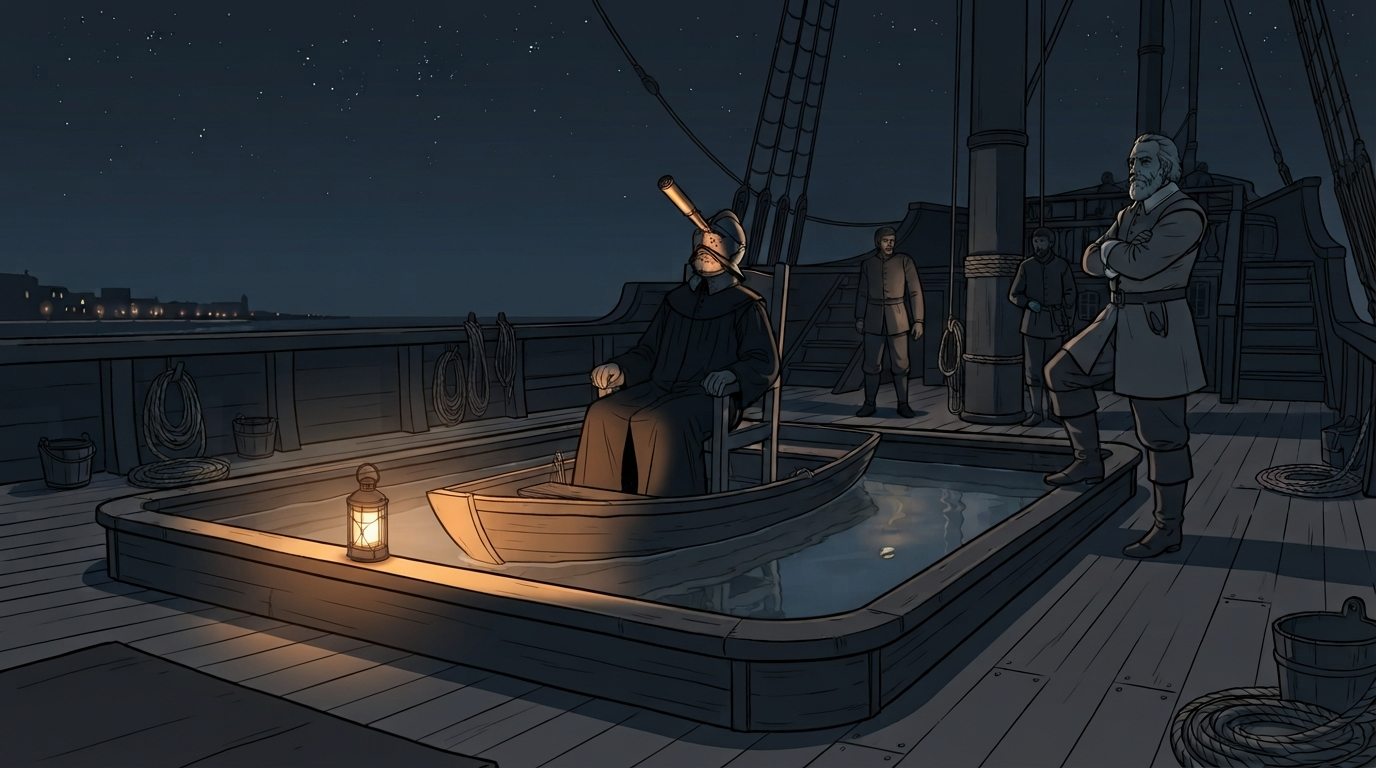
A chair sits inside a small wooden boat. The boat floats in a shallow pool of water, set right in the middle of a larger ship riding the uneasy, salt-soaked swells of the Tuscan port at Livorno.
It is September 1617. The air is heavy with the smell of wet hemp and pitch.
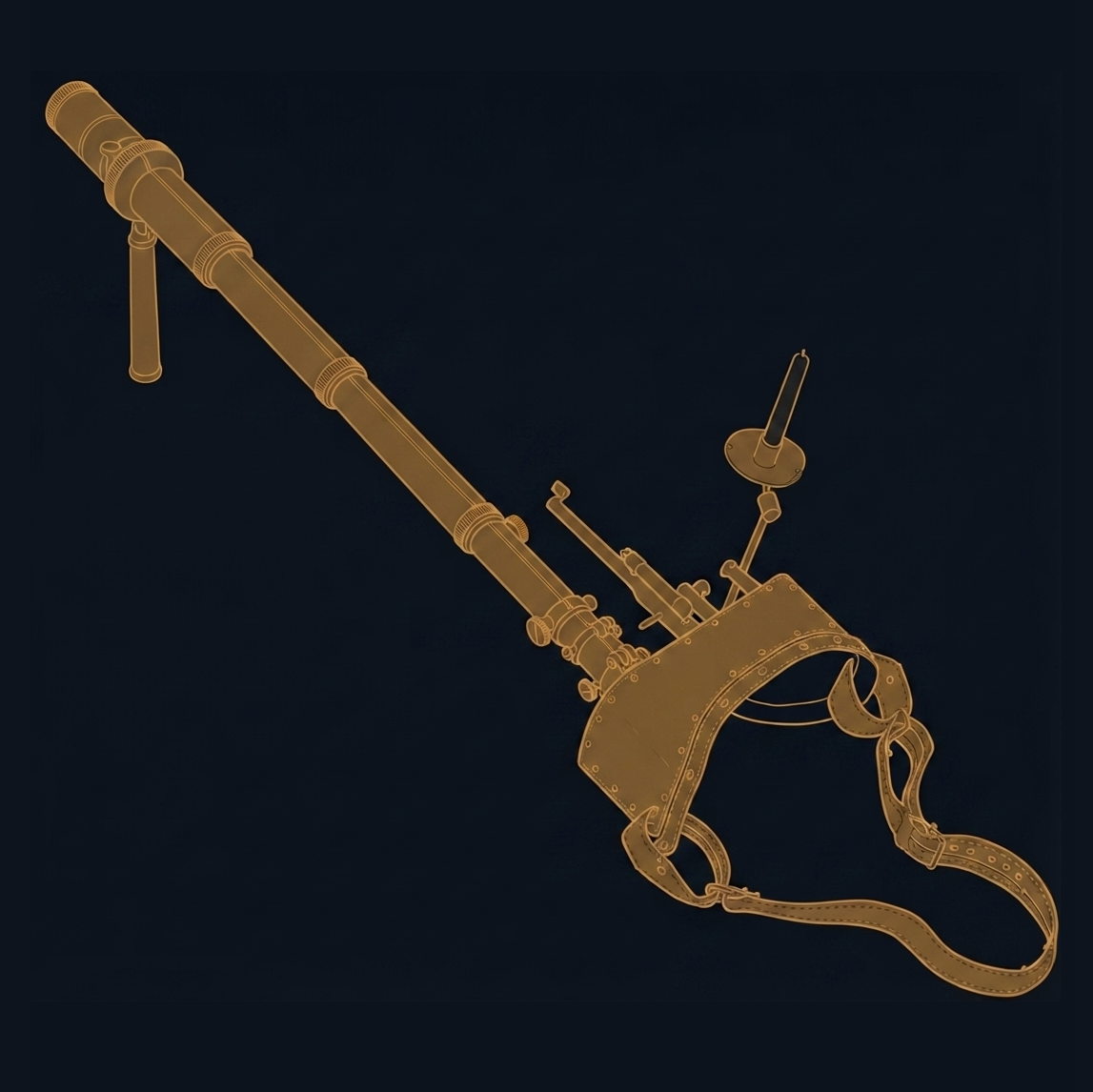
In the centre of it all sits Galileo, wearing a heavy iron helmet with a hinged visor. Soldered straight onto the right eye slit is a short brass telescope, pointing up toward the dark sky while his left eye stays uncovered. He had created it himself down in the Grand Duke's workshop, shaping the metal to fit his own skull.
Standing on the wooden deck beside him, watching the machinery bob with the tide, is Giovanni de' Medici. He keeps his arms crossed, tracking the sway of the basin. A military commander does not usually spend his time watching a professor float in a boat.
The lenses inside the helmet's little telescope are deliberately weak. They're not for revealing distant worlds yet. They're just there to test whether an eye can stay locked to a moving lens while the deck below rolls on the water.
The question being posed in the harbour isn't what the glass can see; it's whether a ship a hundred miles from land can be told where it is.
The iron plates, hinges, catches, and frame making up the contraption were hammered and polished in a workshop where any competent ironworker could have turned out the same. The one component no smith in Europe could have made from scratch was the curved glass.
That glass had a long, slow lineage.
In eleventh-century Cairo, the scholar known as the father of modern optics overturned a thousand years of conviction about how we see. The ancients believed the eye shot beams outward, but al-Haytham showed through systematic physical experiments that light enters the eye rather than leaving it. His Book of Optics ran to seven volumes, and though he never ground a lens himself, his published insights travelled north to become the foundational textbook for future scientists and astronomers.
By 1286, in central Italy, glass was finally being curved to help old eyes continue reading. We know this because on the twenty-third of February, 1306, a friar in a Florentine pulpit remarked that the art of making spectacles was not yet twenty years old. That is the only timestamp for another invention that had no single author. By 1320, the glass guilds of Venice were registering workshops specifically to shape lenses.
Lenses were cut, polished, and fitted, generation after generation, until on the second of October, 1608, a spectacle-maker named Hans Lipperhey walked into the Dutch assembly holding a simple wooden tube fitted with two lenses, a device that made distant things appear close. His patent was refused because the design was already common property, being copied in workshops up and down the coast.
Five hundred and ninety-nine years had passed from al-Haytham's desk to the coming January nights. Three hundred and twenty-two years had passed from the first spectacle bench to the Dutch assembly.
And then, in a week, the sky changed.
In Venice, in June 1609, Galileo heard that a Dutch spectacle-maker had put two lenses in a tube. He went back to Padua, built an eight-power glass by August, and continued to refine it up to twenty, more than six times Lipperhey's magnification.
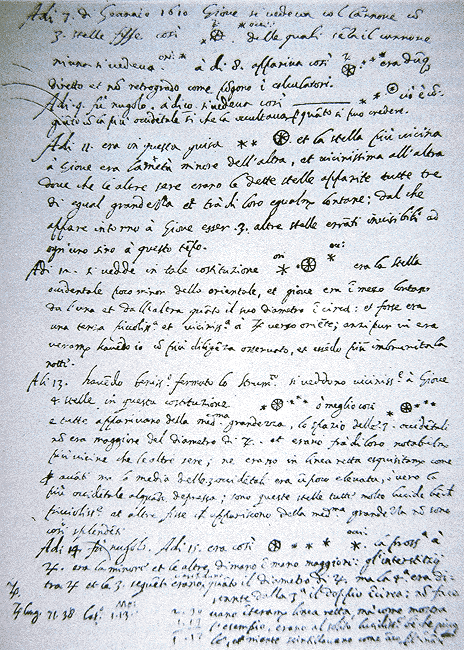
On the evening of 7 January 1610, he turned it toward Jupiter and saw three small, bright stars lined up beside the planet. He took them for fixed stars.
Over the following nights, they moved. They did not move the way fixed stars move with the turning sky; they drifted back and forth, clustering and separating, changing sides in a way that made no sense under any geometry he knew. On 13 January, a fourth appeared.
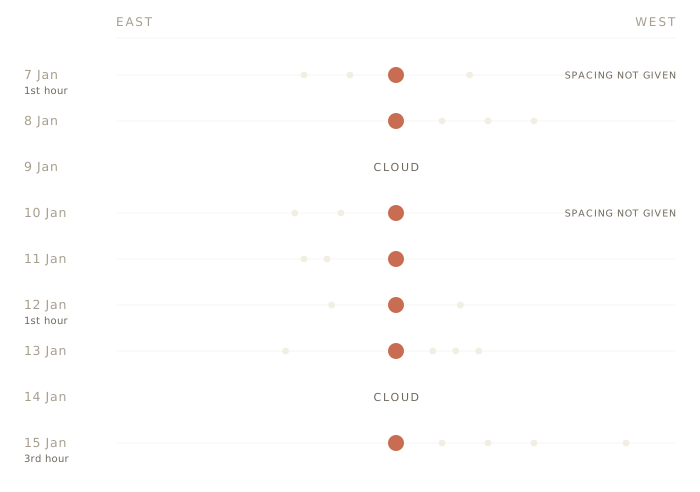
The error took a week to unravel, night by night, until the reality forced itself through the lens. They were not stars at all. They were small bodies bound to the planet, carried with it against the fixed stars. He named them the Medicean Stars, flattering the Florentine court in an attempt to secure a court salary, but the name mattered less than the geometry.
He closed the notebook.
On the thirteenth of March, 1610, just ten weeks after those cold nights in Padua, he published Sidereus Nuncius. It was the first time anyone had printed what a telescope could see.
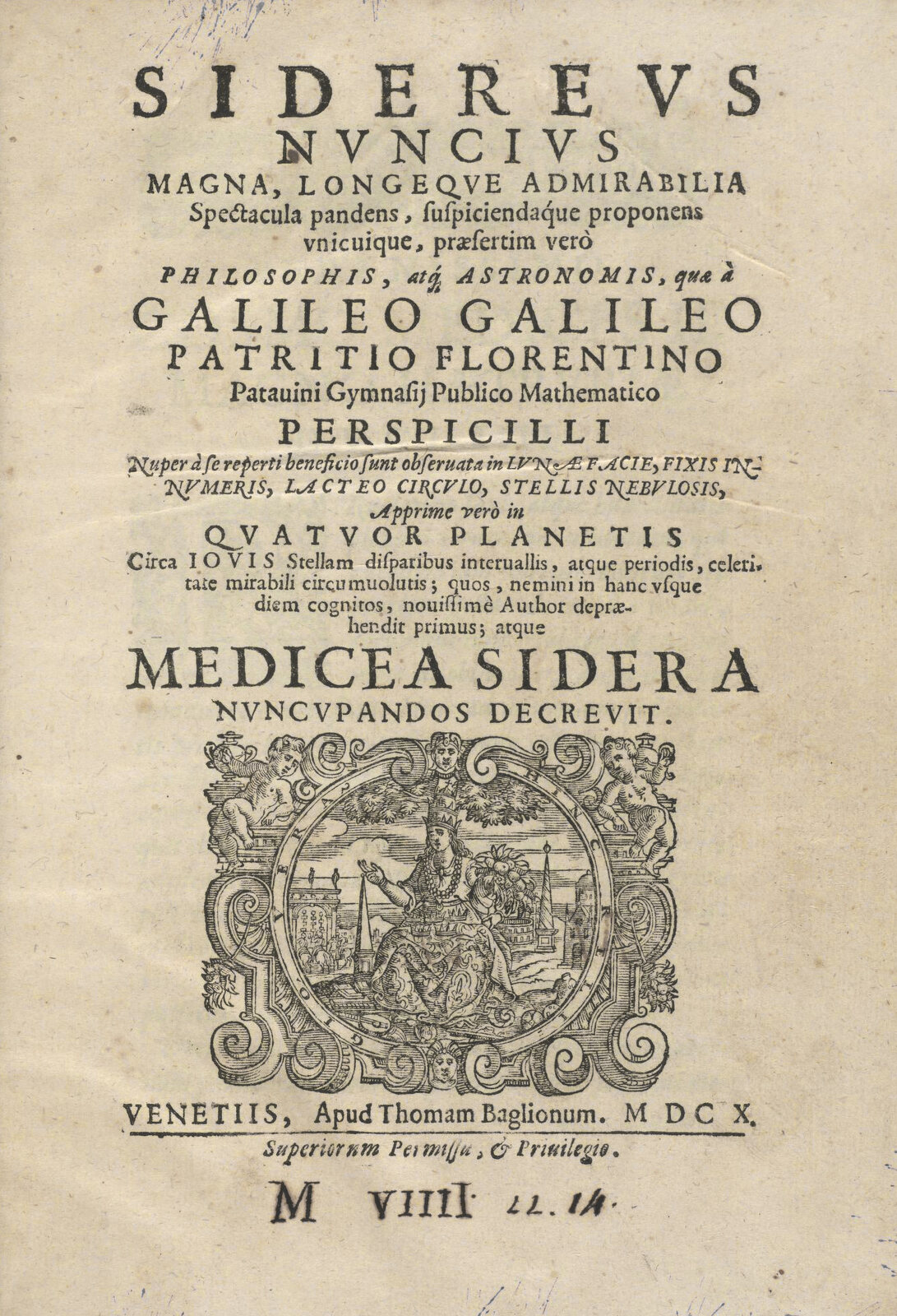
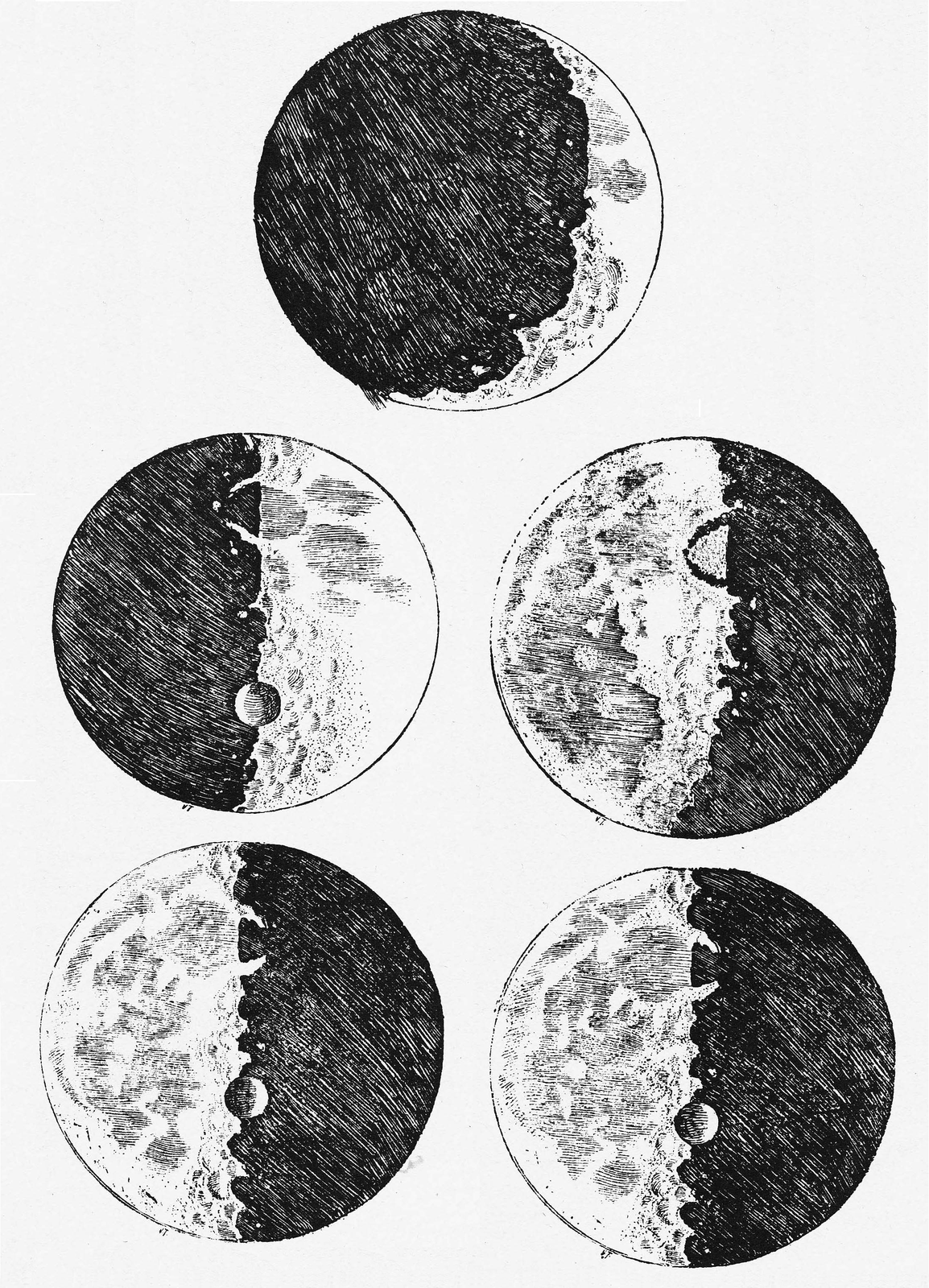
The book broke two ancient certainties. First, the Moon was not a polished sphere of divine perfection; its edge was bitten by shadows, scarred with craters and mountains. Second, Jupiter had four bodies orbiting it. That single fact quietly dismantled the foundation of Ptolemaic astronomy. If a major planet carried its own entourage, the Earth was not the sole centre of all motion.
This answered the biggest objection against Copernicus, who argued that the Earth was just another planet orbiting the Sun. The problem was that his system needed two centres of motion, the Sun for the planets and the Earth for its Moon, and a universe with two centres was held to be absurd. Jupiter shattered that rule by carrying its own family of moons spinning around it, rendering the old objections instantly obsolete.
Even the naming rights refused a single author. Simon Marius published Mundus Iovialis in 1614, claiming independent discovery of the moons; though Galileo tried to name them for the Medicis, history adopted the mythological names suggested to Marius by Johannes Kepler: Io, Europa, Ganymede, and Callisto.
The book did not explicitly argue for the Sun-centred universe. It stayed strictly empirical. Yet carried on the newly relentless machinery of the European press, Sidereus Nuncius reached scholars across the continent within months.
The sky had been pulled down from the divine sphere by way of the workshop bench. Now it needed to be put to work.
Finding latitude is a matter of looking up. You measure the angle between the horizon and the sun at noon, or the pole star at night, and the sky tells you how far north or south you are. That is why latitude was solved early, and why the brass disc on an astrolabe could read it straight off the plate.
Longitude is an entirely different problem.
Because the Earth rotates under your feet, every point along your line of latitude eventually passes beneath the exact same stars. The night sky over Lisbon and the night sky over the Azores show identical patterns, seen at different times as the planet turns.
Looking straight up won't tell you your east-west position: longitude does not change which stars are above you, it only changes when they arrive.
To find it, you have to stop looking at the stars for your position and start comparing two times instead.
You need a way of knowing the exact time back at your home port, and the local time where your ship is bobbing right now. The difference between those two times converts straight into degrees of longitude.
But in 1612, no clock existed that could hold the hour across a voyage of rolling waves and salt air.
The sky, however, carries a clock that cannot be jammed by salt.
By September 1612, Galileo's calculations tracking Jupiter's four moons were accurate enough to predict their eclipses months in advance. Instead of waiting around for an infrequent lunar eclipse, here was a clock that never stopped running.
Every time a moon slips behind Jupiter's bulk, it vanishes into shadow. Because that blackout happens out in space, the exact moment of disappearance was taken to be the same physical instant for every observer on Earth, no matter where they stand.
The method rested entirely on that premise: you look through your glass, note the exact minute a moon slips into the dark, and compare it against a computed reference time. The difference in time is your distance east or west.
In practice, it was fiercely difficult. A moon takes nearly a full minute to slide into shadow, and holding a shaking lens on a rolling ship to track a tiny pinprick of light is an exercise in frustration.
Pointing a telescope at four distant dots tells you nothing about where you are on the water, unless you have the home tables mapping every eclipse down to the minute.
The glass plus the printed tables: that was the machine.
Galileo tried to sell his sky-clock to Spain for sixteen years.
Beginning in 1612, backed by his powerful patron the Grand Duke of Tuscany, he sent ambassadors and letters across Europe pitching the system. He put the case to the maritime court in Seville again and again, offering the complete package: he would hand-deliver powerful telescopes, send a trained expert to teach the sailors, provide annual printed almanacs of the moon eclipses, and move to Spain himself to make sure it worked.
Spain still said no.
Their expert committees raised three unanswerable walls.
Spain was right, of course. But Galileo refused to back down. Beating that first wall meant dragging those bizarre floating chairs and soldered helmets out of the workshop and onto the water.
If a ship's rolling deck made telescopes impossible to hold, he would build a machine to lock the lens to the man.
The first invention out of his workshop in Florence was that heavy helmet with the hinged visor. A short brass telescope was soldered directly over the right eye slit, letting the astronomer track the moons through the glass while the left eye stayed open to the dark. It wasn't meant to study distant worlds; it was a rig built entirely to see if a lens could stay glued to a planet while a ship pitched on the waves.
There was a second design, too: a floating chair cradled inside a hemispheric tub filled with oil, engineered to pivot against the boat's roll and keep the observer level. In September 1617, in the Tuscan port of Livorno, officials watched it test-driven and were genuinely impressed. The nested mechanics worked. The chair isolated itself from the boat, and the boat rode the waves.
But the engineers hit an insurmountable glitch that no workshop could fix.
The final component in the chain wasn't mechanical; it was biological. Galileo himself conceded the truth of it: even standing completely still on dry land, his own heartbeat made Jupiter jump rhythmically out of view. A human pulse cannot be engineered away.
When Benedetto Castelli took the helmet out to sea a few months later, it was a failure.
The trials ended where they began, defeated by a movement so quiet it goes entirely unnoticed in daily life: the gentle thumping of a human heart, which under magnification was enough to throw a distant moon right out of view.
In October 1627, word arrived from abroad: the Dutch had established a prize of thirty thousand scudi for a workable longitude method. At the time, Galileo's salary as a professor in Pisa was a mere sixty scudi a year.
He ignored the offer for nine years, continuing to chase Spain instead.
Then came 1633, the Inquisition trial, and the censure of the Church. By 1636, a broken and isolated man, his calculus shifted. He finally opened negotiations with the northern Protestant Republic.
The committee in The Hague reported favourably. One of its members, Isaac Beeckman, had proposed the same celestial clock independently five years earlier. In April 1637, they voted to send him a gold chain and medallion worth five hundred guilders as a gesture of goodwill.
Urban VIII swiftly forbade him to deal with a heretic government. Galileo declined the chain. He never saw a penny of the thirty thousand scudi.
Woven into that submission, however, was a quiet parting gift: a new device for measuring short intervals of time. By the following summer, he had worked out the principle of the pendulum, noting that its swings remained equal whether the arc was wide or narrow.
He had inadvertently handed over both halves of the longitude puzzle: the celestial clock in the sky and the steady mechanical ticker on the desk. Neither of them ever saw the sea.
The chief Dutch astronomer died before their trials could begin. Galileo went completely blind in 1638, and died four years later.
In 1668, in Bologna, Gian Domenico Cassini published his tables of Jupiter's moons, the Ephemerides Bononienses Mediceorum Syderum.
On the left-hand page sat the predicted configurations of the four moons day by day at seven in the evening, printed inverted the way a telescope shows them. On the facing page ran the hourly schedule of the eclipses and occultations. When checked against modern models, those predictions were accurate to about ten minutes.
That margin of error sealed the method's fate. Ten minutes of time error translates to roughly a hundred miles of misplaced distance at European latitudes. It was a fatal margin on the open water, where a rolling deck gave a watcher only one frantic minute to catch an eclipse and no second chance if the clouds closed.
But on land, the maths changed entirely. A harbour does not move. An observatory could wait out the weather, watch dozens of eclipses over months, and average away the mistakes. Ten minutes was useless to a ship's captain, but it was close enough to map a coastline.
When Cassini took charge of the new Paris Observatory in 1671, French astronomers fanned out across the ports. They set up long brass tubes at fixed stations, timed the eclipses against the tables computed back in Paris, and translated the difference into longitude.
The country did not move. The measurements simply caught up to reality.
When the sweeps were finished, the map of France had shrunk. The distance from Paris to Brest dropped from eight degrees and ten minutes to six degrees and fifty-four, pulling the western capes eastward on the page.
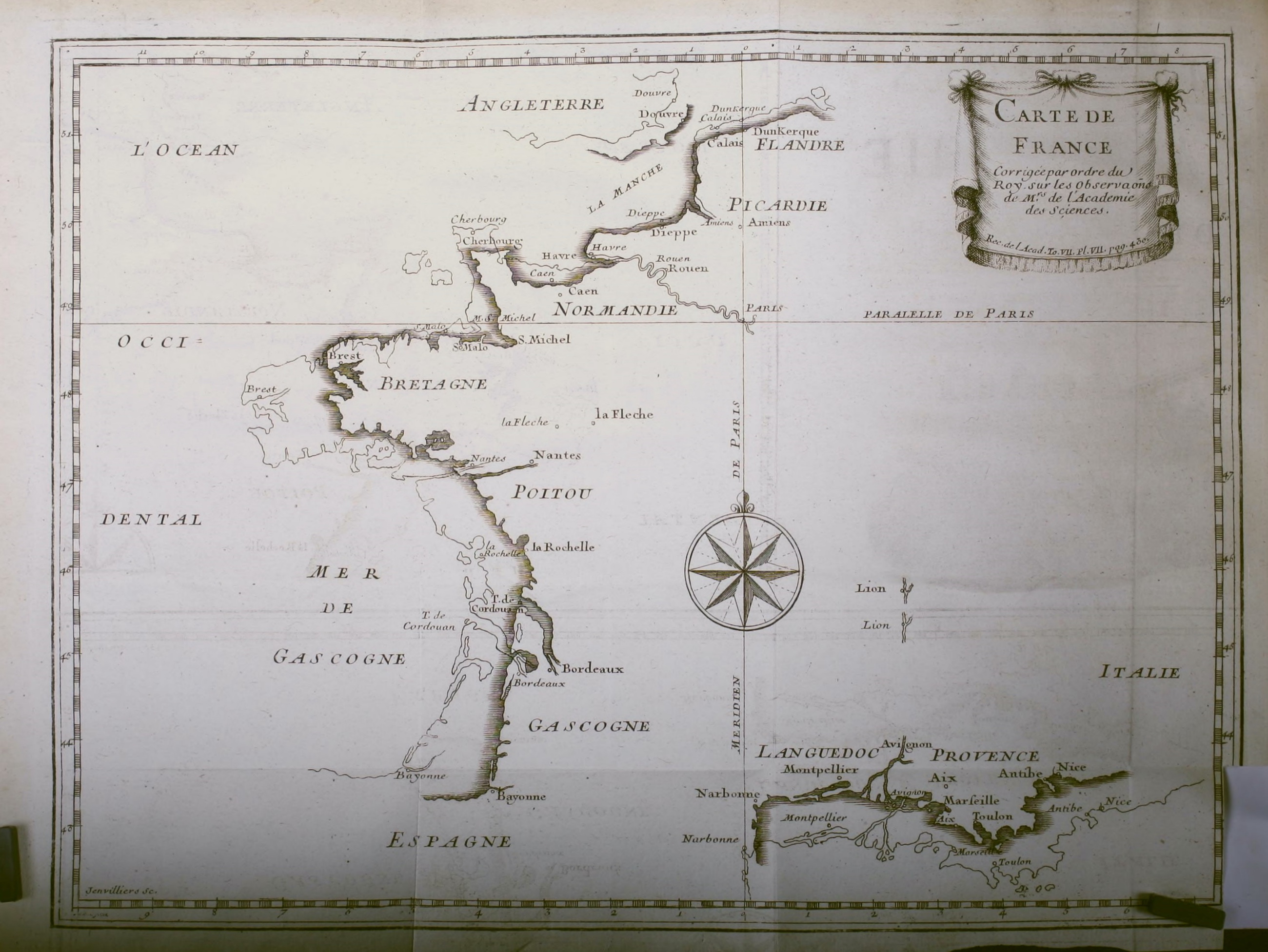
In total, the kingdom lost about a fifth of its area, collapsing from 31,657 square lieues down to 25,386. Roughly 30,000 square kilometres vanished from the charts, shrinking from 150,000 down to 120,000, not through war or treaty, but because the eclipses had been brought down to the desk and measured against a table printed in Bologna.
the kingdom, remeasured
km²
31,657 → 25,386 square lieues
In 1684, Cassini stood before the Académie des Sciences to present the newly trimmed coastline.
It was a kingdom redrawn by four moons of another planet.
In 1676, in Paris, Ole Rømer was working with those same Jovian eclipse timings, trying to make the navigation tables finally work, when he noticed a stubborn anomaly. The discrepancies weren't random errors from faulty equipment. They followed a strict, repeating rhythm tied directly to Earth's own journey around the Sun.
When Earth was swinging through the part of its orbit furthest from Jupiter, the eclipses of the moon Io ran steadily later than predicted. When Earth was closest, they ran early.
The moon's rhythm wasn't breaking down. Instead, Rømer realised something profound: light did not teleport instantly across the void. It had to travel.
Until then, it was simply assumed that an eclipse of Jupiter's moon happened everywhere at the same instant. But the timing drift in Rømer's charts mapped something entirely different: the time required to bridge the expanding and shrinking distance across Earth's orbit. He had made the first real measurement of the speed of light.
The man strapped into his iron helmet could never hold the planet still, because his own body would not stop pulsing. But even if he could have stopped his heart beating, the stillness wouldn't have solved the problem.
The planet was never where he saw it anyway.
When we look up at the sky, we are only ever seeing the past, delivered at the speed of light.
Rømer showed that light has a speed, but knowing what constituted those distant rays was a mystery.
In 1814, a Bavarian glassmaker named Joseph von Fraunhofer was working in his laboratory measuring how glass refracts light. Looking to make his telescope lenses as sharp and accurate as possible, he shone sunlight through a tiny slit and a special glass prism, and found something completely unexpected: hundreds of dark, vertical gaps slicing through the rainbow.
He checked the stars next. The dark lines appeared again, shifted in arrangement, proving they weren't quirks of Earth's atmosphere, but deep properties of the stars themselves.
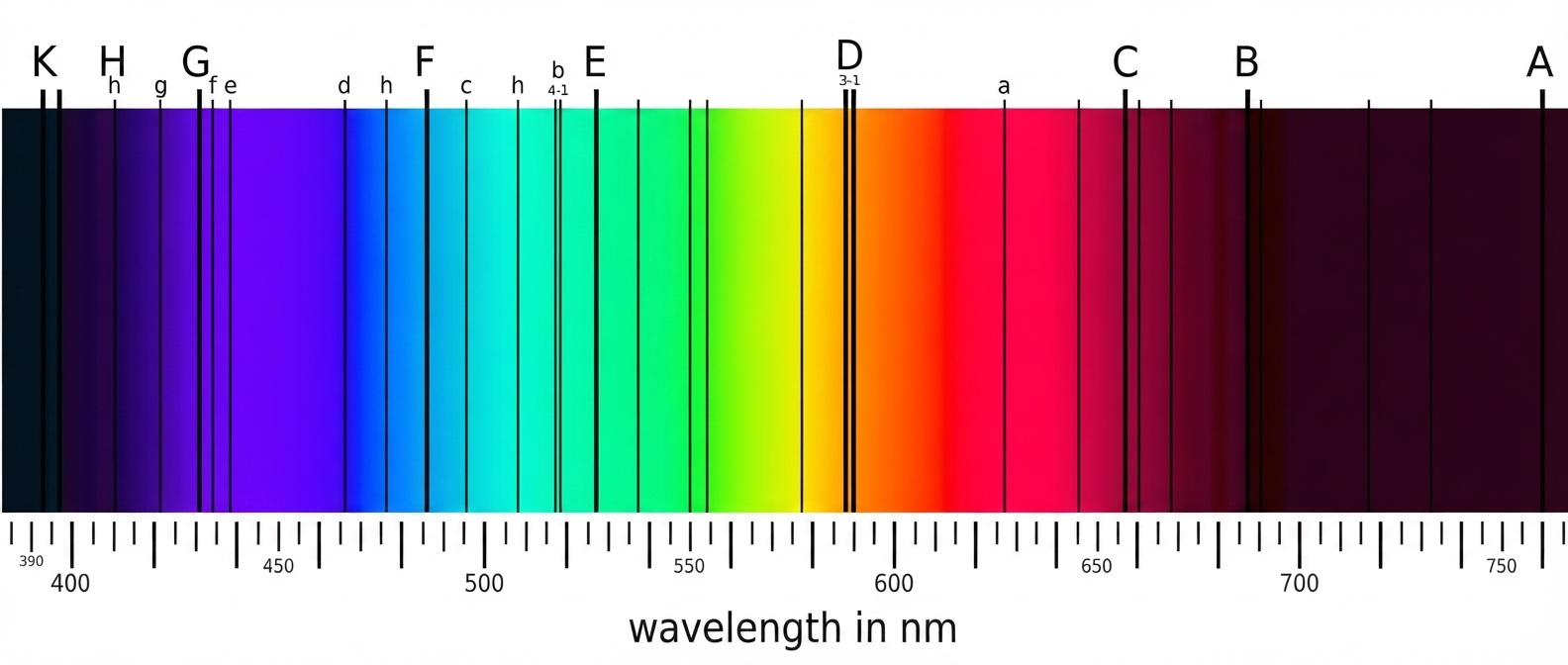
Working with both sunlight and laboratory sources, such as artificial flames, Fraunhofer mapped these spectral lines, still not fully understanding what they meant. Yet within decades, scientists would decode the mystery, realising they were absorption signatures, proof that specific elements in a star swallow certain wavelengths of light. For the first time, science could determine the chemical composition of an object across interstellar space.
The glass had come a long way:
Nature gives us the illusion of the present. The stars are not where we see them, due to the cosmic delay of light's speed. But the universe writes to us in a language of light, and through a simple prism, we learned how to decipher it.