SPACE × TIME
The Blue Filter
The sky is blue. But why? There is nothing up there that is actually blue. A wall painted blue is that colour because its surface reflects blue light into your eyes. But the sky has no surface. It is just a huge layer of air with sunlight passing through.
We often think of sunlight as yellow, but it is actually white light, made up of all the colours of the rainbow. When it enters Earth's atmosphere, it encounters air molecules that are much smaller than the waves of light passing through them.
When a light wave meets something that small, it gets scattered in different directions. And not all colours are scattered equally.
Red light has a wavelength of about 700 nanometres. Blue is about 450 nanometres. That doesn't sound like a huge difference, but the shorter the wavelength, the more strongly the light is scattered. Physicists call this Rayleigh scattering. It turns out that blue light is scattered about six times more strongly than red.
This has nothing to do with dust, smoke or anything floating in the air. It happens because of the air molecules themselves.
So why are clouds white? The water droplets that make up clouds are much bigger than air molecules. They scatter all the colours of sunlight roughly equally, so they look white.
Why Blue, Not Violet
But this does raise a valid question; if shorter waves are scattered more strongly, and violet light has an even shorter wavelength than blue, then the sky should be violet, not blue.
It isn't, for two reasons. First, the Sun produces less violet light than blue. Second, our eyes are better at detecting some colours than others. Violet sits near the edge of our visual range, so our eyes notice it less. Some violet does reach us, but it gets lost in the predominant blue.
What we see isn't simply the world as it is; it's the result of light moving through space and being detected by our eyes. As observers, we are an active part of that measurement.
The Sky Hides the Universe
And our vision has thresholds. In daylight, the scattered blue sky is simply too bright for human eyes to pick out the faint points of light behind it.
Dawn doesn't sweep the stars away; they remain exactly where they were, swallowed by the morning light. As Earth moves through its orbit, our night side gradually turns back toward them. Six months from now, the constellations hidden behind today's noon sky will stand directly overhead at midnight.
It's often assumed that the glare of the Sun simply outshines the stars. But it's not the Sun competing with the stars, it's the sky. Faint objects vanish against a bright background, and the entire dome above us is aglow.
It takes a certain level of brightness to break through and be seen. The Moon manages it, hanging in the pale daytime blue, looking oddly out of place. Venus too can be seen in full daylight, but only if you know exactly where to look. Today, you can point a phone at the bright blue sky, and an augmented reality app will show you where Venus sits. The technology has leaped forward, but you still have to squint to find it, if you can find it at all.
The guest star of 1054, recorded by Chinese astronomers on 4 July, needed no help to be found. It was a supernova so bright that it could be seen in daylight for around three weeks, perhaps as bright as Venus. A thousand years before a screen could tell you where to look, the light from a distant explosion had broken through the daytime sky.
The air that allows us to breathe also acts as a curtain to hide the cosmos. For half of every day, the rest of the universe is right there above us, completely out of view.
The Sky Is a Clock
But that curtain isn't static, its depth depends on how much atmosphere sunlight travels through to reach your eyes, a path that constantly shifts as the planet turns.
When the Sun is overhead, its light takes a relatively short path through the atmosphere. As it sinks towards the horizon, sunlight has to travel through much more air. We know that short waves are scattered much more strongly than long ones. With so much more atmosphere to cross, more of the blue light is scattered away from the direct beam. Sunsets turn red because the longer wavelengths are left to travel on towards you.
The colour of the air tells you where the Sun is, and the Sun's position tells you how far the planet has turned. You can tell the time simply by looking at empty space. Photographers plan around this transition instinctively: when they wait for golden hour or blue hour, they are waiting for sunlight to enter the atmosphere at a lower, longer angle.
That extra distance gives a second mechanism room to work. High in the stratosphere, a thin layer of ozone, a form of oxygen, absorbs light in the yellow, orange and red parts of the spectrum. When the Sun is overhead, sunlight cuts straight down through the layer, leaving those wavelengths mostly intact. But as the Sun sinks towards the horizon, light travels horizontally through the atmosphere, slanting through a far longer stretch of ozone.
By twilight, this absorption takes over. In 1953, physicist E. O. Hulburt calculated that without ozone stripping away those warmer wavelengths, the evening sky overhead would fade into a dull grey-green rather than a rich, deep blue. Modern atmospheric modelling has since confirmed his calculation.
The air isn't a passive window. It scatters some light, absorbs others, and continually alters the balance as the Earth turns.
How High Is the Sky
Waiting for the Sun to sink is one way to change how much air light must cross. Climbing is another.
Look out an aeroplane window or stand high on a mountain, and the sky is noticeably darker. There is simply less atmosphere overhead, which means less sunlight gets scattered back towards your eyes.
Keep going up, and the blue deepens. The air around you might still be thick enough to breathe, but as the column above you thins out, there are fewer air molecules to fill the sky with glow. Bright azure turns to deep indigo, and eventually the daytime sky becomes almost black.
The Edge We Drew
If you go looking for the edge of the atmosphere, you won't find one. The air doesn't stop at a particular height; it just gets sparser and sparser until there's nothing left to measure. There's no boundary or moment when you cross over.
We decided to draw a line anyway, and then argued about where to put it. Theodore von Kármán approached the problem from how a wing flies: it stays up by pushing against air. Around 100 kilometres up the air is so thin that a wing has almost nothing left to push against, and to get enough lift you would have to be moving fast enough to be in orbit anyway, wings along for the ride.
The international body for aviation, the FAI, adopted the 100-kilometre mark, known as the Kármán line. The United States set its boundary lower, at 50 miles (80 km), roughly as low as a satellite can orbit before atmospheric drag pulls it down. Both remain in use today, meaning a pilot can earn astronaut wings in the United States while falling short internationally.
Nature produces gradients, and we turn them into hard edges.
Elsewhere, and Elsewhen
Cross that arbitrary boundary, and it becomes clear that our blue sky is just one variation on a cosmic theme. Other skies are built from the same fundamental elements: a star, an atmosphere, and an observer, but every world combines them uniquely.
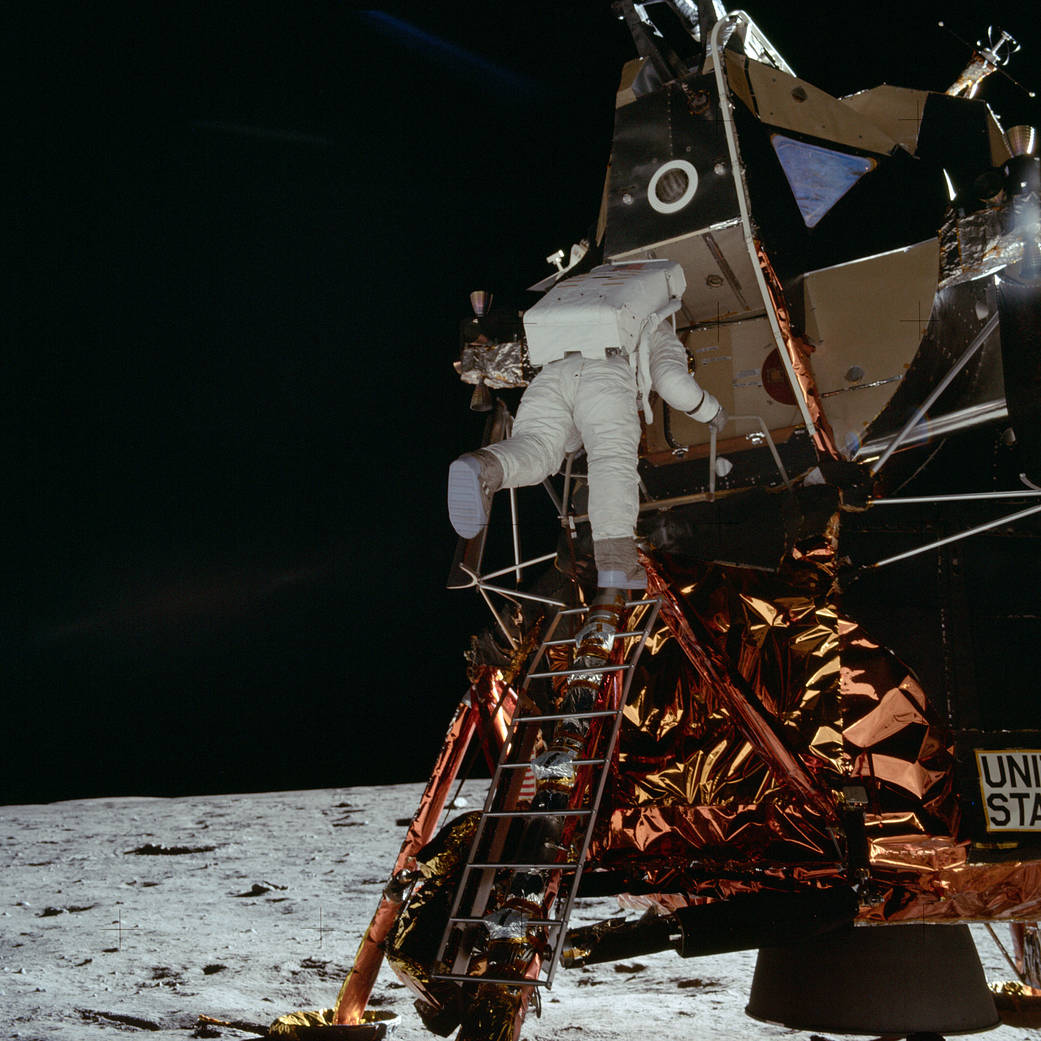
The Moon presents the starkest version: no sky at all. Stand on the lunar surface in full daylight, and space above your head is pitch black. Without an atmosphere to scatter sunlight, there is no ambient glow. The stars are still there, right beside the Sun, but the glare from sunlit regolith overpowers your vision before you can pick them out. The same thing happened to the Apollo 11 cameras. Because the film was exposed for the brilliant lunar surface, the stars were too faint to show in the photographs, an absence that sparked decades of conspiracy theories.
Mars flips Earth's palette entirely. Its daytime sky is a pale butterscotch, tinted by fine dust suspended in thin carbon dioxide. But at dusk, a pool of cool blue blooms around the setting Sun, because those airborne dust grains happen to be just the right size to scatter blue light forward rather than sideways. Where Earth gets blue days and red sunsets, Mars gets rusty days and blue sunsets.
On Titan, Saturn's largest moon, sunlight transforms methane into a permanent orange smog. Early Earth may have had a similar sky: before oxygen was plentiful, methane from the first life could have formed a high haze that shielded the surface from ultraviolet light. Some call that version the Pale Orange Dot.
This is a hypothesis: we are inferring a sky from more than two and a half billion years ago out of chemical traces in old rock, and we could be wrong. What we do know is that the atmosphere changed: oxygen-producing life built up, an ozone layer formed, and it took over the haze's job. The ozone that deepens the blue hour at dusk is the replacement for the curtain that once turned the planet orange, and microbes built both.
Back to Blue
That early haze points to a counterintuitive truth: the sky has no default setting. What we call daylight is a temporary partnership between the light of a 4.6-billion-year-old star, a soup of atmospheric gases, and human retinas.
Step back outside.
The blue overhead seems completely static, but it's a continuous process, running in the thin space where starlight meets the atmosphere.