Terms of Departure
A schoolteacher's page, a two-second flight, and the toll of getting beyond Earth
Kaluga, 10 May 1897.
The manuscript date is 10 May 1897 Old Style (Julian calendar), equivalent to 22 May 1897 in the Gregorian calendar.
Konstantin Tsiolkovsky dates a page of mathematical work. He is a thirty-nine-year-old schoolteacher in a provincial town south-west of Moscow. Nearly deaf since a childhood bout of scarlet fever, he has taught himself physics and mathematics. No university has offered him a post; no academy is waiting for his results.
On the page are calculations showing how much speed a rocket can gain from the material it carries and throws away. The problem can be worked out on paper long before anyone can attempt the flight.
In 1903, a scientific journal in St Petersburg will print his work under the title Exploration of Cosmic Space by Means of Reaction Devices. The paper will attract little notice.
Sixty years from this date, a metal sphere will circle Earth. Before anyone can navigate outwards, they will have to meet the terms written on this page.
Imagine a sled on a frozen lake, the ice so smooth that there is nothing to push against. On board is a rider sat next to a pile of rocks.
Throw a rock off the back, and the sled glides forward. With nothing to slow it down, it slides on at the same speed. In space, as on the ice, coasting is free.
The rider and rocks still on board have to be carried along. The first rock thrown moves the heaviest load, and so adds the least speed. As each rock is chucked off, the remaining cargo gets lighter and later throws add more speed.
To go faster, a bigger pile would appear to be the answer. But a pile twice the size does not give twice as much speed: every extra rock has to be carried until its turn comes.
After the last rock has been thrown, the sled has all the speed it will ever get. That total was determined by the pile it had to begin with. Engineers call this delta-v: the change in speed a load can buy, and the budget every journey is paid from.
To slow down, the rider would have needed to save some rocks and throw them forwards. Braking spends delta-v as well.
A rocket works on the same principle, using hot gas in place of rocks. Tsiolkovsky's equation puts the terms into a line:
Δv = ve × ln(m0 / mf)
- Δv
- Delta-v: the change in speed the rocket can achieve.
- ve
- The speed at which exhaust leaves the engine. Faster exhaust, more speed.
- ln
- The diminishing return. Doubling the propellant does not double the speed.
- m0 / mf
- The rocket's total mass at the start over its mass once the propellant is spent.
It turns the change in speed a journey demands into the mass of rocket needed to achieve it.
Ask how far it is to the Moon and you will get an answer in kilometres. What it takes to get there is counted differently, in kilometres per second.
A journey across the solar system is measured in speed change. One kilometre per second is roughly four times the cruising speed of a passenger jet.
The first step off the ground is by far the most expensive. Climbing through the atmosphere to low Earth orbit, a circular path a few hundred kilometres above the surface, takes about 9.4 kilometres per second. Most of that is sideways speed. A craft in orbit is falling the whole time; it travels so fast across the ground that the Earth curves away beneath it.
From low Earth orbit, setting off for the Moon takes about 3 kilometres per second. Setting off for Mars takes about 3.6. Both figures are the push needed to leave Earth orbit. A craft circling the Earth already has most of the speed it needs to break free of it, so those first few hundred kilometres cost more than twice as much as the departure for a journey of hundreds of millions.
A rocket built to reach the Moon cannot simply be a little larger than one built for Earth orbit. It must carry the propellant for every later step from the moment it leaves the pad.
When the Saturn V Moon rocket stood on its pad in Florida, it weighed roughly 3,000 tonnes, most of it propellant. It could send about 45 tonnes towards the Moon. The rest was burned or dropped along the way.
- From the ground to low Earth orbit: 9.4 km/s
- From low Earth orbit, either set off for the Moon: about 3 km/s
- or set off for Mars: about 3.6 km/s
- Saturn V, 1969. On the pad: about 3,000 tonnes
- Sent towards the Moon: about 45 tonnes
These routes and prices were worked out long before anyone had built an engine capable of paying them. In 1925, an engineer in Essen named Walter Hohmann published The Attainability of Heavenly Bodies. He calculated that the most efficient path between two worlds was an ellipse touching both orbits, requiring two brief engine firings with a long coast between them.
He had mapped the route to Mars a full year before a liquid-fuelled rocket had ever left the ground.
A spacecraft can leave for Mars only when the two planets are in the right positions. That opportunity comes about once every 26 months. Miss the launch window, and the journey demands more delta-v than the rocket can supply.
Fifty years after Walter Hohmann published his calculations, Viking 1 lifted off from Cape Canaveral in Florida, bound for a landing on Mars. A Titan rocket carried it above the atmosphere; then the Centaur stage on top took over. Centaur placed the spacecraft in a temporary Earth orbit, then fired its engines again for just over five minutes, sending Viking onto its path to Mars. The spacecraft separated. Its long coast had begun.
The last burn had done almost all the steering there would be. Corrections were possible, but each needed propellant, and the craft carried only so much. The navigators had to decide when to fire and how much delta-v to spend.
A week after launch, a course correction burn of 12 seconds changed Viking's speed by just over 4.5 metres per second, bringing its trajectory towards the intended Mars encounter.
On 19 June 1976, Viking reached Mars. To enter orbit, it had to slow down enough for the planet to capture it. Its engine fired for 38 minutes and used more than a tonne of propellant. This time, the exhaust went forwards, braking the spacecraft.
Viking had kept its rocks back for this.
Auburn, Massachusetts, 16 March 1926.
Robert Goddard, a physics professor at Clark University, is setting up a rocket on the farm of a relative he called Aunt Effie. It burns gasoline with liquid oxygen. Until now, rockets have flown on solid propellants, but Goddard believes liquids offer a route to much faster exhaust, and exhaust speed is what the rocket equation rewards. The apparatus stands in a frame of pipes, and looks less like a machine for spaceflight than an unfinished piece of outdoor plumbing. His assistant lights it with a blowtorch attached to a long stick.
Esther, his wife, is filming the test. The rocket is slow to lift, and her camera runs out of film before it leaves the ground.
Six years ago, Goddard's suggestion that a rocket might reach the Moon made headlines. The New York Times answered with an editorial dismissing the idea that a rocket could keep speeding up once it had left Earth's atmosphere. There would be nothing to push against, it argued. It suggested that Goddard lacked "the knowledge ladled out daily in high schools".
The rocket ascends.
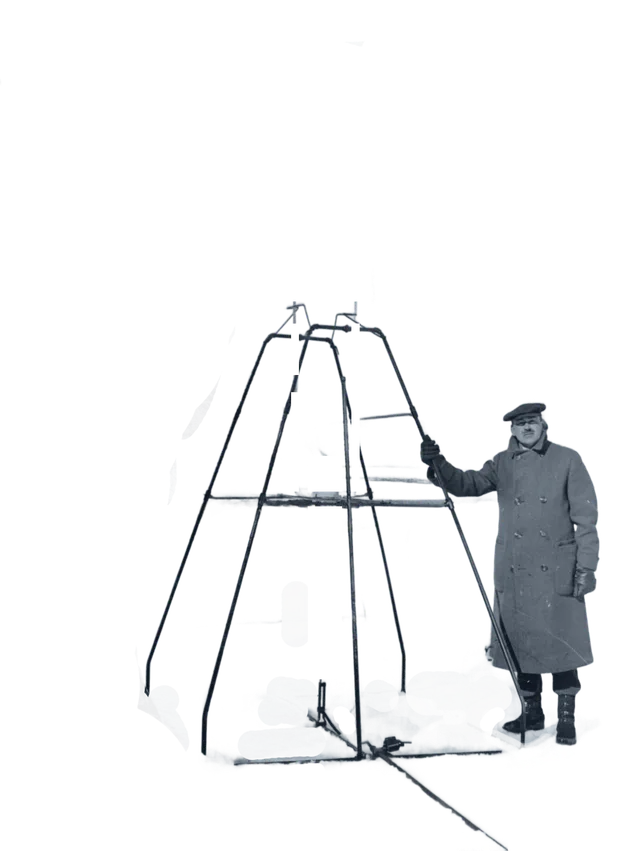
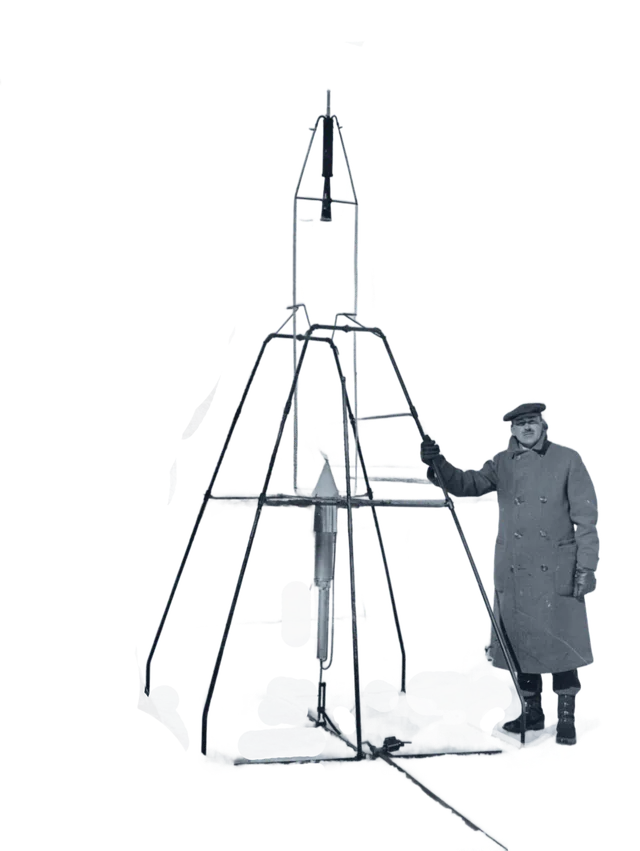
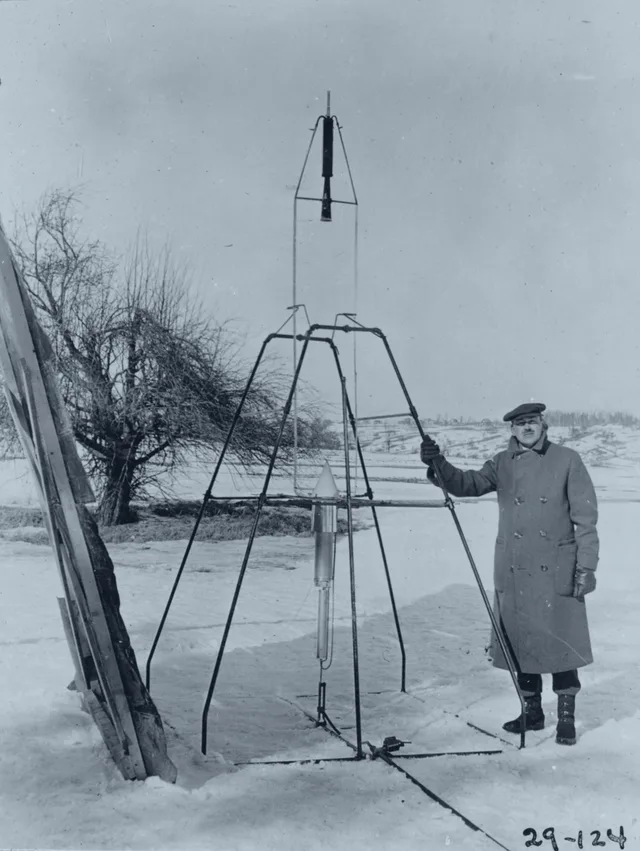
It comes down in a cabbage field.
On the night of 17–18 August 1943, the RAF bombed Peenemünde, on the Baltic coast, where the German army was developing the rocket later known as the V-2. Following this, production was moved underground to shelter it from Allied bombing. Albert Speer's Armaments Ministry created a company to assemble the missiles in tunnels beneath the Kohnstein, near Nordhausen in central Germany. The factory was called the Mittelwerk. The SS supplied prisoners as forced labour.
Ten days after the raid, the first 107 arrived from Buchenwald concentration camp; a subcamp called Dora was begun. Hans Kammler, the SS general overseeing construction, gave the underground factory priority over the prisoners' above-ground barracks. For months, thousands lived and worked underground, sleeping in bunks four high in the side tunnels. Some did not see daylight for months.
On 10 December 1943, Speer toured the tunnels. The historian Adam Tooze writes that he saw "a factory littered with corpses". A week later, Speer wrote to Kammler to congratulate him on a factory with "no equal in Europe", and called it a "really unique achievement".
Wernher von Braun, the rocket's technical director and an SS officer, visited the factory about a dozen times. In 1969 he told a West German court that he had seen terrible conditions underground.
Some prisoners sabotaged the rockets they were forced to build. The SS publicly hanged more than 200 prisoners on accusations of sabotaging production, often with little proof.
Michael Neufeld, a historian at the Smithsonian's National Air and Space Museum, estimates that at least 10,000 prisoners died in the V-2 programme at Mittelbau-Dora, building the factory and producing the missiles. The missiles themselves killed a little over 5,000 people, primarily in London and Antwerp. Across the wider Mittelbau camp system, more than 20,000 prisoners died.
In June 1944, German V-2 test rockets climbed above 100 kilometres, the boundary now commonly taken as the edge of space; they were the first human-made objects to do so. One reached about 175 kilometres. By then, prisoners at Dora were assembling V-2s in the Mittelwerk tunnels.
At the end of the war, the German rocket programme was divided between the United States and the Soviet Union. The Mittelwerk lay in the future Soviet occupation zone, but the Americans reached it first. Before handing the area over, they removed enough rockets and components to assemble about a hundred V-2s. They also recovered the Peenemünde technical archive, which had been hidden in a mine in the Harz. The Americans then brought German engineers to the United States under Operation Paperclip, which recruited German specialists for military work. They included the team of Wernher von Braun. Among them was Arthur Rudolph, who had run production in the tunnels and would go on to manage the Saturn V.
On the Soviet side, Sergei Korolev and other engineers examined the surviving V-2 hardware and records, then developed their own designs.
Both countries went on to build rockets of their own. One would put a metal sphere in orbit; the other would build the rocket that went to the Moon.
The rocket could supply the push. The next challenge was to get each firing exactly as planned. Something on board would have to do the steering. It had to be exact and, because every extra kilogram multiplied the propellant on the launch pad, it had to weigh almost nothing.
New York, 17 July 1969.
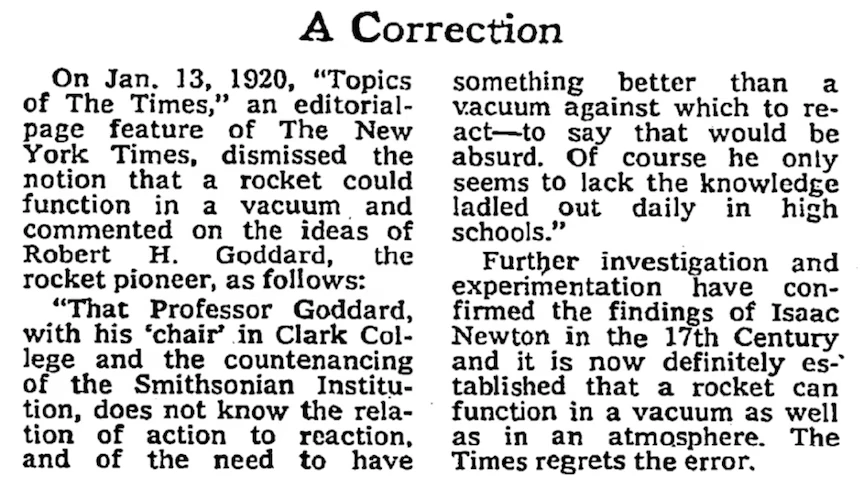
The day after Apollo 11 launches for the Moon, The New York Times prints a short notice under the heading "A Correction".
It recalls the paper's editorial of 13 January 1920, which said Robert Goddard lacked "the knowledge ladled out daily in high schools". The notice says nothing about Apollo 11, which is at that moment coasting towards the Moon with three men aboard.
"Further investigation and experimentation have confirmed the findings of Isaac Newton in the 17th Century and it is now definitely established that a rocket can function in a vacuum as well as in an atmosphere."
It ends:
"The Times regrets the error."