The Woven Memory
The Apollo Guidance Computer kept its programs in fine wire and tiny magnetic rings, woven by hand. This is how it read them back.
Please do not unravel the computer
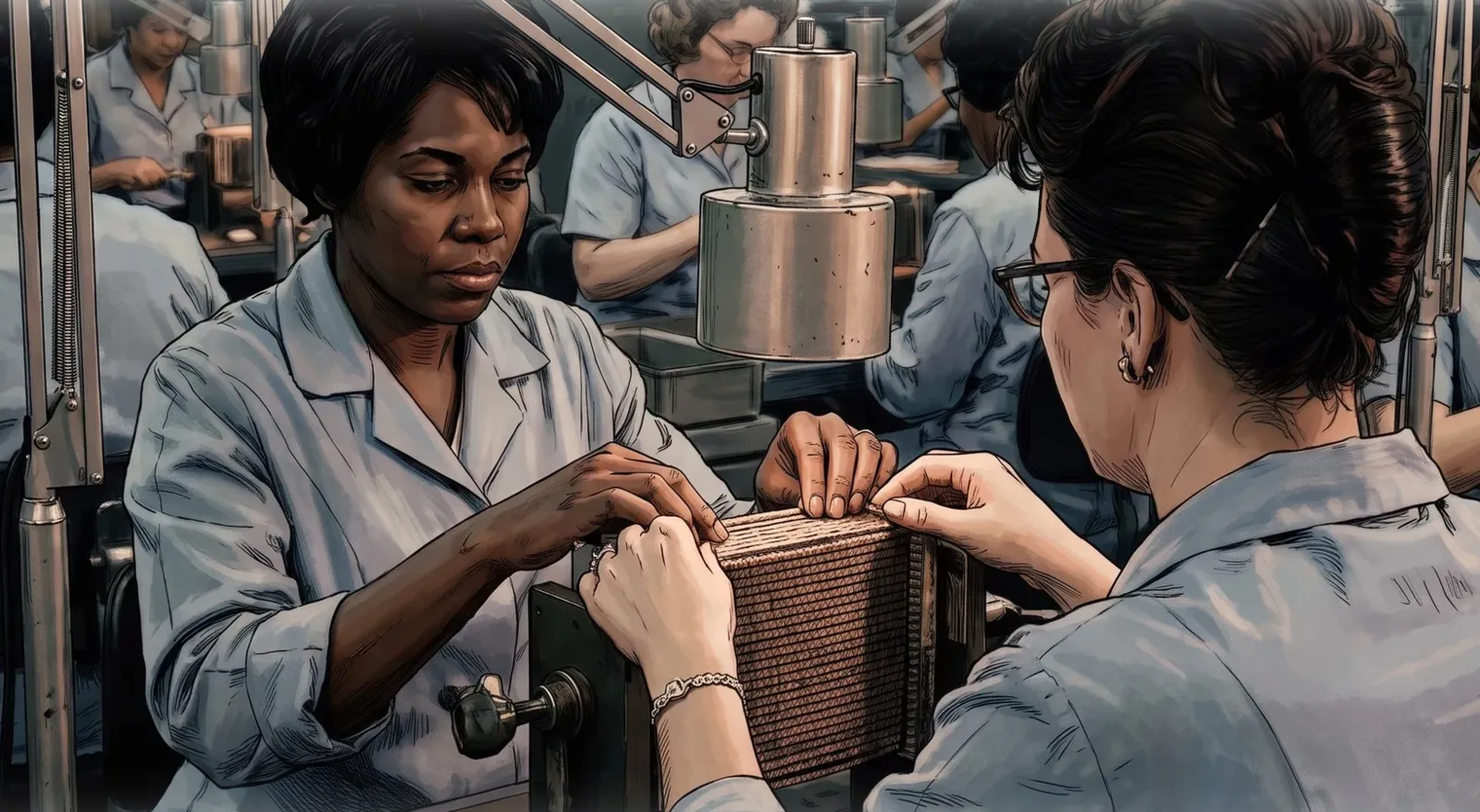
At Raytheon's factory in Waltham, Massachusetts, women threaded thousands of fine wires through tiny metal rings to make the Apollo Guidance Computer's permanent memory. Machines helped position the rings, but the threading was done by hand. Many of the women had been hired from the local textile industry for their sewing skills: they already knew how to work with needles and thread.
The result was a pattern of wires that held the computer's instructions. This was called core rope memory. It worked rather like a piece of fabric, with information built into the way its threads were arranged.
In ordinary magnetic memory, the rings stored information by changing their magnetic direction. Core rope used the rings differently. Each ring, called a core, had sense wires running through or round it. A wire passing through the middle represented a 1. A wire going round the outside represented a 0. The program was stored in the paths of the wires, so it stayed the same when the computer was switched off. It was the embodiment of hard-wired.
Reading the pattern
Even though the wires held the program, magnetism was the key to reading it.
Each core could be magnetised one way or the other. When a current flipped its direction, the change produced a small pulse of electricity in every wire threaded through its centre. This is called electromagnetic induction. Wires that went round the outside felt nothing. Circuits called sense amplifiers picked up the pulses and turned them into 1s, while the silent wires counted as 0s.
But how did the computer read just one core, when hundreds were threaded by the same wires? It used an electrical tug-of-war. A set pulse passed through every core, trying to flip its magnetism. At the same time, currents in other wires, called inhibit wires, created opposing magnetic fields in the cores that were not selected. These holding currents stopped those cores from flipping. The selected core, which was not held back, was free to change direction, so only its wires answered.
Flipping a core never changed the program, because the program was in the paths of the wires. A core that had flipped had to be returned to its starting direction before it could flip again. The wires stayed exactly where they were, so the same word could be read again and again.
The figure below lets you watch this happen. It shows four cores sharing the same 16 sense wires, with one core enlarged so you can see how the wires pass through or round it. Step through a read at your own pace, and try selecting different cores to see how the same wires produce four different words.
- Inhibit current: holds every core but one
- Set or reset pulse, through every core
- Sense pulse: only in wires threaded through the core that flipped
- The chosen core
From one core to one word
The figure reads one word from each core. In the real Apollo computer, each core could contribute to twelve. In all, 192 sense wires ran through or round every core, bundled into 12 groups of 16 called strands, and each strand held one word.
As the figure shows, the last of the 16 bits was a check bit, called a parity bit. The computer used odd parity: every word had to contain an odd number of 1s. If one bit accidentally changed, the count would become even, and the hardware could flag the word as wrong.
Six modules of 512 cores held 36,864 words of permanent software: tiny by modern standards, yet enough to land people on the Moon. Each core was just 6.3 millimetres across, about the width of an eraser on the end of a pencil.
Making the rope
Much of the wiring, including the set, inhibit and reset wires, was the same in every module. To lace it in, two women sat across from each other and passed a hollow needle, filled with wire, back and forth through the cores. It was closer to sewing than to electronics.
The sense wires carried the program, so every module had its own pattern. The code written by the programmers at MIT was turned into a long strip of punched tape. A machine read the tape and moved the next core that wire had to pass through into position, and a worker threaded the wire through it.
Each module used about half a mile of wire and took roughly eight weeks to weave. Because fixing a bug meant weaving a new module, the programmers had to finish and freeze their code months before launch.
Once tested, the flight modules were sealed in protective epoxy. The cores and their carefully arranged wires disappeared inside, leaving the program hidden within a solid block.
How this was made, and what it leaves out
- The figure shows four cores and one strand of 16 sense wires, so each core holds one word. A real Block II module held 512 cores, with 12 strands of 16 sense wires passing each one.
- The figure uses two address bits and two pairs of inhibit wires, so some held cores carry only one inhibit wire. The real computer used seven address bits plus an address-parity pair, each with its complement, so every core not being read carried at least two.
- The four cores are drawn as one plane, so the set and reset wires pass through all of them. A real module had four planes of 128 cores, two set lines, four reset lines and a clear line, which are not shown.
- No source describes the reset after a read step by step. A core that has flipped has to be put back before it can flip again, and each plane had its own reset line, so the last step shows that.
- The pulses are slowed down so they can be followed; a real read took microseconds. The lamps stand in for the sense amplifiers.
- The four words are examples, not words from an actual Apollo program. P marks the parity bit; its place at the end, after bit 1, follows how the Virtual AGC manual writes a word, not where its wire physically sat.
- The opening illustration of the weavers at Raytheon is a drawn reconstruction, not a photograph.
- The octal digits are only a way to display the pattern, three bits to a digit. A word might be a number or an instruction; the digits alone do not say which.
- With odd parity, at most 15 of a word's 16 bits can be 1, so at most 180 of a core's 192 sense wires ever passed through it. Parity catches one changed bit, but two changed bits cancel out and slip through.
- The program wiring also went round small nylon pins that pulled each threaded wire out of the way of the next; the pins were removed at the end, and each finished module was tested by a machine controlled by punched tape. A module cost about $15,000.
Ken Shirriff, Software woven into wire: Core rope and the Apollo Guidance Computer (2019), for the module's construction, its read circuitry, the weaving process (the punched tape, the positioning machine and the nylon pins), its length of wire and its cost.